


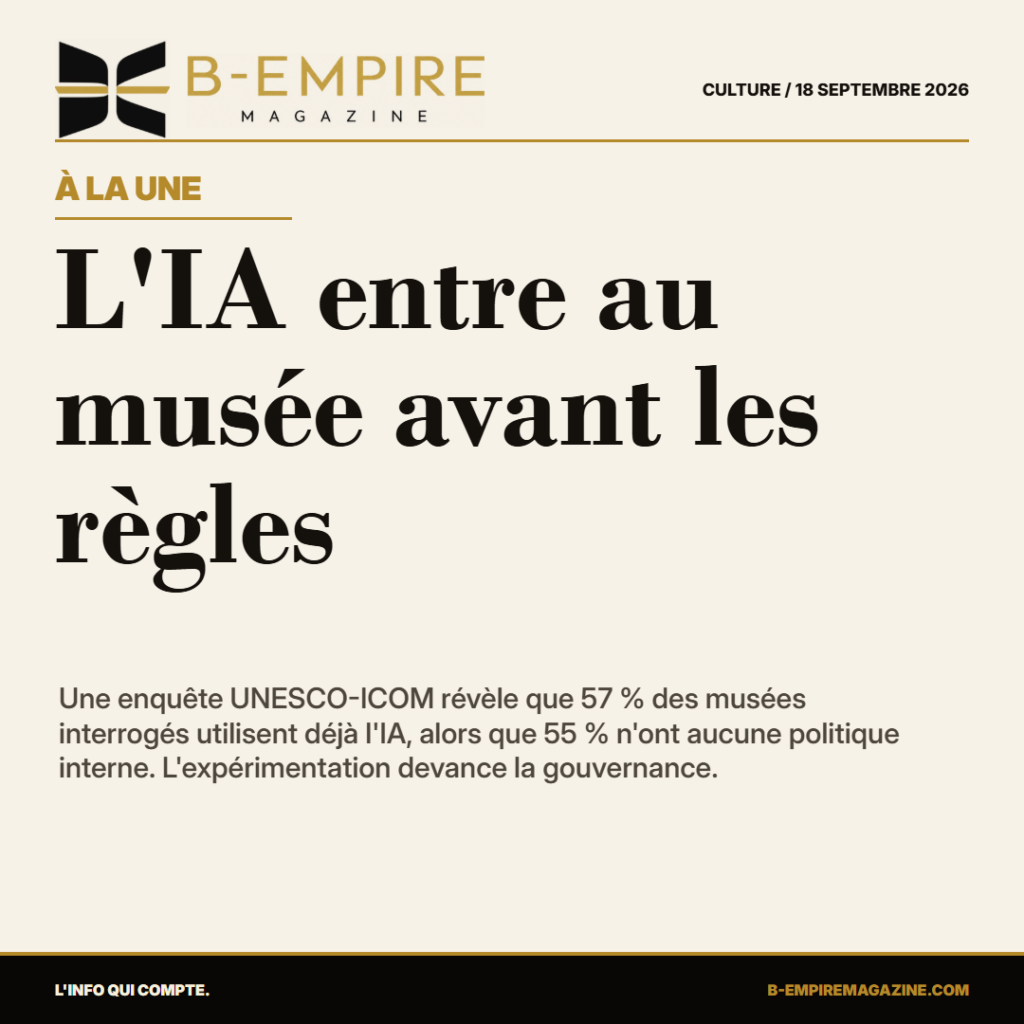
Artificial intelligence has already entered museums, but the rules were left at the door. The first global survey conducted by UNESCO and the International Council of Museums, presented this week in Riyadh, finds that 57% of responding institutions use AI. At the same time, 55% report having no internal policy, strategy or guidelines. More than 400 museums across 90 countries took part. That gap summarizes a problem extending beyond culture: experimentation moves at the speed of tools, while governance moves at the speed of committees.
Real adoption, but still scattered
The uses identified are not limited to generated images or conversational guides visible to visitors. Museums are applying AI to administration, translation, collections research, documentation, exhibition development and audience engagement. Much of this adoption remains exploratory, often driven by a few curious employees rather than an institution-wide decision.
That situation has an advantage: teams can quickly test transcription, summarize archives or produce several versions of interpretation text. It also creates fragmentation. Two departments may use different tools, send sensitive data to incompatible services and create content without a shared verification process. Local innovation then becomes organizational debt.
Museums work with data they do not always own
A collection brings together artworks, photographs, inventories, correspondence, oral accounts and information about people or communities. The associated rights can be complex. An object may legally belong to a museum while remaining connected to moral rights, a sensitive history or knowledge that its holders do not want absorbed by a commercial model.
Before uploading a catalog into an AI assistant, an institution must know where the data will be stored, whether it will be used to train the system, how long it will be retained and who can retrieve it. Data protection is not an IT detail. It concerns trust between the museum, artists, donors, researchers and the publics whose stories are documented.
Accuracy becomes a museum mission
The survey lists accuracy among the leading concerns, alongside copyright and data protection. That anxiety is especially important for an institution whose authority depends on verification. An inaccurate label, invented attribution or false date is not merely a conversational error. It can alter the understanding of an object and spread into schoolwork, articles and other databases.
The answer is not to prohibit every generative model. It is to organize responsibility. Every piece of public-facing content should have an identifiable source, a confidence level and a professional responsible for validation. AI can suggest, classify or rewrite; it should not erase the editorial chain. When the institution does not know the correct answer, the system must be able to say so instead of producing elegant certainty.
Translation opens doors and can flatten voices
Automated translation is one of the most immediately useful applications. A small museum can offer descriptions in several languages, create subtitles or improve access to its archives without an international editorial team. For visitors, that availability removes a concrete barrier. It also allows a local collection to be discovered far beyond its territory.
Translation is not the replacement of words one by one. Object names, religious concepts, identities and historical expressions carry contexts that models may simplify. A fluent version can still be culturally wrong. Museums will need to distinguish content for which reviewed machine translation is sufficient from material requiring a specialist, a community speaker or longer consultation.
Large institutions begin with an advantage
UNESCO and ICOM emphasize gaps in digital infrastructure, funding, technical skills and access to expertise. A national museum may recruit a data lead, negotiate a contract and audit a supplier. A small institution may depend on a consumer subscription used by one employee. Both appear as AI users in statistics, but their ability to control risk is not comparable.
That asymmetry could further concentrate visibility. The collections that are best digitized and documented will feed search tools, recommendations and immersive experiences more easily. Heritage with fewer resources may become less present in the interfaces organizing discovery. The digital divide is therefore not only about access to technology. It influences what the public will be invited to see.
An internal policy can start simply
The figure of 55% without an internal framework does not mean every museum must immediately write a hundred-page document. A first policy can consist of several operational principles: approved tools, data that must never be uploaded, mandatory human review, transparency for visitors, retention of records, an incident procedure and an identifiable responsible person.
That foundation should evolve with use. A visitor chatbot requires safety and accuracy tests different from an internal classification tool. Computer-assisted restoration raises other questions than a marketing campaign. Effective governance does not treat all AI as one category. It evaluates risk, context and whether an error can be repaired.
Tell visitors when a machine intervenes
Transparency should become visible without overwhelming the experience. Visitors deserve to know whether a voice, image, translation or recommendation was generated or substantially modified by a system. That information should not be hidden inside a long legal page. A clear signal lets the public adjust its trust and understand the nature of what it is consulting.
Transparency also protects professionals. Curators, registrars, translators and educators do not disappear when AI intervenes. Their work shifts toward selection, verification, context and correction. Making that contribution visible prevents technology from presenting itself as an autonomous source and reminds visitors that every museum narrative results from human choices.
The museum can become a place for AI literacy
Cultural institutions are not only users. They can help the public understand how systems produce results. An exhibition can compare several descriptions of the same artwork, reveal bias in training data or explain why a model confuses correlation with knowledge. Museums already possess the skills needed to make an often invisible infrastructure visible.
That critical function distinguishes thoughtful adoption from a race for novelty. The goal is not to impress visitors with another screen, but to improve access, research and understanding. Sometimes the best decision will be to use AI. Sometimes it will be to preserve a human conversation, a slow translation or silence in front of an object.
Experimentation needs a memory
The UNESCO-ICOM report arrives when the sector must turn individual trials into collective learning. Museums would benefit from documenting not only successes but costs, errors and abandoned projects. A shared case library would prevent hundreds of institutions from separately repeating the same tests and failures.
The most important number in the survey may be neither 57 nor 55. It is the distance between them. It shows that AI has become ordinary enough to use, but not yet institutional enough to govern. Museums preserve the memory of societies. They must now learn to preserve the memory of their own algorithmic decisions as well.