


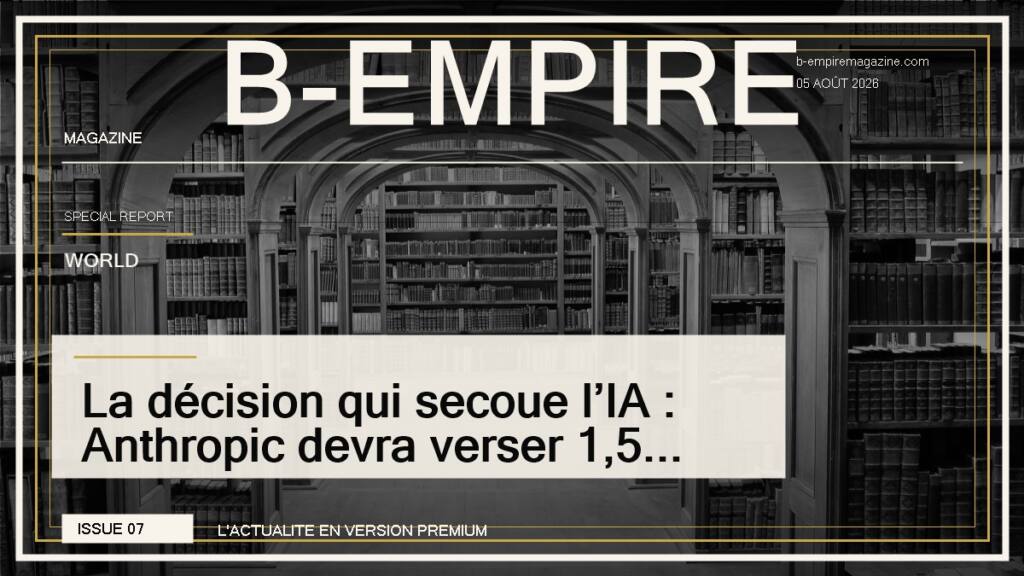
This is the bill that the entire global artificial intelligence industry will now watch closely: $1.5 billion. The U.S. federal court has given its final approval to the settlement reached between Anthropic and thousands of authors and publishers whose books were retrieved from pirate libraries. The creator of the chatbot Claude turns a judicial page, but the signal sent to Silicon Valley is immense: innovation does not exempt one from answering for the provenance of data.
The case goes far beyond a battle between writers and a tech company. It touches the core of the economic model of generative AI, which requires vast amounts of text to learn to understand and produce language. It also raises a simple, global question: can a company use a work to train a model if it obtained that work illegally?
$1.5 Billion: An Unprecedented Settlement
Federal Judge Araceli MartÃnez-OlguÃn found that the settlement provides significant redress to the members of the class action. According to the Associated Press and the Authors Guild, over 482,000 books are covered by the settlement, and about 91% of them have been claimed by their rights holders. Only a few hundred authors chose to opt out of the proceedings.
The total fund amounts to $1.5 billion, approximately â¬1.3 billion at the exchange rate mentioned at the time of the decision. The gross amount corresponds to nearly $3,000 per work, before fees, royalties, and potential sharing between author and publisher. The exact amount received by each beneficiary will depend on their contractual situation and the final calculations of the administrator.
The settlement will be funded in several installments. The official FAQ of the settlement specifies that an initial tranche of $300 million has already been paid, a second is to follow after final approval, and then two payments of $450 million are scheduled for September 2026 and September 2027. The fund is described as ânon-reversibleâ: undistributed money is not simply to return to Anthropic.
The Legal Point That Must Not Be Confused
This decision does not mean that all training of an artificial intelligence with protected books is automatically illegal in the United States. In fact, it is the opposite on a central point: a previous ruling by Judge William Alsup had considered that the use of books to train Anthropic’s models could fall under âfair use,â the American exception to copyright, as the process was deemed sufficiently transformative.
However, the judge established a fundamental distinction between use and acquisition. Anthropic had built a library of millions of files obtained notably from LibGen and PiLiMi, platforms known for distributing pirated copies. The fact that training could be transformative did not make the creation of a permanent library from files downloaded without authorization legal.
It is this boundary that gives the case its historical significance. An AI company can defend the transformative nature of its model, but it must still explain how it obtained the content. In other words, the debate is no longer just about what the machine does with a book; it is also about how the company got its hands on it.
Why Authors Speak of a Global Warning
Representatives of authors present the settlement as the most significant redress known in a copyright case. The Authors Guild believes that the final approval sends a clear message: AI companies cannot circumvent intellectual property rules in the name of speed or technological competition.
For writers, the stakes are not abstract. Works have economic value even before a model produces a single response. They have required years of work, funded by advances, sales, subscriptions, and translation rights. When a tech player massively copies these texts without a license, it avoids the costs that libraries, readers, and companies that legally purchase content normally bear.
However, the decision does not resolve all concerns. European authors whose works are not registered with the U.S. copyright office may be less well covered. The Danish Rights Alliance has pointed out that the settlement risks primarily benefiting rights holders who meet the criteria of the American system. The global dimension of databases contrasts with remedies that are still very national.
Claude and Anthropic Avoid an Even Heavier Risk
For Anthropic, $1.5 billion is a spectacular sum, but the settlement also allows the company to avoid a lawsuit whose potential damages could have reached several billion more. The company sidesteps a lengthy battle before a jury, a major uncertainty for its investors, and the risk of seeing each work lead to much higher penalties.
Anthropic emphasizes that the court recognized that training AI on books could constitute fair use. The company states it wants to close old claims while continuing to develop useful AI systems. The settlement also includes the destruction of the original files from the disputed downloads.
Thus, the compromise protects both narratives. Authors can present the record amount as a victory against piracy. Anthropic can remind that the very principle of transformative training has not been rejected. This ambiguity explains why the case is being watched by OpenAI, Meta, Google, Apple, Microsoft, publishers, and visual artists engaged in other proceedings.
A New Price for Training Data
The most concrete consequence may lie in contracts. If downloading pirated corpora exposes one to colossal settlements, developers have more incentive to purchase licenses, forge partnerships with publishers, or build datasets where each element has a verifiable origin. The cost of data then becomes a visible part of the cost of AI.
This evolution may favor large companies capable of paying, but it can also create a healthier market. Collective management platforms, publishers, and agencies could negotiate training licenses accompanied by rules on remuneration, transparency, duration of use, and withdrawal of works.
For startups, the message is harsher. Using a database found on the internet without legal audit can turn a technical shortcut into a gigantic liability. Investors will likely demand more guarantees on the traceability of corpora, just as they already scrutinize cybersecurity or software licenses.
What France and Europe Must Remember
In Europe, the legal framework is not identical to American âfair use.â The European directive provides exceptions for text and data mining, but rights holders can, under certain conditions, reserve the use of their works. The European AI regulation also imposes transparency obligations and respect for copyright on general-purpose model providers.
France, with its publishing industry, literature, comics, and audiovisual creation, has a direct interest in this battle. Authors want to be compensated; European AI companies want access to quality corpora to avoid complete dependence on American models. The challenge is to create licenses that are simple enough to support innovation without turning works into free raw material.
The Signal That the Entire Industry Can No Longer Ignore
The Anthropic settlement does not definitively resolve all questions related to copyright and artificial intelligence. A friendly settlement does not create the same precedent as a ruling made after a full trial, and the rules vary from country to country. But its magnitude is already changing the risk calculation.
The message is now impossible to mask behind the race for innovation: the power of a model also depends on the legitimacy of the data that built it. The next significant competitive advantage in AI may not only be the size of models or the number of processors. It will be the ability to prove, work by work, that the knowledge used was obtained legitimately.
Sources
- Associated Press â Final approval of the Anthropic settlement and numbers of claimed works, July 21, 2026
- Authors Guild â Analysis of the final approval and organization of the settlement, July 21, 2026
- Official site of the Bartz v. Anthropic settlement â fund, payment schedule, and terms
- Reuters â Judicial validation and position of the parties, July 20, 2026