


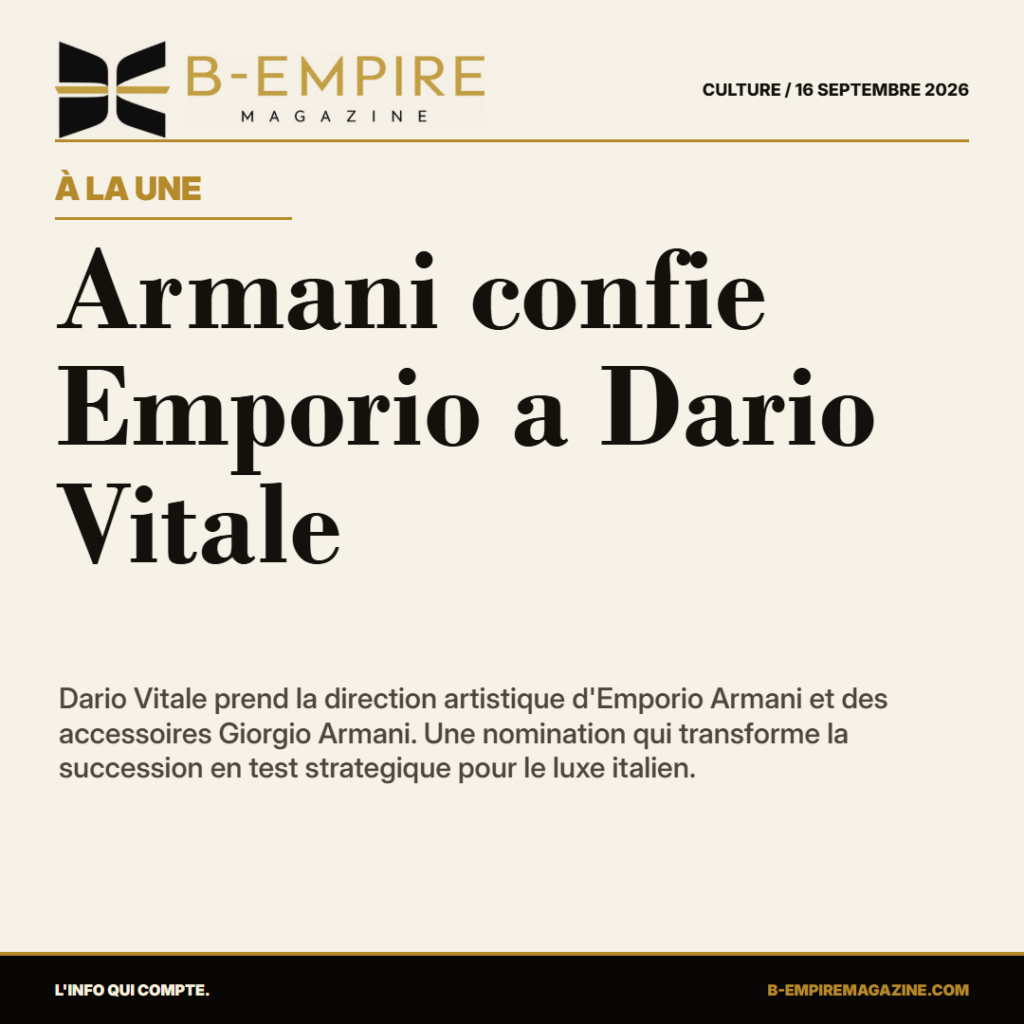
The move is quiet in form, but heavy in meaning: Armani has appointed Dario Vitale creative director of Emporio Armani and Giorgio Armani Accessories. In the restrained language of Italian luxury houses, this is more than a staffing announcement. It is the first major creative succession decision after Giorgio Armani, and it is also a live test for a company that was governed for decades by one hand, one eye and one discipline.
Vitale arrives with a resume that speaks to both the market and the studio. A former Miu Miu designer who later had a short but closely watched run at Versace, he understands houses where identity is never only a matter of logo. He knows that an accessory can shift the perception of a brand, that a jacket can make an archive feel young again, and that a campaign can reopen desire around a name people thought was already fully defined. At Emporio Armani, that intelligence will be decisive. The line was born as a freer, more urban and more accessible promise than the main Armani universe, but it now has to speak to a generation that reads fashion through images, prices, archives and cultural signals.
The appointment comes at a sensitive moment. According to announcements reported by the Associated Press and several fashion publications, Vitale becomes the first person outside the family to hold this role. Reuters, via Boursorama, noted that the group framed the choice as a strengthening of its creative organization and a way to move forward while staying faithful to Giorgio Armani’s values. That language matters. It captures one of the central tensions in contemporary luxury: how do you protect a legacy without turning it into a museum? How do you attract younger consumers without erasing the rigor that made the house valuable in the first place?
Armani is not a house like any other. Giorgio Armani built an empire by removing excess, softening the suit and giving power a more fluid silhouette. His revolution was not loud; it was structural. It changed the way men and women imagined elegance, from Hollywood cinema to the offices of financial capitals. After him, the challenge is therefore not simply to design attractive collections. The group has to preserve a grammar: the fall of fabric, the controlled neutrality, the sensuality without noise, the idea that luxury can assert authority without raising its voice.
Vitale is an interesting choice because he does not look like a theatrical rupture. He is not arriving as a provocateur hired to overturn the table. He arrives as a creative capable of restoring tension inside a highly coded system. His years at Miu Miu gave him familiarity with young desire and with the small signals that turn a product into a conversation piece. His brief Versace chapter showed an ability to handle Italian heritage without flattening it. At Armani, that quality can become strategic, especially in accessories, the category where luxury manufactures margin, visibility and purchase frequency.
Emporio Armani may be the best possible laboratory. The line carries the Armani name, but it allows more movement. It can absorb a sharper sneaker, a more identifiable bag, a more nervous jacket, or a more graphic form of tailoring. It can speak to Milan, Seoul, Paris, New York and Dubai without losing its Italian center. By giving Vitale both Emporio and accessories, the group appears to be seeking balance: letting the main house keep its sovereign calm while the younger line and desire-driven products test a new temperature.
The issue is also economic. In luxury, creative succession has become a financial event. Investors watch appointments almost as closely as quarterly sales, because a creative director can accelerate a handbag, revive a wardrobe, and return a brand to the global conversation. Armani, a private company and an image empire, has to manage this passage with even greater care: too much audacity could weaken the myth; too much loyalty could put it to sleep. Vitale will therefore have to execute a delicate operation: make the change felt before it is loudly declared.
His first collection will be examined for a simple reason: it will say whether Armani can enter the post-Armani era without losing Armani. The paradox sounds almost philosophical, but it is very concrete. Stores will need desirable products, editors will need a clear narrative, long-time customers will need reassurance, and younger buyers will need a new reason to step inside. Fashion loves rupture, but great houses often survive through transitions that are carefully controlled rather than dramatically advertised.
For B-EMPIRE, this appointment tells a story bigger than Italy. Global luxury is entering a phase in which heritage is no longer enough. Houses must prove that they can transfer power, organize creativity, activate archives and turn memory into a commercial future. With Dario Vitale, Armani is not only naming a designer. The house is opening a controlled door to a new generation, hoping that this generation can still hear the elegant silence that made Armani powerful.