


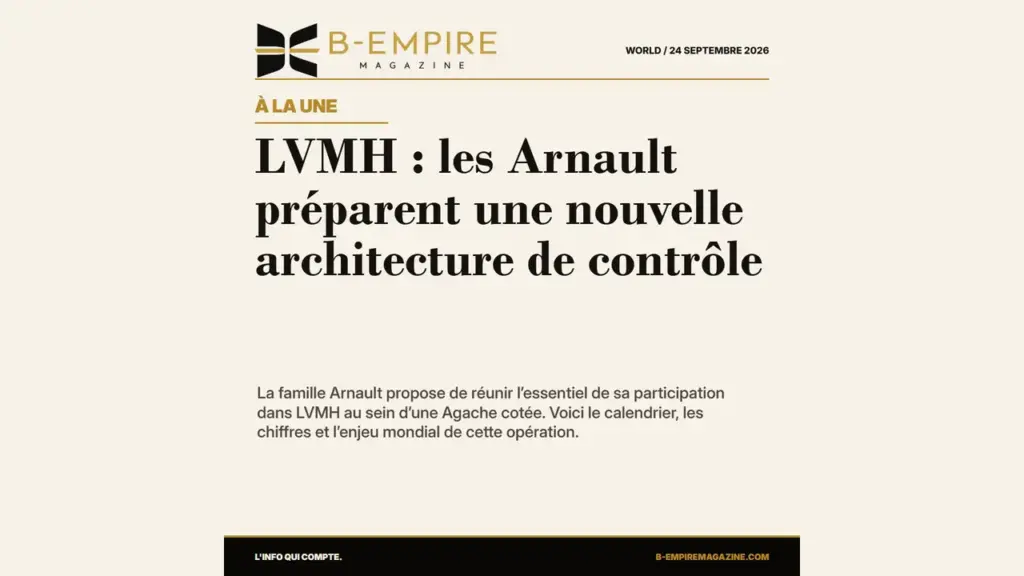
A corporate announcement may seem distant. However, the one revealed by the Arnault family on September 23 deserves attention far beyond the Paris stock exchange: it pertains to the control house of LVMH, the world’s leading luxury group. The project aims to simplify the stack of holdings that currently links Agache, Financière Agache, Christian Dior, and LVMH. Ultimately, the majority of this stake would be consolidated into a single listed company, renamed Agache and organized as a limited partnership by shares.
This is not a change of ownership of LVMH nor a sale of its houses. Louis Vuitton, Dior, Moët & Chandon, Hennessy, Sephora, and Tiffany remain within the same scope. The issue is more structural: how a family organizes, over the long term, the control of a group that shapes fashion, beauty, wines and spirits, selective distribution, and a significant part of the global luxury imagination.
A Project in Three Movements
The statement from Christian Dior outlines a precise sequence. First, Financière Agache would be absorbed by Agache. Next, Agache would be absorbed by Christian Dior. Finally, Christian Dior would be transformed into a limited partnership by shares â an SCA â and would take the name Agache. These steps remain subject to the decisions of governance bodies and shareholders, as well as the necessary approvals from the Financial Markets Authority.
In French law, the SCA allows for a distinction between partners who provide capital and those who manage and bear specific responsibilities. This form has already been used by the Arnault family for Agache. The project thus intends to retain this mechanism while reducing the number of layers between the family and the listed group.
The Figures That Explain the Importance of the Operation
According to Christian Dior, the entity resulting from the operation would directly hold 49.76% of LVMH’s capital and 65.55% of its voting rights. Considering other family holdings, the Arnault group currently controls 50.33% of LVMH’s capital and 66.27% of its voting rights. The difference between capital and voting rights illustrates a crucial point: in large groups, power is not only reflected in the percentage of shares but also in the ability to steer strategic decisions.
The project also includes a cash public buyout offer for the shares of Christian Dior that the family does not hold, approximately 2.44% of the capital at the date of the announcement. Minority shareholders would have two choices: tender their shares to the offer, if declared compliant, or remain shareholders of the future Agache SCA. The buyout would not be followed by a mandatory withdrawal; the new structure is intended to remain listed.
Why the Global Luxury Market is Watching Paris
The reorganization of LVMH’s control is a French matter, but its symbolic repercussions are global. LVMH is present in the major luxury capitals, has houses rooted in Europe as well as in the United States and Asia, and sells to an international clientele. Its decisions regarding creation, investment, distribution, and acquisition are closely monitored by the entire sector: competitors, suppliers, creators, investors, and consumers.
In a period where luxury must navigate a more varied demand across regions, governance visibility matters. A more transparent control structure can facilitate long-term investor reading. It does not change the sales of a bag, a perfume, or a bottle of champagne by itself, but it clarifies who maintains the strategic continuity of a group whose brands rely precisely on longevity, desirability, and mastery of their image.
A Matter of Continuity, Not an Announced Succession
It would be unwise to present this operation as an announcement of an immediate succession. The official text does not state this. However, it clearly affirms the desire to ensure the continuity of family control over LVMH. Bernard Arnault would retain his role as manager of the future structure and, with Agache Commandité, that of general partner.
This nuance is essential. Long-term governance does not presuppose a timeline for managerial transmission. It rather creates a framework in which the family can preserve the unity of its control block, while operational teams manage the houses of the group and the supervisory board fulfills its role. For the markets, this is a signal of institutional stability, not an indication of an imminent change at the helm of LVMH.
The Timeline to Watch
The project is not yet realized. Christian Dior indicates that the merger and transformation operations should be submitted to an extraordinary general meeting by the end of 2026, subject to the exemptions requested from the AMF regarding mandatory offer rules. The public buyout offer is anticipated in the first quarter of 2027, following compliance review by the regulator.
The offer price would be proposed based on 95% of the revalued net assets of Christian Dior, transparently calculated from a one-month average of LVMH’s share price, according to the published details. This method, any expert reports, the opinions of governance bodies, and the decision of the AMF will be the next concrete steps to watch for shareholders.
What This Does Not Change â and What It Clarifies
Customers will not see a new brand on the windows of Louis Vuitton or Dior tomorrow. Creators, house directors, and local markets will continue to maintain their distinct identities. The value of LVMH remains tied to execution: collections, quality, innovation, desirability, boutique networks, and the ability to navigate economic cycles.
What the reorganization of LVMH’s control clarifies is the architecture at the top. In an industry where brands are built over decades, the Arnault family chooses to consolidate the structure that holds the group together. Paris gains a renewed reminder of its role in the global governance of luxury; investors now have a timeline and precise data to evaluate the operation.