


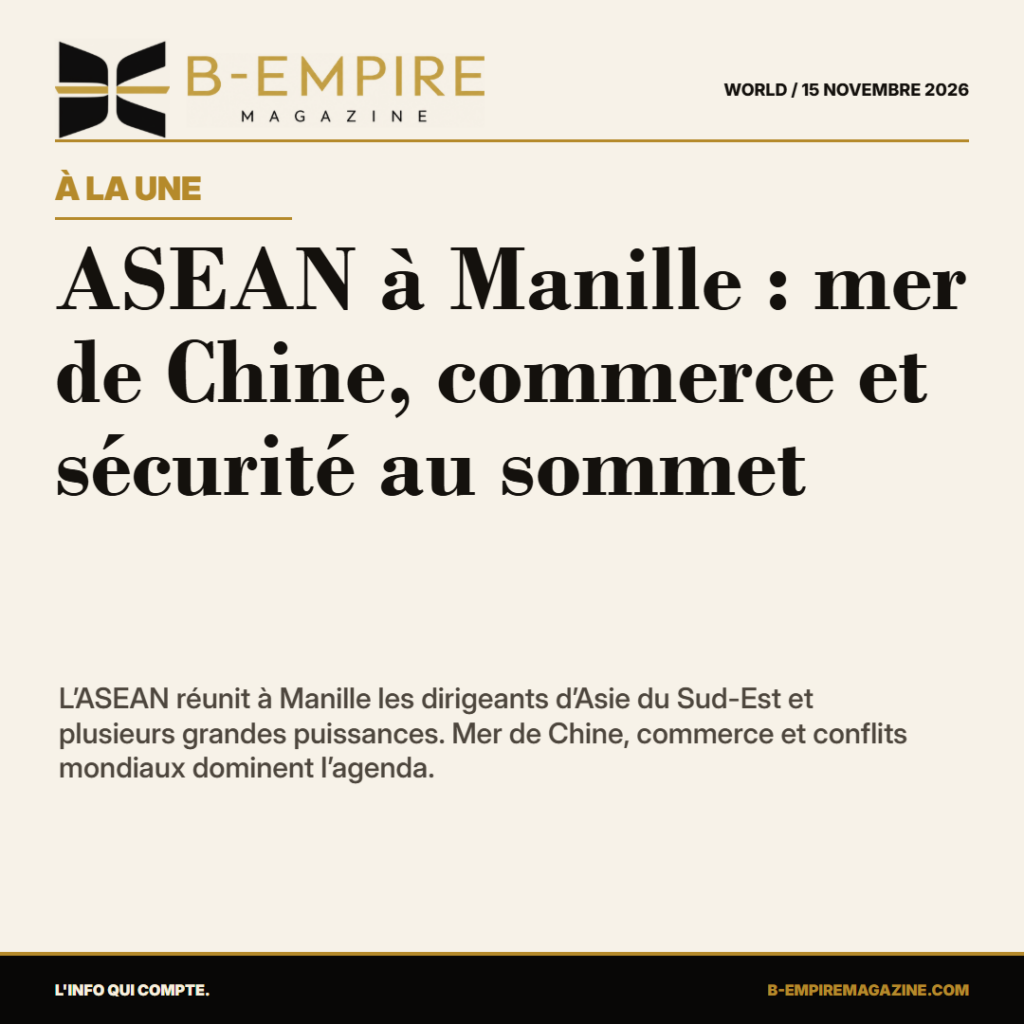
Manila becomes one of the world’s focal points for three days. From November 15 to 17, 2026, the leaders of the Association of Southeast Asian Nations (ASEAN) host several major powers with a question that extends far beyond the region: how to prevent military rivalries, wars, and trade tensions from further fracturing the global economy? The South China Sea, the crisis in Myanmar, conflicts in the Middle East and Ukraine, as well as trade agreements will be at the heart of a summit where every word will be scrutinized.
The 49th edition of the ASEAN summit is taking place in the Philippines under the theme “Navigating Our Future, Together.” This phrase seems consensual but conceals an intense battle for influence among China, the United States, Japan, India, Australia, and Southeast Asian countries. All aim to strengthen their ties with a young, industrial, and strategic region located at the crossroads of major global maritime routes.
Why the Manila Summit Concerns the Entire World
ASEAN brings together eleven states, including Indonesia, Thailand, Vietnam, Singapore, Malaysia, and the Philippines. Together, they represent nearly 700 million inhabitants and a market that has become essential for industry, electronics, energy, logistics, and digital services. The region is no longer just a battleground for external powers vying for influence; it seeks to shape the rules of the game.
This ambition explains the presence of partners from both Asia and the West. The official program includes meetings with Australia, China, India, Japan, South Korea, the United States, and the United Nations. Philippine President Ferdinand Marcos Jr., who is chairing the summit, is also expected to hold numerous bilateral meetings. According to Philippine authorities, discussions will focus on peace, economic resilience, maritime security, and regional integration.
The South China Sea: A Red Line at the Summit
The most explosive issue remains the South China Sea. This area sees a significant portion of global maritime trade and is subject to competing claims. China asserts a vast claim over this space, while the Philippines, Vietnam, Malaysia, and Brunei defend their own maritime rights. Incidents between vessels, coast guard maneuvers, and the militarization of positions have transformed a legal dispute into a permanent security risk.
Negotiations on a code of conduct between Beijing and ASEAN have progressed, but they are not expected to conclude this year as some officials had hoped. The stakes are considerable: a weak text would not change the reality on the water, while a genuinely binding agreement could reduce collision risks and provide a mechanism for dispute resolution. For the Philippines, the host country and directly affected, the summit represents a credibility test.
The United States is closely monitoring the issue. Washington is not a party to the territorial claims but defends freedom of navigation and remains bound to Manila by a defense treaty. The announced participation of American President Donald Trump in the final meetings adds another dimension to the summit. His arrival could enhance the diplomatic weight of the event but also amplify the perception of a face-off between Washington and Beijing.
Trade: ASEAN Refuses to Choose a Single Camp
The other battle is being fought over supply chains. Global companies are seeking to diversify their production, secure their supplies, and reduce dependence on a single country. Vietnam, Indonesia, Malaysia, Thailand, and the Philippines are thus attracting new investments in semiconductors, batteries, electric vehicles, data centers, and electronic assembly.
However, this diversification does not mean a break with China, the primary trading partner for many countries in the region. ASEAN aims to maintain access to Chinese capital and markets while developing its ties with the United States, Europe, Japan, India, Canada, and Australia. This balancing strategy is sometimes described as hesitation. It is primarily a survival doctrine: not allowing the competition among great powers to diminish the region’s economic sovereignty.
Canada has already announced that it has substantially concluded its free trade negotiations with ASEAN. Ottawa believes that such an agreement could add nearly CAD 2 billion to its economy and support about 14,000 jobs. This figure illustrates the concrete value of the bloc. Behind diplomatic statements, each delegation is seeking opportunities, investments, and a place in future supply chains.
Myanmar, Ukraine, and the Middle East: Unity Under Pressure
The summit will also address the civil war in Myanmar. ASEAN developed a five-point consensus in 2021 calling for an end to violence and political dialogue. Progress has remained limited. The crisis highlights the weaknesses of an organization based on consensus and non-interference: it allows very different regimes to remain at the table but makes coercive decisions difficult.
Draft statements mentioned by the Associated Press are also expected to call for peaceful solutions to the wars in the Middle East and Ukraine. No diplomatic upheaval is anticipated on these fronts. The interest lies more in the ability of Southeast Asian countries to express a common position while their relations with Washington, Beijing, and Moscow differ profoundly.
A Signal That Europe and France Cannot Ignore
For France and the European Union, Manila is far geographically but close economically. A maritime crisis in Southeast Asia would quickly affect transport prices, delivery times, and the supply of essential sectors. European ports, car manufacturers, equipment manufacturers, and luxury goods players all depend, to varying degrees, on trade routes passing through the Indo-Pacific.
France also has territories, citizens, and military interests in the Indo-Pacific. It seeks to defend an approach that does not boil down to a confrontation between the United States and China. The ASEAN summit reminds us that a credible strategy in the region requires listening to the capitals of Southeast Asia, not just agreements concluded with great powers.
Three Days to Prevent Asia from Becoming a Battlefield
The Manila summit is unlikely to produce a grand treaty capable of resolving all crises. Its success will be measured more by specific advances: maintaining dialogue on the South China Sea, economic commitments, humanitarian coordination, and a collective refusal to allow external rivalries to dictate the region’s future.
The central message is already clear: Southeast Asia no longer wants to be viewed as merely a transit zone between China and the United States. With its demographic, industrial, and maritime weight, it is becoming an actor that can slow escalation or, if tensions spiral out of control, find itself at the heart of the next major global crisis. That is why the world is watching Manila.
Sources
- ASEAN, official announcement of the 49th summit and related meetings, November 11, 2026.
- Philippine Presidency, official program of the Manila summit, November 13, 2026.
- Associated Press, diplomatic stakes of the summit and American participation, November 14, 2026.
- Associated Press, negotiations on the code of conduct in the South China Sea, November 11, 2026.
- Associated Press, progress in trade negotiations between Canada and ASEAN, November 14, 2026.