


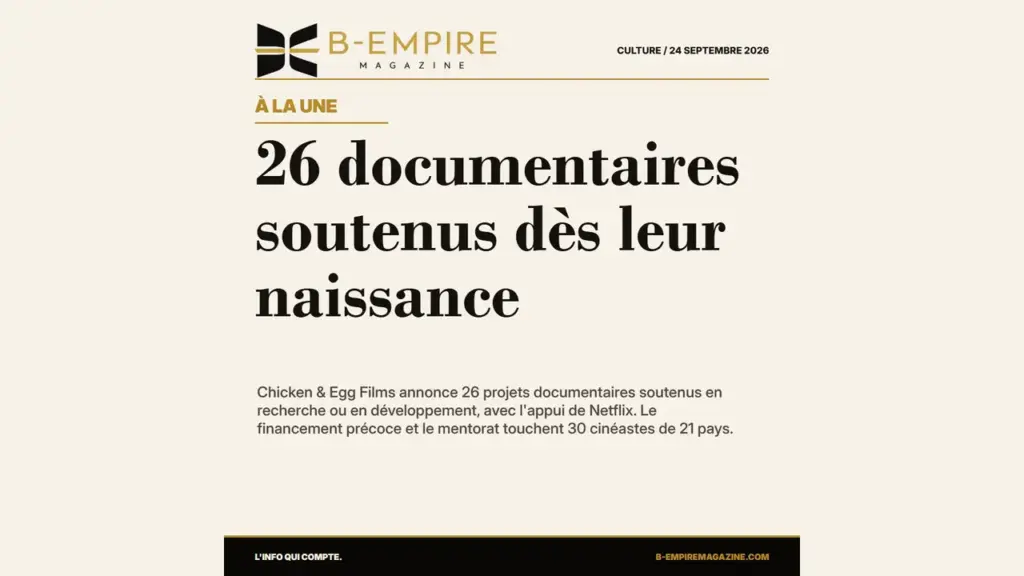
A documentary can run short of money long before a camera starts rolling. Filmmakers must meet the people involved, find archives, understand a place, test a narrative path and sometimes abandon one idea to find a better one. On September 23, 2026, Chicken & Egg Films announced support for 26 projects at these still largely invisible stages. Thirty filmmakers will receive research or development grants, with support from Netflix. The announcement recalls a basic fact of the cultural economy: funding a film is not only a matter of paying for production or release. It also means giving time to the investigation that makes the film possible.
Two amounts for two stages of work
The program distinguishes $10,000 grants for research from $20,000 grants for development of a new feature documentary. The first phase can involve finding sources, following possible storylines and building relationships with the people at the center of a subject. The second explores access to key participants, budgets, fundraising and the shape of the story in greater depth. This separation avoids pretending that all projects reach the same level of maturity at the same time.
Recipients will also have support from the Chicken & Egg Films team, a community of peers, mentorship and industry connections. That nonfinancial help matters. A documentary often depends on the trust of the people being filmed and on finding partners willing to respect the pace of an investigation. Money arriving late can help complete a work; a resource available earlier can shape the way the work is conceived in the first place.
A genuinely international cohort
According to the announcement, 70% of the cohort is international, the highest share in the program’s history. The 30 filmmakers represent 21 countries, including France, Madagascar, Chile, Iran, India, Lebanon and South Korea. That geographic range does not automatically guarantee a diversity of viewpoints. It does, however, create conditions in which stories made outside the familiar centers of English-language cinema can reach a wider funding and professional network.
The list includes Tatiana Botovelo, associated with France and Madagascar, for a project called Daughters of Zafy. Maite Alberdi of Chile, Sepideh Farsi of Iran and Sam Feder of the United States are also among the supported filmmakers. The announcement does not provide detailed descriptions of every film, and several projects do not yet have public titles. It would therefore be premature to recount their plots, name distributors or predict release dates. What matters now is their place in the research and development stage.
The work an audience never sees in the credits
When a documentary reaches a festival or a streaming service, its early work is often invisible. Yet the choice of perspective, the search for archival material and the relationship established with a witness can determine the entire form of the film. Chicken & Egg Films presents this fourth edition of its grant as a response to that shortage of early support. The program is not purchasing a finished work. It is taking a chance on an open question at a point when the answers are not yet known.
That approach is especially relevant to the subjects represented in the cohort: women’s rights, climate, war, migration, disability rights and democracy. Such themes often need more than a strong idea and a team ready to leave. They require checking facts, working over time and thinking carefully about what it means to represent other lives on screen. A grant cannot solve all of those problems, but it can make room to address them before production pressure dictates the choices.
A platform’s backing, an investigation’s independence
Netflix supports the 2026 grant. That does not mean all 26 films will be produced, acquired or streamed by Netflix: the announcement promises none of those things. The distinction matters in an industry where a funder’s name can be mistaken for a distribution guarantee. The program described here pays for stages of work and offers a professional network. Each film’s later path will still depend on its creators, additional partners and decisions made during development.
Chicken & Egg Films defines its mission as supporting women and gender-expansive documentary filmmakers affected by industry bias. The organization says it has awarded more than $15.5 million in grants to over 550 filmmakers since its founding. The new cohort offers a concrete measure of that mission without turning every project into a promise of success. Funding research lets more directors attempt ambitious forms before the market asks them to deliver a perfectly defined product.
Precedents, not guaranteed outcomes
The organization points to several films supported by earlier research and development grants that later screened at Berlinale, Locarno or Tribeca. Those examples show how early support can accompany a project until it meets an audience. They do not predict what will happen to the 2026 cohort. The path from idea to full financing, filming, editing and first screening remains long and uncertain. The point of the grant is precisely that it does not wait for all those stages to be secured in advance.
The most important news is therefore not a list of future films that viewers can watch immediately. It is the decision to value a rarely visible moment in cinema: the point when a question may become a documentary. The 26 projects announced on September 23 are not finished works. But by giving 30 filmmakers in 21 countries the means to investigate and build, Chicken & Egg Films reminds the storytelling industry that it must also finance the uncertainty that comes before the images.
Sources
- Chicken & Egg Films / Netflix, September 23, 2026 announcement: cohort, grant amounts, projects and background.
- Chicken & Egg Films, official Research & Development Grant overview: program goals and stages.