


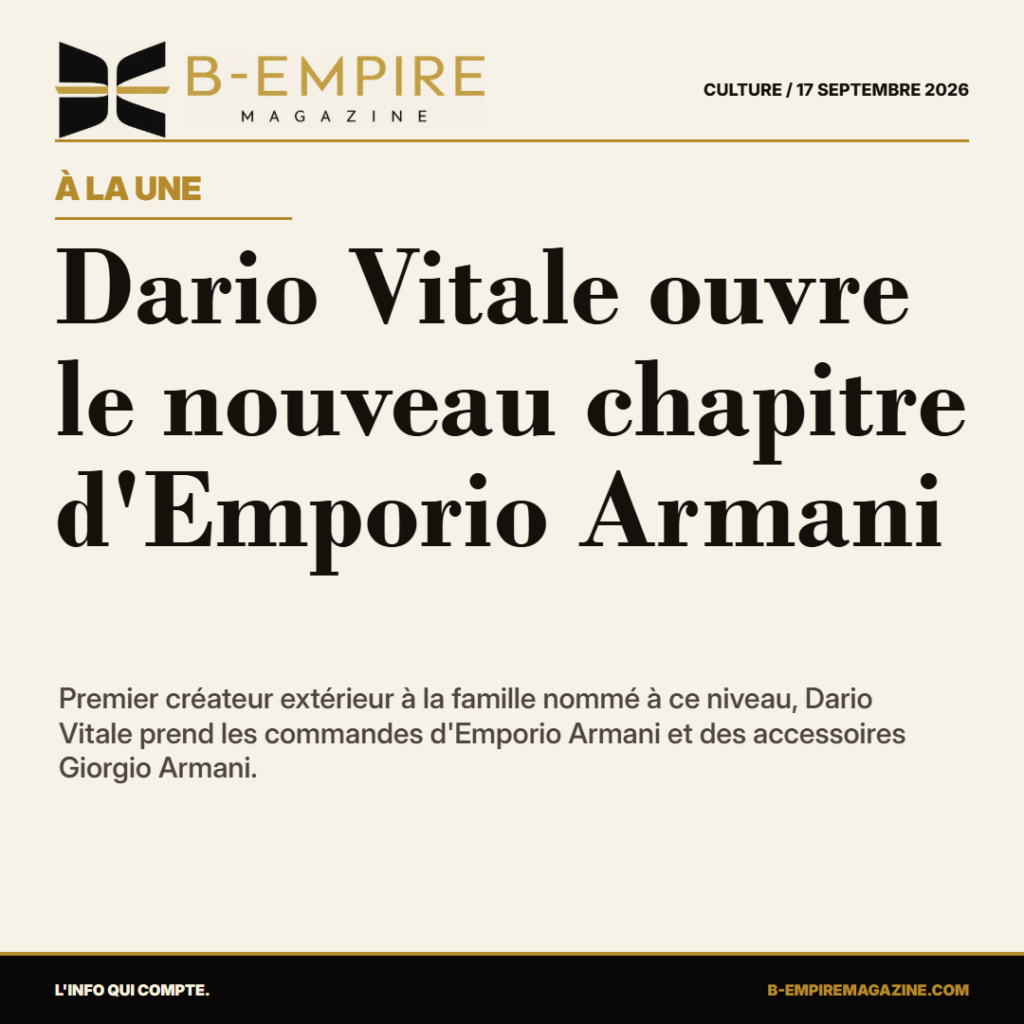
Armani has crossed a boundary the house had preserved since its creation. The Italian group has appointed Dario Vitale creative director of Emporio Armani and Giorgio Armani accessories. For the first time, a designer from outside the family and the founder’s historic circle has received responsibility on this scale. The announcement is therefore more than another round of fashion appointments: it reveals the method the company has chosen to enter the post-Giorgio Armani era.
Vitale takes up the position immediately. He joins an organization in which Silvana Armani retains control of womenswear design for the main lines and Leo Dell’Orco remains responsible for menswear. This division creates a multi-voice creative structure. It protects the language of the house while opening space for a fresh perspective in two strategic territories: Emporio, designed for a younger customer, and accessories, essential economic engines of contemporary luxury.
A carefully framed break
The move is bold, but its form is cautious. Dario Vitale has not been handed every Giorgio Armani collection. He enters a territory broad enough to transform the group’s image without erasing the role of its historical guardians. Emporio Armani therefore becomes a succession laboratory: a place where the company can test new energy, measure the public response and learn how to operate without every creative decision returning to one central figure.
This architecture fits Armani’s culture. The founder built an independent, coherent and tightly controlled empire spanning clothing, hospitality, furniture and beauty. After his death in September 2025, a spectacular revolution would have contradicted that discipline. Vitale’s appointment instead proposes evolution in stages. An outsider enters the house, but through a clearly defined door.
Why Dario Vitale
The designer’s career helps explain the choice. After experience that included Bottega Veneta, he spent roughly fifteen years at Miu Miu, working closely with a brand able to make intellectual, youthful and deliberately offbeat codes commercially desirable. That period taught him to connect product, image and culture, knowledge especially useful for Emporio Armani, whose original mission was to translate the house’s elegance into a more accessible and urban vocabulary.
His tenure as Versace’s creative director was brief but closely watched. His single collection showed an ability to revisit powerful archives without treating them as a museum. At Armani, the difficulty will be almost the reverse. He must work inside a universe built on restraint, fluidity and controlled color without confusing modernization with agitation. His profile is compelling precisely because he can read heritage while producing a contemporary proposition.
Emporio as a natural field for experimentation
Created in 1981, Emporio Armani has always been more than a diffusion line. It allowed the group to speak to a different generation, explore denim, sport, music and mass communication, while retaining the eagle symbol and the authority of the Armani name. Its positioning gives it a crucial role today: connecting Italian heritage with consumers who discover luxury houses through social platforms, collaborations and accessories.
Vitale must avoid two traps. The first would be producing a cheaper imitation of the main line. The second would be chasing youth through short-lived effects. Emporio can be modern without becoming loud. Its potential strength lies in a real wardrobe able to accompany work, mobility and new ways of wearing tailoring. Here the designer has a territory where experimentation must remain compatible with everyday life.
Accessories are the real center of gravity
The second part of the assignment may be the most important. In luxury, bags, shoes, eyewear, watches and small leather goods reach a wider customer base than ready-to-wear. They travel more easily across markets, provide immediate visual signatures and often deliver stronger profitability. Giving Vitale responsibility for Giorgio Armani accessories hands him a commercial key, not merely a styling exercise.
Armani enjoys worldwide recognition, but its accessories do not always possess the same cult-object status as those of some French and Italian rivals. The opportunity is therefore substantial. The challenge is to create identifiable products without escalating the use of logos. A handle, a soft construction, a material or a proportion can become a lasting code. The strongest strategy would remain faithful to the house: make the object recognizable before its name is read.
An appointment where creativity meets capital
The change comes while the group’s financial future is also under scrutiny. Giorgio Armani’s will calls for the sale of a 15 percent stake within a specified period, opening the possibility of an alliance with a major industry player. In that context, clarifying the creative structure makes the company easier to understand. A potential partner evaluates more than revenue and stores; it also wants to know who will create the brand’s future desirability.
Vitale’s appointment sends two messages. To employees, it demonstrates that the group is prepared to integrate outside talent. To markets, it suggests that Armani is preparing continuity without surrendering its cultural independence. Creativity becomes part of governance. The designer’s success could strengthen the strategic value of Emporio and accessories, two activities capable of supporting growth during a difficult period for global luxury.
The first collection will not yet be his
The Emporio Armani Spring/Summer 2027 collection is scheduled for presentation on September 24 during Milan Fashion Week, in a presentation rather than a conventional runway show. It was designed by Leo Dell’Orco and Silvana Armani. It would therefore be misleading to search for Vitale’s full signature there. His influence will take time, particularly because development cycles for clothing and accessories begin many months before their public appearance.
The transition nevertheless offers an advantage: it allows the new creative director to study the ateliers, suppliers, commercial teams and archives before exposing his ideas. In a house where cut and fabric matter more than runway scenery, that listening period can be productive. His first true proposal will be judged not by its ability to cause an immediate shock, but by the precision with which it shifts established codes.
Italian luxury searches for new models
Beyond Armani, the decision illustrates a broader transformation in Italian fashion. Several great houses built around a founder or family must now organize the transfer of their identity. Some choose integration into a group, others recruit an international star, while others strengthen an internal team. Armani is testing a hybrid model: close collaborators guard the heritage while an outside designer receives a strategic field of action.
This model could reduce dependence on an all-powerful creative director. It recognizes that major brands have become complex systems where clothing, accessories, imagery, retail and digital experiences must move together. Vitale does not succeed Giorgio Armani alone, because such a succession would be impossible. Instead, he becomes one of the architects of a house learning to distribute authority once concentrated in its founder.
The test of inventive loyalty
The group says it wants to combine innovation and identity. That familiar luxury phrase will have a concrete meaning here. If Vitale follows the archives too literally, his appointment will appear cosmetic. If he imposes a break foreign to the house, he will weaken trust built over fifty years. Success lies between the two: a loyalty capable of invention, where Armani remains recognizable without simply repeating what Armani has already done.
The appointment is therefore not a conclusion but an early indicator. It says the group refuses immobility while preferring evolution to a clean break. Emporio Armani will be where that promise must become visible, wearable and commercially convincing. For Dario Vitale, the challenge is enormous. For Armani, it is historic: proving that a language shaped by one man can become a culture strong enough to welcome a new voice.