


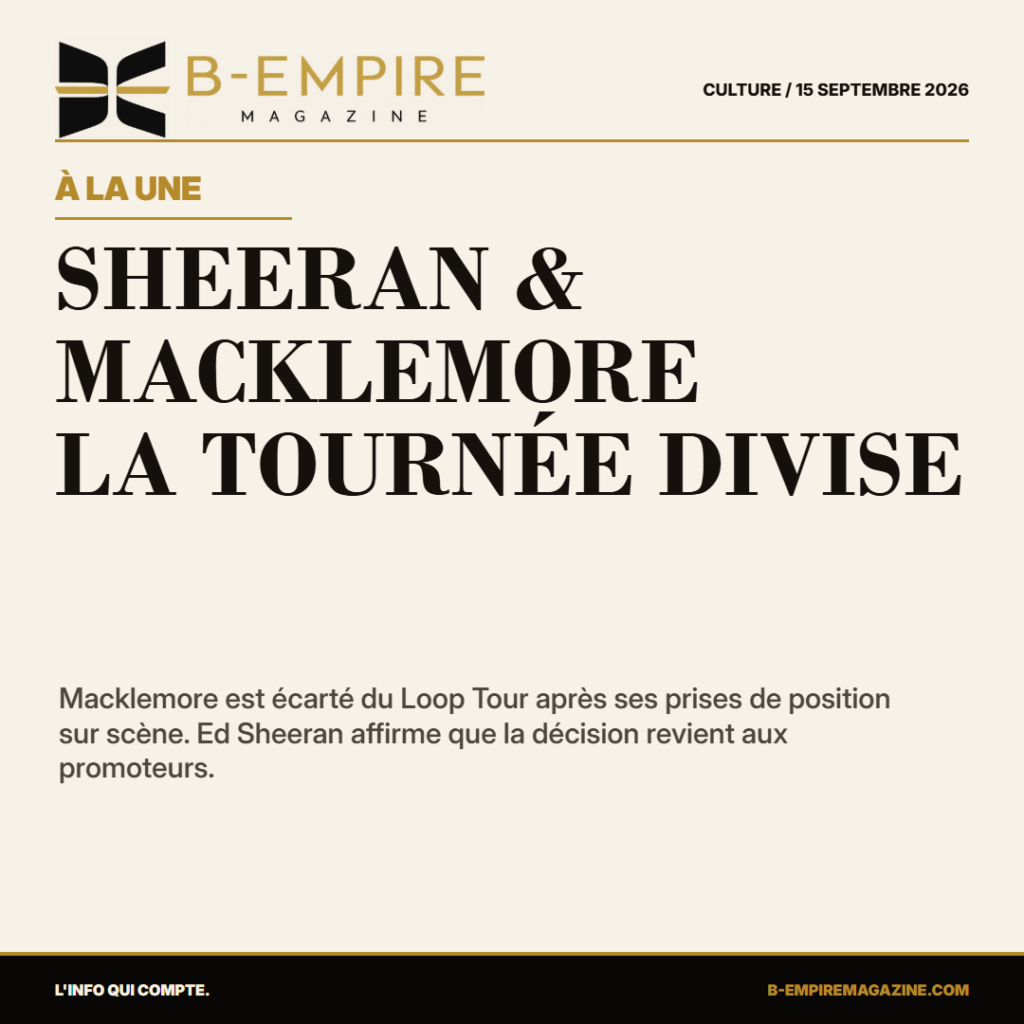
A decision made far from the stage has forced the global concert business to face an explosive question: who really controls what an artist can say inside a stadium? Macklemore has been removed from upcoming American dates on Ed Sheeran‘s Loop Tour after pro-Palestinian remarks during shows at MetLife Stadium in New Jersey. On September 15, Ed Sheeran responded publicly, saying the decision was made by promoters rather than by him alone.
The issue now goes beyond the relationship between two musicians. It involves stadium owners, a promoter, hundreds of thousands of spectators and an international tour with very high financial stakes. Above all, it shows how quickly a political statement can change the lineup of a global event, even when tickets have already been sold and artist names still appear on some official materials.
What Happened Between Macklemore and the Loop Tour
According to the Associated Press, Macklemore was removed from the remaining dates where he was scheduled to open for Ed Sheeran in the United States. The controversy intensified after the September 4 and 5 concerts at MetLife Stadium. The rapper performed Hind’s Hall, a track connected to student protests in support of Gaza, and delivered a message backing a free Palestine.
Messina Touring Group, the promoter of the American leg, said it had been informed by several venues that they would not allow the shows to proceed with Macklemore on the bill. According to that account, keeping the rapper would have exposed the tour to cancellations affecting a very large audience. The company therefore framed his removal as an operational decision intended to preserve the concerts.
Ed Sheeran Responds: A Promoter Decision
Ed Sheeran’s clarification, reported by the Associated Press on September 15, is the latest development. The British singer said Macklemore’s removal was a promoter decision and that he would not abandon the hundreds of people working on the tour. He also expressed distress over the suffering linked to the Israeli-Palestinian conflict and defended his desire to offer a safe space at his concerts.
Macklemore, however, presents a more personal reading. In a long Instagram statement reported by several outlets, he said his participation became impossible after pressure from stadium owners. He specifically named Robert Kraft, owner of Gillette Stadium and the New England Patriots. Kraft confirmed that he supported the rapper’s removal, saying remarks and imagery associated with him had hurt the Jewish community. These accounts need to be separated: some come from Macklemore, others from the promoter or Kraft, and they do not assign exactly the same responsibility to Ed Sheeran.
The Invisible Power of Stadiums Over Artists
A stadium tour is a temporary giant company. It depends on contracts between the headliner, the producer, venues, insurers, ticket sellers, local teams and commercial partners. In that system, a stadium owner does more than rent a building. They can set access conditions, invoke security or reputational risks and influence the composition of the bill.
Ed Sheeran’s official website had recently still listed Macklemore as a guest for several dates, including Philadelphia and Foxborough. That gap between commercial communication and a last-minute decision illustrates the complexity of live entertainment. For ticket holders, the headliner remains Ed Sheeran, but an opening act can be an important reason for travel or purchase. Any change therefore fuels demands for explanation, even if ticket terms generally allow lineup changes.
Why the Case Is a Global Test for Music
Artists have always used the stage to defend causes. What has changed is the speed and scale of reaction. A video filmed in a stadium can reach millions before the concert is over, trigger opposing activist campaigns and force partners to respond the next day. The show is no longer separate from public debate; sometimes it becomes one of its most visible centers.
This speed creates a dilemma for tours. Protecting artistic speech can expose an event to boycotts, protests or partner withdrawals. Limiting a guest artist’s speech can, in turn, prompt accusations of censorship and weaken public trust. There is no neutral solution, because the choice to keep or remove an artist becomes a political message in itself.
A Public Friendship Inside a Commercial Machine
The human dimension has made the story even more viral. Macklemore and Ed Sheeran have known each other for years and have shared the stage before. The rapper described the British star as a friend while refusing to present him simply as a victim of circumstance. Sheeran, for his part, emphasized collective responsibilities and the jobs that depend on keeping the tour running.
This tension summarizes contemporary entertainment. A global star can have immense influence without controlling every decision alone. But the star’s name, placed at the top of the poster, carries much of the public reaction. Promoters and owners hold contractual power; the headliner absorbs the symbolic cost.
The Signal No One in Live Music Can Ignore
The next Loop Tour dates will be watched well beyond Ed Sheeran’s fan base. Organizers will need to clarify guest artists, manage reactions inside and around stadiums and show that the concerts can continue without another incident. Macklemore has said he does not regret his message, which guarantees the discussion will not disappear when his name leaves the poster.
The final issue is not to decide for the public what position to take on the conflict. It is to understand the precedent: when a network of venues can alter an international tour, cultural power is also logistical and financial. The case reminds the global music business that the stage belongs to artists for a few hours, but access to that stage depends on a chain of actors able to change the show before the lights even come on.
Sources
- Associated Press — Ed Sheeran’s response to Macklemore removal, September 15, 2026
- Associated Press — Macklemore removed from the Loop Tour, September 14, 2026
- CBS News New York — Messina Touring Group statement
- Pitchfork — statements from Macklemore and Robert Kraft
- Ed Sheeran official site — Loop Tour calendar