


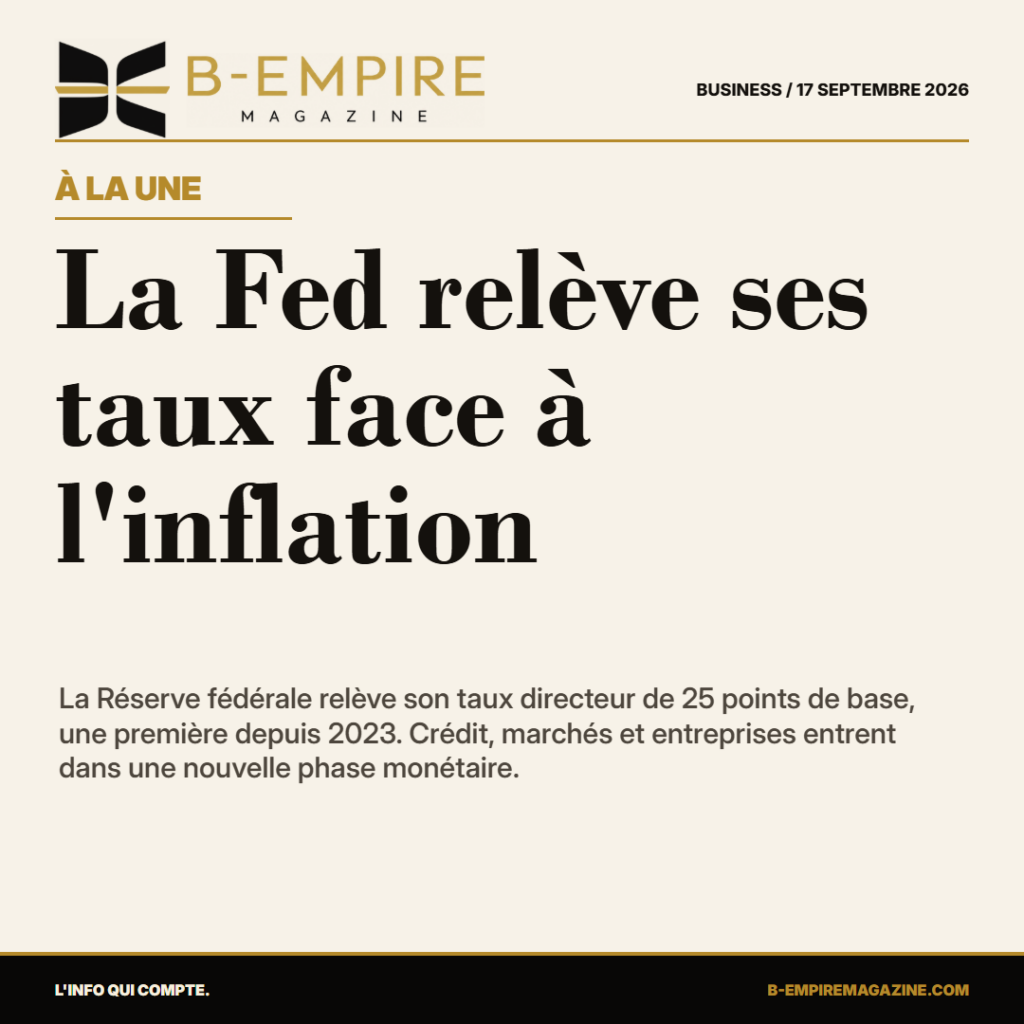
The Federal Reserve has made money more expensive for the first time since 2023. On September 16, the Federal Open Market Committee raised its benchmark rate range by a quarter point to 3.75%-4%. The decision was unanimous, with all twelve members voting in favor. Under Chair Kevin Warsh, the US central bank is tightening monetary policy despite repeated calls for lower rates from the White House. The move reaches far beyond banks: it resets the price of credit for households, businesses and investors well outside the United States.
A small increase with a powerful signal
Twenty-five basis points may sound modest. Yet the change in direction matters more than the size of the step. After several years without an increase, the Fed is acknowledging that inflation remains high enough to require additional action. Its statement describes economic activity expanding at a solid pace, resilient domestic spending, strong productivity and robust capital investment. Job gains have kept pace with labor force growth, while unemployment has changed little.
Against that backdrop, the central bank believes it has room to fight rising prices without immediately triggering a recession. It says the move should support a timelier return to the 2% inflation objective. Warsh’s message is intentionally clear: price stability remains the priority and underlying trends have not improved convincingly enough.
Credit moves through the economy in waves
The federal funds rate is a wholesale price between banks, but its effects spread throughout the economy. Variable-rate credit cards, some credit lines and corporate loans usually respond quickly. Auto loans and mortgages also depend on expectations for longer-term interest rates. They do not automatically rise by the same amount, but a more restrictive Fed gives lenders reason to demand higher returns.
For households already carrying debt, higher rates reduce disposable income. For new buyers, they lower the amount that can be borrowed for the same monthly payment. Savers, on the other hand, may receive better returns on certain deposit and money-market products. The same decision therefore creates winners and losers depending on whether a household owns liquid capital or relies on borrowing.
Businesses must recalculate their plans
Inside a company, interest rates create an invisible threshold for nearly every investment. A factory, acquisition, property development or new service must earn more than the cost of financing it. When that cost rises, projects with the weakest returns are postponed. Highly indebted companies and those facing near-term refinancing feel the pressure first, especially when large bond maturities are approaching.
Young companies are affected as well. A higher risk-free return makes investors less willing to pay extreme valuations for profits expected far in the future. Venture capital does not disappear, but it becomes more selective. Founders must demonstrate revenue, cost discipline and a credible path to profitability earlier. In that sense, a Fed increase acts as a filter on the innovation economy.
Wall Street loses its comfortable narrative
US stocks moved lower after the announcement, while bond yields rose. Markets must now price a less comfortable scenario: an economy that remains solid but faces higher rates for longer. Growth stocks are especially sensitive because much of their value depends on profits expected many years ahead. When the discount rate increases, those future earnings are worth less today.
Banks may benefit from wider interest margins, but only if credit quality remains healthy. Property developers, heavily indebted utilities and some consumer companies are more exposed. Energy is a special case: high prices may support producers while feeding the inflation that forces the Fed to tighten. Markets are no longer asking only whether earnings will grow. They must also measure the cost of every dollar required to produce them.
Fed independence faces a political test
The decision comes amid intense political pressure. Donald Trump has demanded lower rates, while Kevin Warsh, appointed Fed chair in May, must establish his credibility. A unanimous increase shows that the committee wants to present a strong institutional front. The central bank is not meant to make government financing easier or support a political party. Its mandate is price stability and maximum employment.
That independence is never absolute. Governors are appointed through the political system and the Fed must explain itself to Congress. But its ability to make an unpopular decision is essential to its credibility. If households and businesses believe the central bank will allow inflation to persist, they adjust wages and prices upward, making the problem more difficult to solve.
The dollar exports the decision
Higher US rates tend to increase the appeal of the dollar and dollar-denominated assets. For countries and companies that borrowed in dollars, debt service becomes heavier when their local currency weakens. Foreign central banks may be forced to keep their own rates elevated to limit capital outflows even when domestic growth needs support.
Commodities, which are often priced in dollars, provide another transmission channel. A strong dollar makes oil, metals and grain more expensive for many buyers. A decision made in Washington can therefore squeeze budgets in Istanbul, Lagos, São Paulo or Jakarta. The Fed runs a national policy whose consequences remain structurally global.
A second increase is no longer theoretical
The new move does not end the debate. Projections released alongside the decision suggest another increase could arrive before the end of the year. That signal is not a promise. It will depend on incoming data for inflation, employment, spending and financial conditions. Still, it forces markets to abandon the assumption that September’s increase will necessarily stand alone.
Communication will be difficult. If the Fed stresses future increases too strongly, it could tighten market rates abruptly before taking further action. If it appears hesitant, it may weaken its anti-inflation message. Warsh appears determined to avoid automatic guidance and remain dependent on the data. That flexibility protects the central bank, but it also increases the market impact of every economic release.
The price of time has changed
At its core, a rate increase changes the price of time. Consuming today becomes more expensive when borrowing is required. Saving becomes more rewarding. Promising profits ten years from now becomes less persuasive. The Fed is deliberately seeking this slowdown in present decisions to reduce pressure on prices. Its challenge is to apply the brakes without breaking the economic momentum it describes as solid.
The September 16 increase is therefore more than a technical adjustment. It begins the first true monetary sequence of the Warsh era and reminds businesses that capital is no longer an almost free fuel. The coming months will show whether this quarter point is enough to stabilize expectations or marks the start of a longer cycle. Either way, credit has just entered a new regime.