


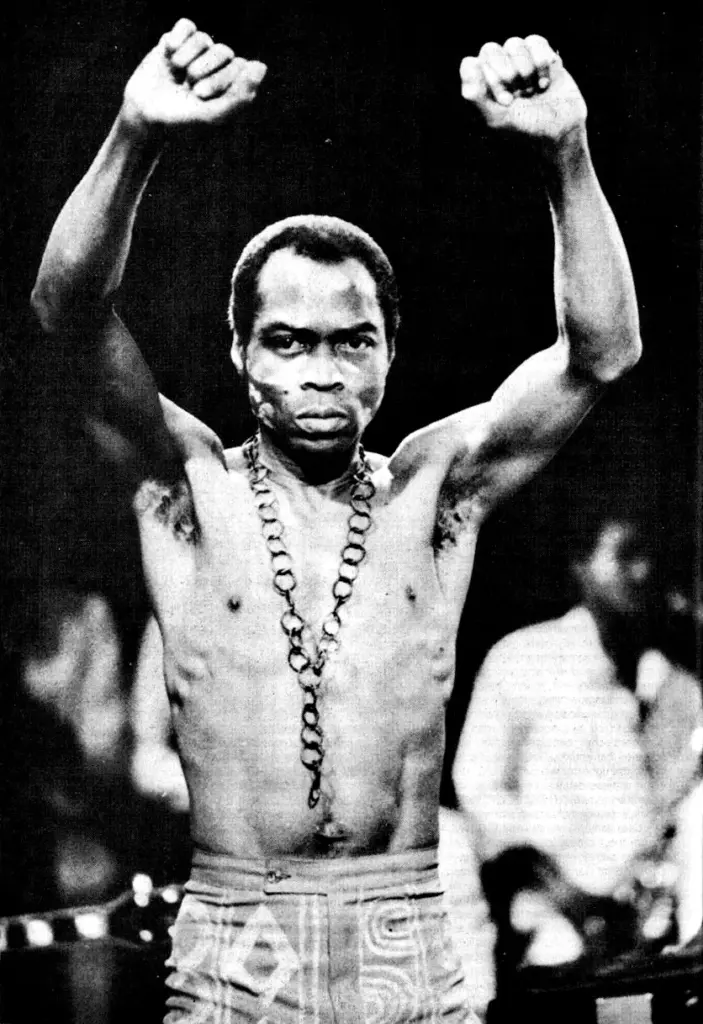
Los Angeles has honored a revolution born in Lagos. On Saturday, November 14, 2026, Fela Kuti was posthumously inducted into the Rock & Roll Hall of Fame in the ‘Early Influence’ category, which recognizes artists whose work has changed the language of popular music. Nearly thirty years after his passing, the creator of Afrobeat joins one of the most famous musical institutions in the world. This recognition transcends a mere trophy: it affirms that the rhythm, anger, and freedom embodied by Fela have profoundly altered global culture.
The ceremony held at the Peacock Theater in Los Angeles featured a spectacular lineup, from Phil Collins to Sade, Oasis, Iron Maiden, Wu-Tang Clan, and Luther Vandross. However, the tribute to Fela Kuti holds a special significance. The Nigerian musician never sought to fit into established frameworks. He invented his own sound, transformed the stage into a political platform, and made long, feverish, and hypnotic songs a tool of resistance. Seeing the Rock Hall welcome him today acknowledges a long-ignored truth: the center of gravity of modern music is not solely located in the United States or Europe.
A Historic Recognition for Fela Kuti and Afrobeat
The Rock & Roll Hall of Fame presents Fela Kuti as a revolutionary voice who fought against injustice while merging jazz, West African music, highlife, soul, and funk. This synthesis became Afrobeat, a genre immediately recognizable by its powerful brass, repetitive bass lines, complex percussion, interwoven guitars, and long builds of tension. Fela did not merely combine influences; he constructed a new musical architecture.
The ‘Early Influence Award’ precisely highlights this foundational role. It does not merely reward a popular career or a series of commercial successes. It celebrates a structuring influence capable of changing how other artists compose, perform, and think about music. Fela had already been nominated in the performer category in 2021 and 2022. His induction in 2026 thus closes a long wait while placing his legacy on par with the great builders of contemporary music.
This recognition comes at the end of a symbolic year. In February 2026, the Recording Academy had already awarded him a posthumous Grammy Lifetime Achievement Award. In just a few months, two major American institutions have thus celebrated a body of work that was originally deeply critical of power, imperialism, and structures of domination. The irony is strong, but it primarily testifies to the ability of this music to survive its time.
From Lagos to the World, a Sound Became a Universal Language
Born in 1938 into an engaged family, Fela Anikulapo Kuti grew up surrounded by music and politics. His father, a teacher and unionist, loved the piano. His mother, Funmilayo Ransome-Kuti, was a major figure in the anti-colonial struggle and women’s rights in Nigeria. After studying music in London, Fela formed Koola Lobitos, then refined his artistic identity through travels and encounters, notably in the United States, where he directly discovered soul, funk, and black liberation movements.
Upon returning to Africa, he imposed a music that rejected short formats. His songs could last fifteen, twenty, or thirty minutes. The orchestra patiently establishes the groove; the brass strikes like slogans; the voice arrives to narrate corruption, police brutality, social injustice, and the absurdity of power. Tracks like ‘Zombie,’ ‘Water No Get Enemy,’ or ‘Sorrow, Tears and Blood’ have become references far beyond Nigeria.
His influence is heard today across several generations of artists. It transcends jazz, hip-hop, pop, electronic music, and contemporary African scenes. Current Afrobeats—a plural term, a distinct pop genre from Fela’s Afrobeat—does not confuse with his invention, but its global success owes much to the cultural openness created by Nigerian pioneers. Burna Boy, Wizkid, Davido, and many producers now elevate Lagos to the top of international charts and festivals.
Why This Induction into the Rock Hall Goes Beyond Music
Fela Kuti never separated creation from engagement. He used the stage as a space of truth and often paid the price for his stances. His songs denounced Nigerian military regimes, predatory elites, and the legacies of colonialism. His Kalakuta Republic, an artistic and symbolic community established in Lagos, became a site of political defiance. Authorities arrested him numerous times, and his entourage suffered extreme violence.
This dimension explains why his admission to the Rock Hall resonates particularly in Africa. It does not merely crown a brilliant composer. It validates the idea that an African artist can speak from their own context, in their own language, and reach the universal without diluting their reality. Fela did not seek to make his music more palatable to conquer the West. It is precisely his refusal to compromise that ultimately imposed his work.
The choice of the ‘Early Influence’ category also carries a message about the official history of music. For decades, dominant narratives have presented rock, funk, or pop as essentially Western stories. However, the circulations are much broader: African rhythms, Caribbean traditions, American jazz, Ghanaian and Nigerian highlife, soul, and Latin music constantly respond to one another. Honoring Fela compels the institution to recognize this global map.
A 2026 Induction That Breaks Down Borders
The 2026 induction illustrates the gradual broadening of the Rock & Roll Hall of Fame. Alongside Fela Kuti are the Cuban legend Celia Cruz, hip-hop pioneers Queen Latifah and MC Lyte, as well as Gram Parsons in the influences category. The honored performers range from Iron Maiden’s heavy metal to Wu-Tang Clan’s rap, to Sade’s sophisticated pop and Joy Division/New Order’s post-punk.
This mix may spark debates among those who wish to limit the museum to traditional rock. However, it better corresponds to the reality of artists. Genres never evolve in airtight boxes. Rock has drawn from blues, country, gospel, and rhythm and blues; hip-hop has sampled funk and soul; Afrobeat has transformed African and American influences into a new language. Fela perfectly embodies this circulation.
The ceremony was not broadcast live to the general public, with the televised edition scheduled on ABC and Disney+ for December 9. This delay does not diminish the strength of the event. In Los Angeles, celebrations dedicated to Fela surround the Rock Hall weekend, notably with DJ Rich Medina’s Jump-N-Funk nights, designed to transmit his repertoire to new audiences.
A Signal the Industry Can No Longer Ignore
Fela Kuti’s induction comes at a time when African music occupies an unprecedented commercial and cultural space. Platforms have accelerated the circulation of tracks, international collaborations are multiplying, and artists from the continent now fill arenas once reserved for American or European stars. However, there is a risk of narrating this success as a sudden phenomenon born with algorithms.
The Rock Hall, on the contrary, reminds us that this story has deep roots. Before global playlists, Fela and his Africa 70 band had already created music capable of making Lagos, London, Paris, and New York dance. Before brands spoke of an ‘African revolution,’ he had proven that an African sound could sustainably influence the planet. The recognition of 2026 thus reconnects the spectacular present of African music to one of its most audacious founders.
A Posthumous Victory, A Legacy Still Alive
Fela Kuti passed away in 1997, but his work has never ceased to circulate. His children, Femi and Seun Kuti, have continued the family legacy while building their own paths. The Felabration festival gathers admirers every year in Lagos. His records are being reissued, sampled, studied, and rediscovered by young people who were not born when he took the stage at the Shrine.
The night in Los Angeles does not transform Fela Kuti into a legend: it finally recognizes a legend that already existed. His induction into the Rock & Roll Hall of Fame does not close his story. It offers him a new entry point to a global audience and reminds us that Afrobeat was from the start much more than an irresistible rhythm. It was a vision of freedom, a weapon against silence, and a declaration that Africa could write the future of music itself.
Sources
- Rock & Roll Hall of Fame, official page of Fela Kuti, biography, influence, and induction category, accessed November 15, 2026.
- Rock & Roll Hall of Fame, 2026 induction, official list of artists and ceremony details.
- Associated Press, 2026 Rock & Roll Hall of Fame ceremony, context of the event and honored artists, November 14, 2026.
- Associated Press, Fela Kuti’s honorary Grammy and its importance for African music, February 2, 2026.