


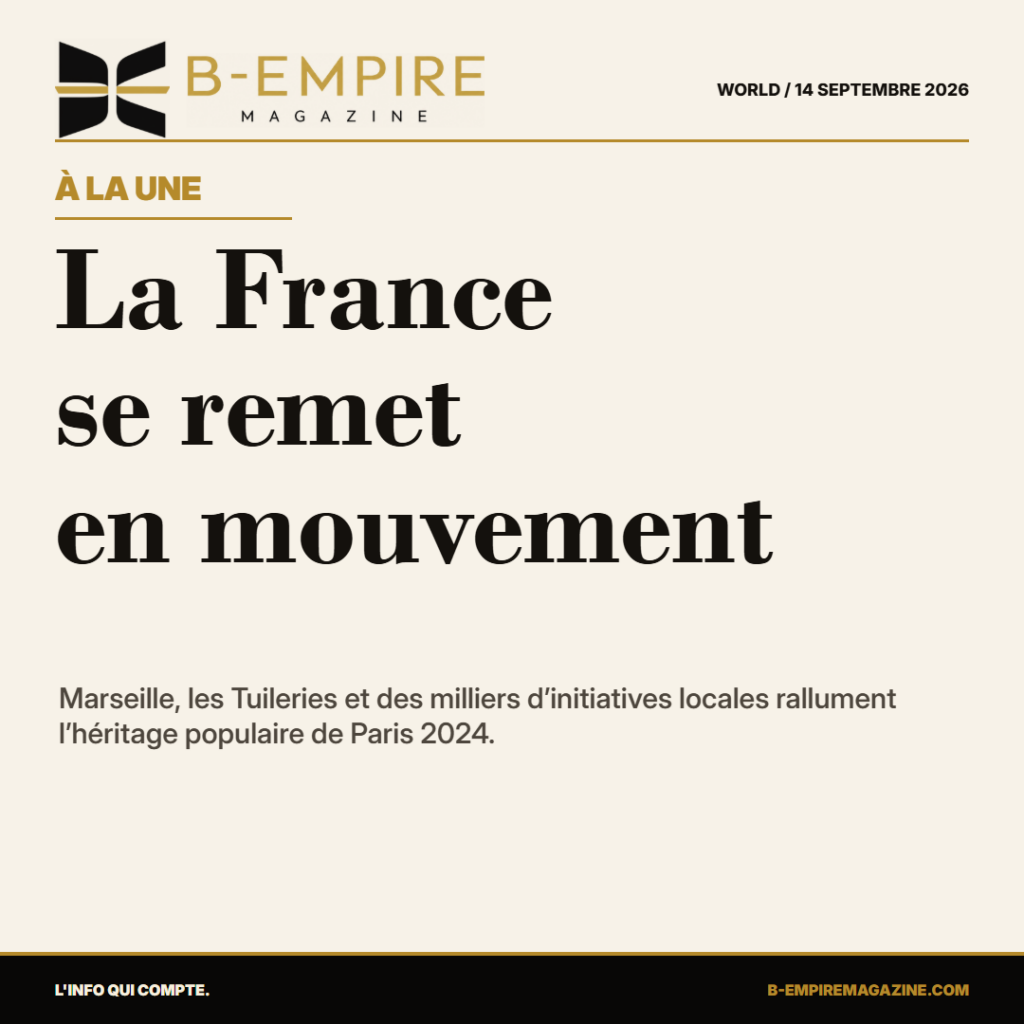
France does not want the flame of Paris 2024 to become just a memory. On Monday, September 14, 2026, the second edition of the Fête du Sport transforms squares, clubs, schools, and public facilities into a vast free playground. At the heart of the initiative is a XXL village at the Vieux-Port of Marseille, a challenge with students and champions at the Tuileries Garden, and the final ascent of the Olympic flame for the year. Behind the spectacular images lies a much deeper question: can France convert the emotion of the Games into a daily habit?
The official motto, “30 minutes, move!”, gets straight to the point. It promises neither podiums nor exceptional performances. Instead, it offers an accessible first step, regardless of age, level, or physical condition. Initiations, demonstrations, workshops, open houses, and meetings are announced across the country. The ambition is to bring sports closer to those who feel distanced from it, particularly for reasons of health, disability, cost, or lack of confidence.
Marseille Becomes the Popular Capital of Sport
The focal point of this edition is in Marseille. From 11 AM to 7 PM, the Vieux-Port will host a large village organized around practice, health sports, demonstrations, and exchanges. Freestyle football, parakarate, wheelchair basketball, and blind football will remind everyone that sports are not limited to the most publicized disciplines.
This choice is symbolic. By placing the event in the heart of a large Mediterranean city, in an open space frequented by diverse audiences, the organizers are taking physical activity out of the closed stadium. Sports become visible in the city, in contact with families, tourists, associations, and residents who may never have crossed the threshold of a club.
At the Tuileries, the Flame Rises One Last Time
In Paris, the Tuileries Garden brings back one of the most powerful images of the 2024 Games. The flame is set to rise for the last time in 2026, giving this day an obvious emotional dimension. But the Olympic setting also hosts a very concrete action: 200 students will participate in a sports challenge alongside Olympic and Paralympic athletes.
Among the announced athletes are Manon Apithy-Brunet, Olympic champion in sabre, Charles-Antoine Kouakou, Paralympic champion in the 400 meters, Hakim Arezki, Paralympic champion in blind football, and para-athlete Amadou Meite. Their presence gives a face to the legacy. It shows the younger generation that sporting success can take many forms, paths, and ways to inspire.
Inclusion is No Longer an Add-On
The common thread of 2026 is inclusion. This choice aligns with the impact of the Paris Paralympic Games, but it also requires organizers to go beyond mere symbolism. Truly accessible activities require adapted venues, trained facilitators, clear information, and formats that do not turn physical ability into a barrier to entry.
The official program emphasizes free access, openness to all, and the discovery of adapted practices. The CNOSF specifies that labeled events must be free, inclusive, and eco-responsible. This combination matters: it connects physical activity to contemporary social expectations, from well-being to autonomy, while also considering local cohesion and environmental responsibility.
The Real Challenge Begins After the Celebration
A national day can produce images, attract curious onlookers, and awaken enthusiasm. However, it alone is not enough to sustainably reduce sedentariness. Success must therefore be measured in ways other than the number of participants on September 14. How many people will return to a club? How many municipalities will extend free slots? How many businesses, schools, and health facilities will genuinely incorporate thirty minutes of movement into their routine?
This is where “September Moves”, the national month of physical and sporting activity, of which the Fête du Sport is the highlight, makes perfect sense. The tour will pass through 18 cities and aims to embed movement into daily life. The stated goal is to make physical activity a daily reflex, a health tool, and a factor in maintaining autonomy. The celebration draws attention; the month aims to build the habit.
An Olympic Legacy That Must Remain Alive
Paris 2024 has provided France with a reservoir of images and emotions rarely matched: the venues at the heart of the city, the popular fervor, Olympic performances, and the historical visibility of parasports. Two years later, the legacy can no longer be limited to celebrating what has happened. It must translate into more accessible practices, strengthened clubs, and a more natural place for movement in daily life.
The Fête du Sport deliberately borrows from the model of the Fête de la Musique: an identifiable, free event present everywhere. The idea is powerful because it removes the image of sports as an obligation or constant competition. One can try without committing, move without being judged, and discover a discipline before deciding if it suits them.
Why This Day Can Change More Than a Calendar
If September 14 becomes an anticipated event, it can change the national narrative around physical activity. Sports would no longer be just the domain of champions, supporters, or licensed participants, but a common good associated with health, pleasure, and connection. For associations, it opens the door to new audiences. For local authorities, it serves as a real-world test of the accessibility of their facilities. For citizens, it is an invitation without pressure.
The most important signal will therefore not just be the flame rising above the Tuileries. It will be the thousands of ordinary gestures accomplished throughout France: a child discovering blind football, an elderly person joining an adapted workshop, a family entering a gym for the first time, an employee deciding to walk for thirty minutes. The legacy of Paris 2024 will survive if these gestures become stronger than nostalgia. On this September 14, France has a day to transform the flame into movement.