


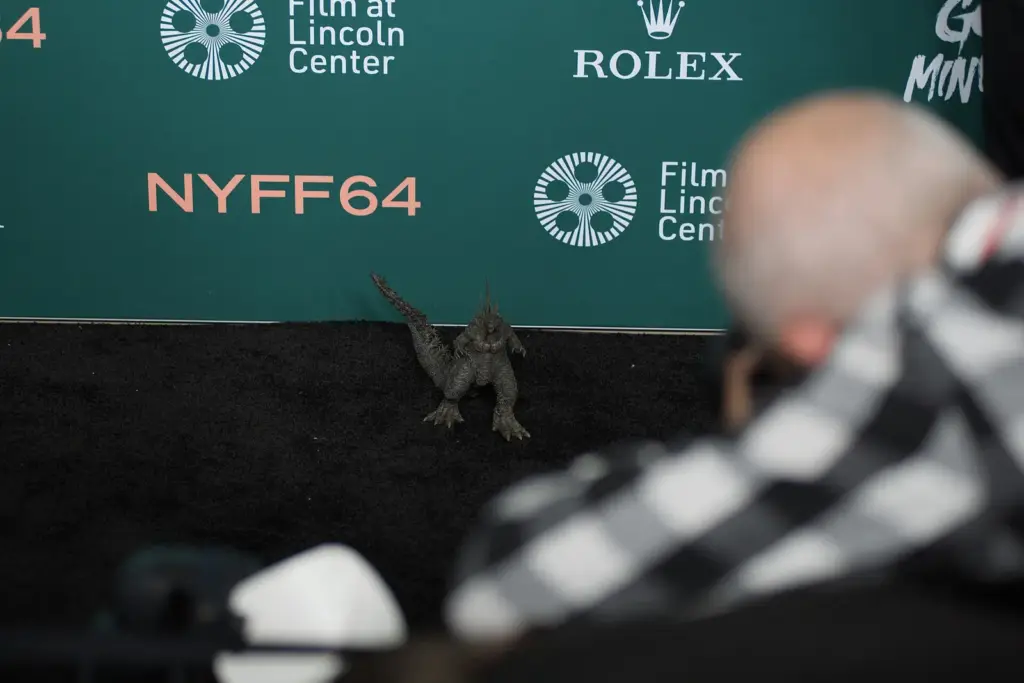
The most famous monster from Japan is not just returning to destroy cities: it is coming to shake up the order of global cinema. Released in Japan on November 3, 2026, Godzilla Minus Zero is set for a large-scale launch in North America on November 6. Early professional projections suggest an opening close to $30 million across more than 3,200 North American screens. If this scenario holds true, a Japanese film in its original language could top the American box office, a cultural and industrial signal that cannot be ignored.
This arrival does not resemble an ordinary foreign release. TOHO and GKIDS have organized a near-simultaneous launch between Japan and North America, a first in the long history of Japanese Godzilla productions. The studio is no longer merely selling a national phenomenon abroad after its domestic success: it is now treating its monster as a global franchise capable of creating events simultaneously across multiple markets.
A $30 Million Bet Right from the First Weekend
Boxoffice Pro places expectations in a very high zone for a Japanese production distributed in its original version, while estimates relayed as the release approaches aim for around $30 million for the first North American weekend. The film will face a crowded market, but it benefits from a rare advantage: Godzilla is both a popular icon over seventy years old and the hero of a recent critical renaissance.
The previous installment, Godzilla Minus One, changed the international perception of the saga. Its Oscar for Best Visual Effects proved that a spectacle designed in Japan could compete with major Hollywood productions without losing its uniqueness. TOHO claims that the film surpassed 7.65 billion yen in Japan and won over fifty major awards worldwide. Minus Zero thus arrives not as a curiosity: it carries the pressure of a success that has redefined the ambitions of the entire franchise.
The First Japanese Godzilla Designed for IMAX
The most powerful argument is also technical. According to GKIDS, Godzilla Minus Zero is the first Japanese production filmed for IMAX. This choice places the film on the same field as global blockbusters and transforms each large-format screening into a promise of experience. Director Takashi Yamazaki once again takes on the roles of screenwriter, director, and visual effects supervisor, a creative concentration that gave the previous film its spectacular and deeply human identity.
The Associated Press describes a narrative set in 1949, two years after the events of Minus One. Japan is still trying to rebuild when a new catastrophe strikes. The film runs for 135 minutes and reunites the Shikishima family while expanding the threat. This continuity is essential: Yamazaki does not present Godzilla as just a giant adversary, but as a force that reveals the traumas of a country, its fractures, and its will to survive.
Why This Release Goes Far Beyond Japan
The Godzilla case shows how the boundaries of global entertainment are shifting. Korean series, Japanese animation, Latin American music, and afrobeats have already proven that international success no longer needs to be born in Hollywood. Live-action Japanese cinema is now seeking to cross the same threshold. A top spot at the North American box office would give TOHO a decisive argument to accelerate coordinated releases, strengthen international distribution, and invest more in its intellectual properties.
The economic model is also revealing. GKIDS, a North American distributor recognized for animation and acquired by TOHO in 2024, gives the Japanese group direct access to the American audience. This integration reduces dependence on major Hollywood studios and allows for control over scheduling, marketing, and relationships with theaters. Godzilla Minus Zero thus becomes as much an industrial test as a cultural event.
Mixed Reviews, Yet Unwavering Curiosity
However, triumph is not guaranteed. In its review, the Associated Press praises Yamazaki’s visual mastery, particularly a spectacular aerial sequence, but notes that the human melodrama sometimes takes up too much space and that the final confrontation does not fully deliver on its promises. This reservation reminds us that the anticipation created by Minus One has become almost overwhelming. The new film must satisfy kaiju enthusiasts, viewers drawn to historical drama, and an international audience discovering the Japanese version of the character.
But this tension can also fuel the event. The R rating in the United States for violence and bloody images confirms a proposal that is darker than traditional family entertainment. TOHO thus embraces a Japanese film, subtitled, over two hours long, aimed at a mature audience, while offering it a wide release. This combination would have seemed extremely risky just a few years ago.
The Signal Hollywood Can No Longer Ignore
The real stakes are not limited to the first weekend’s numbers. If Godzilla Minus Zero turns its launch into lasting success, it will demonstrate that a non-English production can be marketed as a global blockbuster without being reshaped by Hollywood. The audience would no longer just be purchasing a known monster: they would be choosing a Japanese vision, a language, a historical memory, and a director’s signature.
For TOHO, victory would consist of establishing a direct circuit between Japanese creation and major international theaters. For exhibitors, it would confirm that IMAX can serve as a gateway for works from other industries. For the audience, it would open the door to more global films treated as events upon their release, rather than as niche products discovered months later.
What to Watch Now
Three indicators will tell if the bet is won: the level of North American previews, the film’s performance after its first weekend, and the gradual announcement of new international dates. Word of mouth will be crucial, as the gap between the power of monster scenes and the density of human drama is already dividing critics. Strong stability would confirm that Godzilla attracts beyond its core fanbase.
One thing is already clear: Godzilla Minus Zero no longer asks the world for permission to exist. Its coordinated launch, its IMAX format, and its commercial ambitions show that a new center of gravity is emerging in popular cinema. The Japanese monster has long symbolized nuclear fear. In 2026, it could also become the symbol of a truly global box office.