


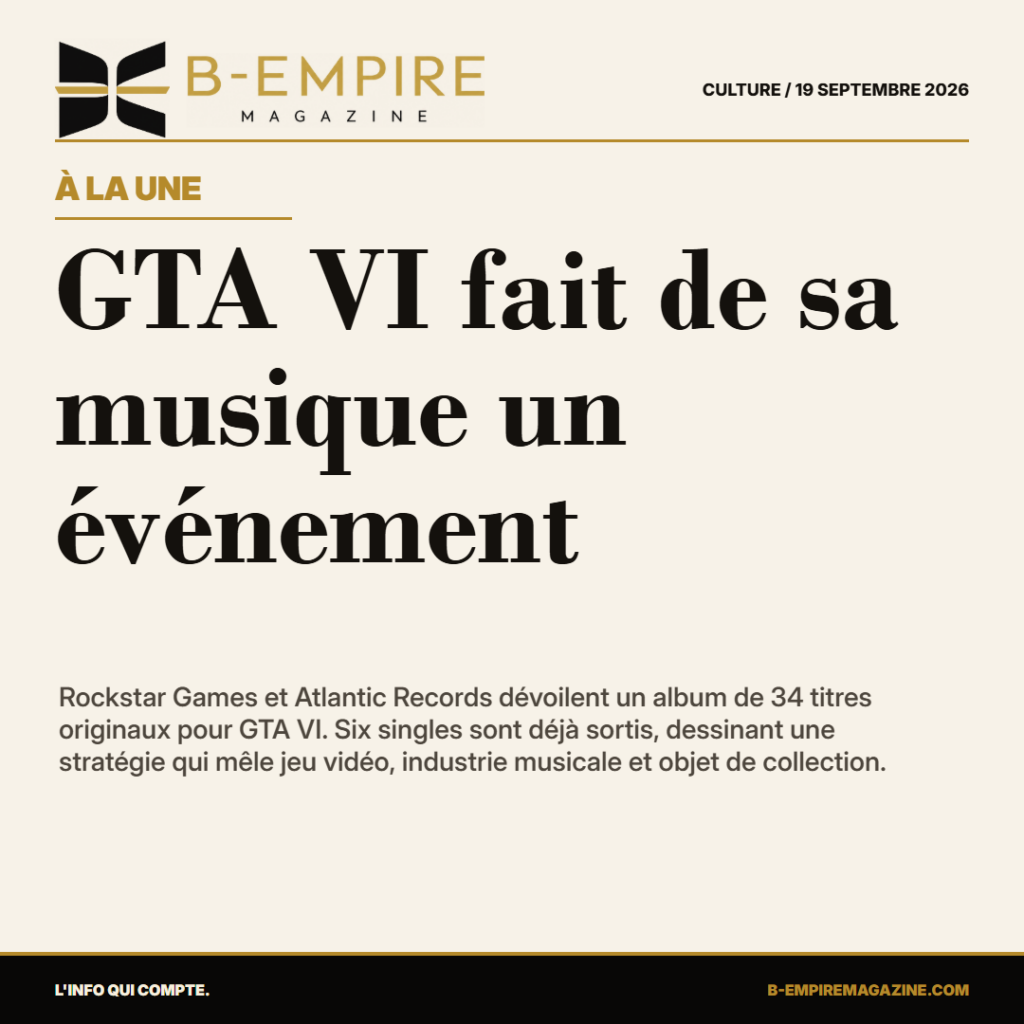
Grand Theft Auto VI is building its soundscape before the game even arrives. Rockstar Games and Atlantic Records have announced Grand Theft Auto VI: The Album, a 34-track collection of original music due on November 19, the same day as the game. Six songs are already available. This opening release is more than a promotional add-on: it shows how a gaming franchise can launch an entire music season, bring distant audiences together and turn its soundtrack into a cultural product in its own right.
Six singles open the gates to Vice City
The first sample makes a virtue of contrast. Yung Lean shares “That’s It” with Future and Metro Boomin. Travis Scott delivers “RHYNO,” produced by Guy-Manuel de Homem-Christo. “Sexy Magic” brings together CA7RIEL & Paco Amoroso, PinkPantheress, Fred again.. and Etienne de Crécy. Morgan Wallen, Rauw Alejandro and Keith Richards complete the first wave with “Last Thing You Need,” “Macacoa 2000” and “Bright Lights, Big City.”
The selection works like a map rather than a display of star power. Rap, electronic pop, country, Latin music and historic rock coexist without being flattened into one genre. Rockstar is not imposing a single color; it is composing an imaginary city through contrasts. Vice City and the fictional state of Leonida become places listeners can begin to explore through sound two months before they can enter them through play.
The album is no longer merchandise
The distinction matters. A conventional compilation often follows a film or game after the main work has established its identity. Here, all 34 songs are presented as original creations connected to the world of GTA VI. The record is therefore not merely archiving music heard elsewhere. It is participating in the construction of the setting alongside the interactive radio, dynamic score and other musical systems that Rockstar has yet to reveal in detail.
That structure gives Atlantic Records a role deeper than distribution. The label is assembling a global cast, coordinating individual releases and placing the project inside the music industry‘s familiar machinery: platform pre-saves, successive singles, physical formats, exclusive editions and artist-led storytelling. Rockstar gains twice. The GTA brand occupies music feeds before launch, while every performer brings a separate community into the event.
A campaign running on several calendars
Releasing six songs at once turns the announcement into an immediate experience. Audiences receive more than artwork or a promise: they can already listen, compare, share and argue. The move shortens the distance between communication and the work itself. It also creates several editorial cycles before November, because each track can generate its own video, performance, social trend or chart story.
The game and the album nevertheless follow different distribution logics. GTA VI will be sold for PlayStation 5 and Xbox Series X|S, while the songs travel through major streaming services and physical products available without a console. Music becomes the franchise’s most open layer. Someone can enter the world through Travis Scott or Rauw Alejandro without following gaming news; a player can discover Keith Richards or an unexpected electronic collaboration by moving in the opposite direction.
The spectacular return of the physical object
The strategy does not rely on streaming alone. The album will be offered on CD and through several vinyl pressings, including a liquid-filled edition, a splatter version and variants reserved for individual retailers. Each object carries GTA VI’s visual language into collectible culture. The record becomes a tangible fragment of a launch that is otherwise overwhelmingly digital.
The range of editions reveals a precise business model: convert anticipation into value without revealing the game itself. Collectors buy cover art, vinyl colors, posters and the promise of belonging. The price no longer pays only for listening, which is available elsewhere, but for scarcity, presentation and the status of owning an artifact attached to one of the year’s most closely watched entertainment releases.
When a soundtrack becomes brand infrastructure
Grand Theft Auto has long understood that radio can give texture to a virtual city. It accompanies travel, shapes the rhythm of a mission and summons an era inside a car. With this album, Rockstar extends that idea beyond the screen. Music establishes the game’s cultural setting before launch and will probably continue to live through playlists, clubs and collections long after the first playthrough.
The partnership also illustrates a convergence that now sits at the center of the entertainment economy. Labels want stages capable of breaking songs; game publishers want artists who can anchor fictional worlds in the present. The two industries are no longer simply exchanging licenses. They are co-producing moments, objects and conversations designed to travel from one platform to another.
A full-scale test for the industry
The true measure will not be only the streaming numbers earned by the first six singles. The industry will watch whether the record can stand as a collective work, whether individual songs become hits independently of the game and whether the promised diversity adds up to a coherent identity. The challenge is substantial: an enormous lineup can command attention, but it cannot guarantee that 34 tracks will tell a story.
For now, Rockstar and Atlantic have completed the first move: they have made GTA VI a major talking point without showing another mission, while giving audiences something real to hear. Music is no longer scenery placed behind the action. It is the first street of Vice City to open, a space where the fictional universe has already begun to meet the real world.