


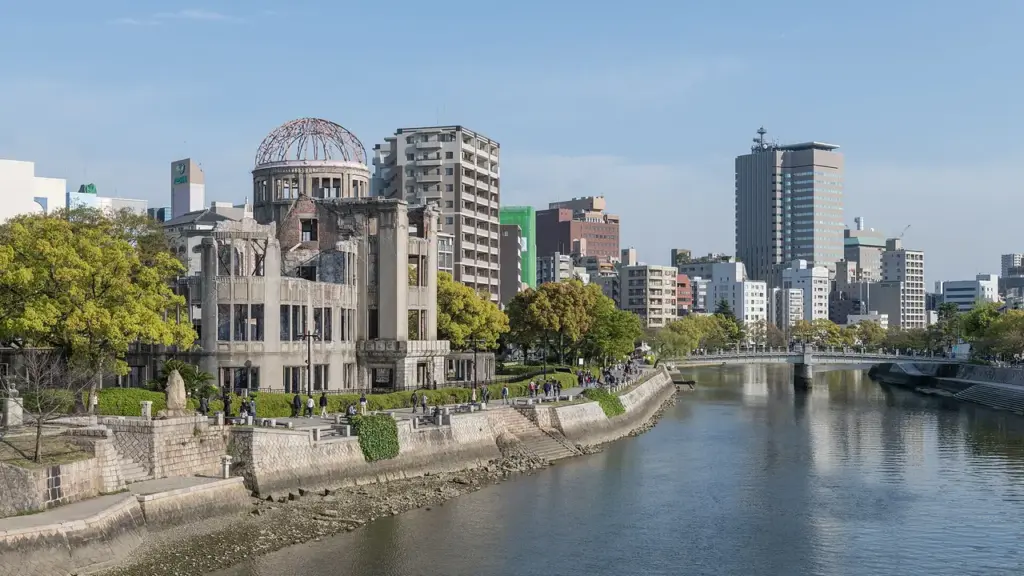
At 8:15 AM on August 6, a bell will toll in Hiroshima, placing the world before a question it often prefers to postpone. Eighty-one years after the atomic explosion that devastated the Japanese city, the 2026 ceremony will not only pay tribute to the victims. It will take place in an era marked by rearmament, war in Europe, crises in the Middle East, and the resurgence of nuclear deterrence at the center of power discourses.
The city of Hiroshima has confirmed a ceremony at the Peace Memorial Park on Thursday, August 6, from 8:00 AM to 8:50 AM. Approximately 7,000 seats will be set up at the main site, with an additional 2,200 in two rooms connected to the ceremony. The moment of silence at 8:15 AM corresponds to the exact time the American bomb exploded over the city on August 6, 1945.
A 50-Minute Ceremony Transformed into a Global Message
The protocol announced by Hiroshima is precise: the registry of victims will be presented, flowers will be laid, a silent prayer will be offered, the peace bell will be rung, the mayor will make a statement, doves will be released, and commitments from younger generations will be made. This sequence of gestures may seem immutable. However, their significance changes with the state of the world. In 2026, each symbol will be interpreted through the lens of military tensions and the weakening of international arms control mechanisms.
The official update published by the city on August 3 confirms that the event is treated as a major diplomatic and security appointment. Access to the park will be strictly controlled, with baggage inspections and metal detectors. The solemnity of the ceremony contrasts with an international environment where nuclear threats, once considered a language of exception, are re-emerging in public statements.
140,000 Deaths and a Memory Losing Its Last Witnesses
The bomb dropped on Hiroshima destroyed the city and caused approximately 140,000 deaths by the end of 1945, according to the commonly accepted historical toll. Three days later, Nagasaki was struck in turn, resulting in about 70,000 deaths. These figures include those killed instantly and those who later died from their injuries or the effects of radiation.
However, the challenge of 2026 goes beyond preserving a toll. The hibakusha, the survivors of the atomic bombings, are aging rapidly. At the 80th anniversary in 2025, their average age exceeded 86 years. The gradual disappearance of direct witnesses creates an urgency: to transform their narratives into active memory, transferable to generations who have known the bomb only through books, films, or museums.
This is why the National Peace Memorial is organizing readings of testimonies on August 5 and 6, 2026. The fight against forgetfulness now involves families, teachers, archivists, artists, and young peace ambassadors. The danger is not only that the facts disappear but that they become so abstract that they lose their capacity to alert.
Why Hiroshima’s Warning Resonates Stronger in 2026
The commemoration comes after the 2026 Review Conference of the Treaty on the Non-Proliferation of Nuclear Weapons, a cornerstone of the international system. In New York, Hiroshima, Nagasaki, the International Atomic Energy Agency, states, and civil society organizations presented their initiatives. This diplomatic activity reveals a deep contradiction: the expressed desire to limit danger coexists with the modernization of arsenals and the persistent reliance on deterrence.
The previous year, the mayor of Hiroshima warned that the growing acceptance of military reinforcements threatened the peace frameworks built over decades. Nihon Hidankyo, the Japanese survivors’ organization awarded the Nobel Peace Prize, also stressed the dwindling time left to convey lived experiences and convince nuclear powers.
Japan at the Heart of a Strategic Contradiction
Japan is the only country to have suffered atomic bombings in wartime, yet it remains protected by the American nuclear umbrella. This reality fuels an ongoing debate. Survivors and activists regularly urge Tokyo to sign and ratify the Treaty on the Prohibition of Nuclear Weapons. The Japanese government responds that the country’s security still depends on its alliance with Washington in a region where China, Russia, and North Korea weigh heavily on military balance.
Hiroshima thus exposes the fracture between moral idealism and strategic calculation. Japan seeks to carry the memory of the catastrophe while remaining within a deterrence system. This tension is not solely Japanese; it also permeates European democracies, which advocate long-term disarmament while reinforcing their security in the face of current crises.
France and Europe: A Memory That Speaks Directly to the Security of the Continent
For France, a nuclear power and permanent member of the UN Security Council, the message of Hiroshima strikes at the heart of its defense doctrine. Paris presents its deterrence as strictly defensive and linked to the protection of vital interests. However, France also participates in discussions on non-proliferation, risk reduction, and the prevention of uncontrolled escalation.
The European debate has become more concrete since the return of high-intensity warfare on the continent. How to ensure security without trivializing the idea that a nuclear weapon could be used? How to preserve channels of dialogue when treaties weaken? And how to prevent new states from concluding that only the bomb guarantees their survival? Hiroshima does not provide a simple answer but compels us to ask these questions candidly.
A Cultural Battle as Much as a Diplomatic One
The transmission of memory is no longer played out solely in international summits. It unfolds on video platforms, in classrooms, museums, and popular works. As witnesses disappear, archival images and recorded narratives become the first encounter for millions of young people with Hiroshima. Their presentation must remain accurate, human, and accessible.
The risk of misinformation is real. Social media can reduce history to a confrontation of slogans, erase civilian victims, or use the catastrophe to justify contemporary violence. A robust memory must hold together multiple truths: the responsibility for the American bombing, the immense suffering of civilians, the militarism of imperial Japan in Asia, and the universal demand to prevent any repetition.
The Signal That the World Can No Longer Treat as a Ritual
On August 6, global attention will rest for a few minutes on Hiroshima. Then governments will return to crises, military budgets, and power dynamics. The true significance of the ceremony will depend on what remains after the doves have flown: concrete commitments to reduce risk, protect treaties, maintain dialogue, and convey the voices of survivors.
Eighty-one years later, Hiroshima does not belong to the past. The city is a mirror held up to our time. It reminds us that a technology presented as an instrument of power can, in a matter of seconds, transform an entire population into victims. In a world that is beginning to speak of the bomb with alarming familiarity, the silence at 8:15 AM could be the most powerful message of the week.
Sources
- City of Hiroshima, official program of the ceremony on August 6, 2026, timings, locations, and capacity.
- City of Hiroshima, update from August 3, 2026, on participants and security measures.
- National Peace Memorial of Hiroshima for the Victims of the Atomic Bomb, readings of testimonies scheduled for August 5 and 6, 2026.
- Associated Press, report on the 80th anniversary, historical figures, age of survivors, and diplomatic issues.
- United Nations, official calendar of initiatives presented at the 2026 NPT Review Conference.