


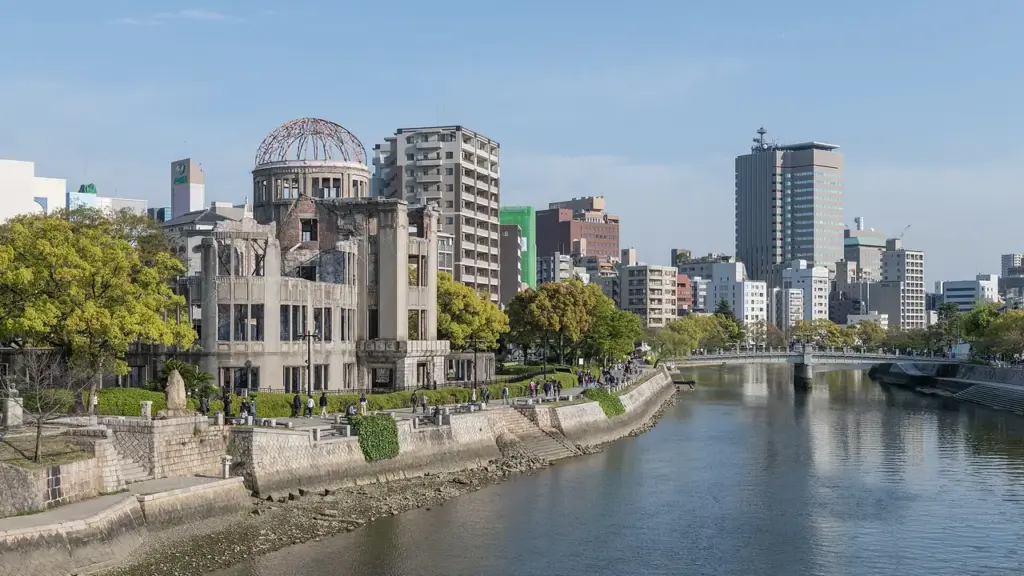
At precisely 8:15 AM, the Peace Bell rang in Hiroshima, confronting the world with a truth it often prefers to sidestep: a nuclear weapon is not a strategic abstraction, but the capacity to obliterate a city and its inhabitants in mere seconds. On this August 6, 2026, 81 years after the American atomic bombing, the ceremony held at the Peace Memorial Park took on the form of a planetary warning. As deterrence regains a central place in power discourses, Hiroshima urges that security should never be confused with the normalization of the unthinkable.
Approximately 50,000 people and representatives from nearly 120 countries and territories, including the United States and Iran, were expected, according to the Associated Press. This number lends a diplomatic dimension to the commemoration, but its moral center lies elsewhere: in the voices of the hibakusha, the survivors of the bomb, whose ranks diminish each year. Their message is not solely about 1945; it directly questions the political choices of 2026.
Hiroshima, 81 Years Later: A Ceremony Focused on the Present
The official proceedings maintained the sobriety characteristic of significant memorial events: the laying of a register bearing the names of the victims, the offering of flowers, a moment of silence, the Peace Bell, a declaration by the mayor, the release of doves, and a commitment made by children. At 8:15 AM, the exact time the bomb was dropped on August 6, 1945, the city came to a standstill.
The bombing destroyed Hiroshima and caused the deaths of approximately 140,000 people by the end of 1945. Three days later, a second bomb struck Nagasaki, where around 70,000 people perished. Japan announced its surrender on August 15, after years of war and aggression in Asia. It is essential to recall these facts together: memory must neither erase the context of war nor diminish the human reality of the atomic weapon.
The Mayor Denounces the Return of the Logic of Force
In his peace declaration, Mayor Kazumi Matsui criticized the major powers that continue to wage wars and present the possession of nuclear weapons as a realistic method of deterrence. His reasoning is clear: minimizing the inhumanity of these weapons and accepting force as an instrument of prosperity perpetuates cycles of retaliation capable of leading to a new Hiroshima or a new Nagasaki.
This statement transcends the annual ritual. It aims for a shift in global vocabulary. When nuclear weapons are described solely in terms of warheads, missile ranges, or strategic credibility, their concrete consequences vanish behind concepts. Hiroshima places bodies, families, and the city at the center of the debate. This is precisely what makes its message difficult to ignore.
In Japan, the Three Non-Nuclear Principles Under Pressure
The commemoration also occurs at a sensitive moment for Japan. Prime Minister Sanae Takaichi, attending the ceremony for the first time as head of government, promised a “realistic” approach to prevent the use of nuclear weapons within the framework of the non-proliferation treaty. However, she did not make an explicit commitment to preserve the three non-nuclear principles of the country unchanged.
Adopted after the war, these principles consist of not possessing, not producing, and not allowing the introduction of nuclear weapons on Japanese territory. The possibility of a review of the third principle fuels concerns. Japan remains protected by the American nuclear umbrella while carrying the memory of the only two cities destroyed by atomic bombs in wartime. This tension between pacifist memory and strategic calculation is becoming increasingly visible.
The Voice of the Hibakusha in a Race Against Time
Japan now counts 91,105 officially recognized survivors, according to figures reported by the Associated Press, which is about a quarter of the initial number. Their average age exceeds 86 years. Many were children in 1945; the youngest sometimes have only fragmented memories of the explosion and its aftermath. Thus, the transmission of their experiences faces a biological urgency: soon, the history will have to be carried on without direct witnesses.
This gradual disappearance changes the responsibility of subsequent generations. Archives, objects, filmed narratives, museums, and education cannot replicate an encounter with a survivor, but they can prevent the event from being reduced to a mere date. Hiroshima has been working for decades to transform individual memory into a culture of peace. In 2026, this effort appears less as a tribute to the past than as an infrastructure of vigilance for the future.
The UN Calls for Making Nuclear Use Unthinkable
In a written message, United Nations Secretary-General António Guterres reminded that the horror of nuclear weapons is only part of the lesson of Hiroshima. The other part is to build a world where their threat or use becomes unthinkable. He presented the city as an example of resilience and called for choosing dialogue, cooperation, and common security.
The word “unthinkable” is crucial. The risk does not begin when a leader presses a button. It increases when public opinion becomes accustomed to hearing about tactical use, controlled escalation, or limited nuclear war. None of these terms erase the radiation, fires, collapse of health services, and cross-border effects. Thus, the battle of Hiroshima is also a battle against the normalization of language.
Why France is Directly Concerned
France cannot observe this debate as a mere spectator. As a nuclear power, a permanent member of the UN Security Council, and a major military actor in Europe, it bases part of its security on deterrence. At the same time, it defends the non-proliferation treaty and the goal of general disarmament under conditions of sufficient international security. Hiroshima compels the maintenance of these two dimensions in the same conversation.
The issue also touches on the French memory of nuclear tests in Algeria and Polynesia. The health, environmental, and political consequences of these campaigns continue to fuel demands for recognition and compensation. Keeping the warning of Hiroshima alive means listening to Japanese victims, but also closely examining the responsibilities and nuclear legacies specific to France.
A Global Warning, Not an Automatic Commemoration
The risk of anniversaries is that they become predictable: a minute of silence, a few speeches, then a return to the ordinary cycle of news. However, the message of this 81st commemoration is precisely that the ordinary has changed. Wars, rivalries between powers, the weakening of control mechanisms, and the aging of the last witnesses create a dangerous combination.
Hiroshima does not ask the world to look back reflexively. It asks it to look ahead with clarity. As long as states consider nuclear weapons as the ultimate guarantee of their survival, abolition seems distant. But accepting this distance as a fatality would mean abandoning the most concrete lesson of August 6, 1945: behind every doctrine, there exists a real city, a real population, and a point of no return.
Sources
- Associated Press â 81st anniversary ceremony, statements and context, August 6, 2026
- City of Hiroshima â official program of the 2026 Peace Memorial ceremony
- City of Hiroshima â archives and presentation of the annual Peace Declaration
- United Nations â statements by the Secretary-General on peace and disarmament