


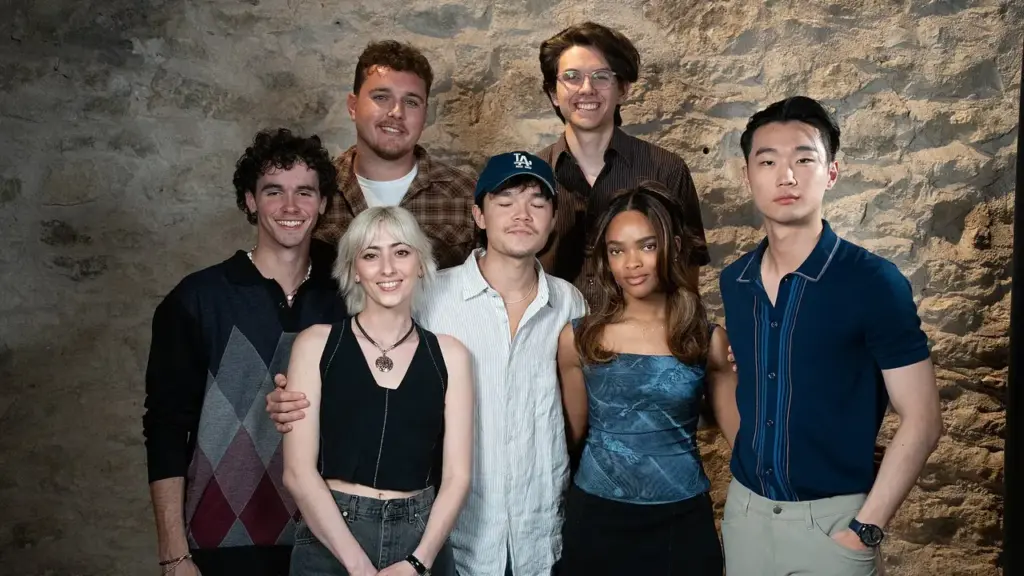
On August 21, 2026, It Ends arrives in theaters through Neon, and this release looks less like a simple distribution date than a very readable test for independent genre cinema. The film, the feature debut written and directed by Alexander Ullom, follows four young graduates whose post-college plans derail when a wrong turn traps them on a backroad that never ends. SXSW presented it in its 2025 Narrative Feature Competition with a short and formidable promise: four friends, one road, no exit. Neon is now taking that minimalist idea and turning it into a theatrical event.
The interest of It Ends lies in its simplicity. In a season crowded with franchises, digital effects and extended universes, the film sells an almost primitive fear: continuing to move forward without ever arriving. Decider notes that the title is not available on Netflix, Prime Video, Hulu or Shudder at the time of release, and that the only immediate access is the theater. That absence from streaming is not a detail. It gives the film rarity, framing and urgency. For a generation used to waiting for platforms, Neon places physical attendance back at the center of desire.
A Road as a Business Model
Horror cinema has long known that a strong concept can be worth more than a spectacular budget. A house, a camera, a forest, a phone, a videotape, a smile: the genre has often built its successes on a clear idea the public can retell in one sentence. It Ends belongs to that family. The endless road becomes an ideal marketing argument because it is immediately visual, anxious and shareable. It promises a device that is easy to understand, but abstract enough to generate interpretation.
This kind of film is particularly interesting for Neon. The distributor has built part of its prestige on works able to circulate between cinephilia, social conversation and commercial efficiency. Independent horror offers a high cultural return: it can launch through mystery, feed on theatrical reactions, travel through trailer excerpts and settle into fan debate. With It Ends, the company is not only selling a film. It is selling the impression of entering a phenomenon early.
The Unease of a Stalled Generation
The premise also works because it speaks to its moment. Four young graduates stuck in a path with no way out: it is difficult not to hear a generational metaphor. The post-college period should be a moment of openness, choice and departure. Here, it becomes a loop. The road promises autonomy, but produces confinement. The vehicle becomes room, border and survival ritual. The American space most symbolically associated with freedom turns into a mental corridor.
That is where the film can exceed a simple exercise in style. The most effective contemporary horror does not merely make a threat appear. It organizes an unease already present in the culture. In It Ends, the fear is not only being attacked by what emerges at the side of the road. It is realizing that movement itself no longer guarantees anything. Moving forward is not enough. Leaving no longer saves. Travel, traditionally associated with maturation, becomes repetition without reward.
The Word-of-Mouth Wager
For a distributor, a film like It Ends rests on a delicate equation. It has to say enough to attract, but not too much to preserve the experience. The trailer, amplified by Neon and specialized outlets such as Fangoria, emphasizes the nightmarish and almost existential character of the project. The vocabulary around the film speaks of road movie, hangout horror and nightmare without horizon. That framing is precious because it sells an atmosphere rather than a simple monster.
Word of mouth can then do its work. Viewers do not leave only saying whether they were scared. They explain what the road means, how the film handles time, whether the characters’ routine becomes comic, sad or terrifying, and whether the ending answers or refuses to answer. Concept-driven genre films win when they provoke this kind of conversation. The spectator becomes commentator, then recruiter.
Why Theaters Still Matter
The theatrical release gives It Ends an advantage that streaming would have diluted. On a platform, the film would be one thumbnail among hundreds, consumed between two notifications and perhaps abandoned after twenty minutes. In a theater, the endless road imposes its duration. The viewer is captive with the characters. They share the dark, the silence, the nervous laughter and the breathing of the audience. For a work built on confinement, that collective constraint becomes almost part of the device.
This strategy reminds us that independent cinema does not only need to be available. It needs to be situated. A date, a theater, a poster, a trailer, a conversation after the screening: all of this manufactures value. Neon understands that. The platform market remains essential, but the identity of a genre film is often forged before streaming, in that short window where the public feels it is discovering something that has not yet been fully absorbed by the algorithm.
A First Film Under Watch
Alexander Ullom arrives with the particular exposure of a first feature noticed by a festival and then taken on by a highly identifiable distributor. His professional site already gathers several interviews around the film and his idea of hangout horror. That expression is interesting: it suggests a cinema where fear is not born only from shock, but from time spent with the characters. The public is not watching only four potential victims. It is spending time with a small community trying to make the absurd inhabitable.
In the current genre economy, that positioning can become a signature. Horror audiences are not looking only for efficient mechanics. They are looking for voices, angles and textures. If It Ends succeeds, Ullom will not simply be the director of a good concept. He can be perceived as a filmmaker capable of turning waiting, conversation and emptiness into dramatic material.
What to Remember
It Ends arrives at a moment when independent horror continues to play a disproportionate role in the cultural health of cinema. It takes risks at controlled cost, reveals new authors, produces simple but durable images and reminds audiences that people still like to travel for a precise experience. Neon is betting here on a very pure idea: a road that does not end, young people who no longer know how to get out, and a theater that turns that dead end into a collective ritual.
The film will not win only through mystery. It will win if it manages to make us feel that the era itself sometimes moves this way: fast, long, with no guarantee of arrival. That is the strength of the best genre films. They speak of a monster, a road or a threat, but they end up describing modern life with a precision that realism does not always dare to reach.
Sources
- Neon – In Theaters / Coming Soon, accessed August 21, 2026.
- SXSW – Film & TV Lineup 2025, It Ends, accessed August 21, 2026.
- Decider – Is the It Ends Horror Movie Streaming?, August 20, 2026.
- Fangoria – New It Ends trailer teases the horror hangout movie of the summer, July 22, 2026.
- Alexander Ullom – official site, accessed August 21, 2026.