


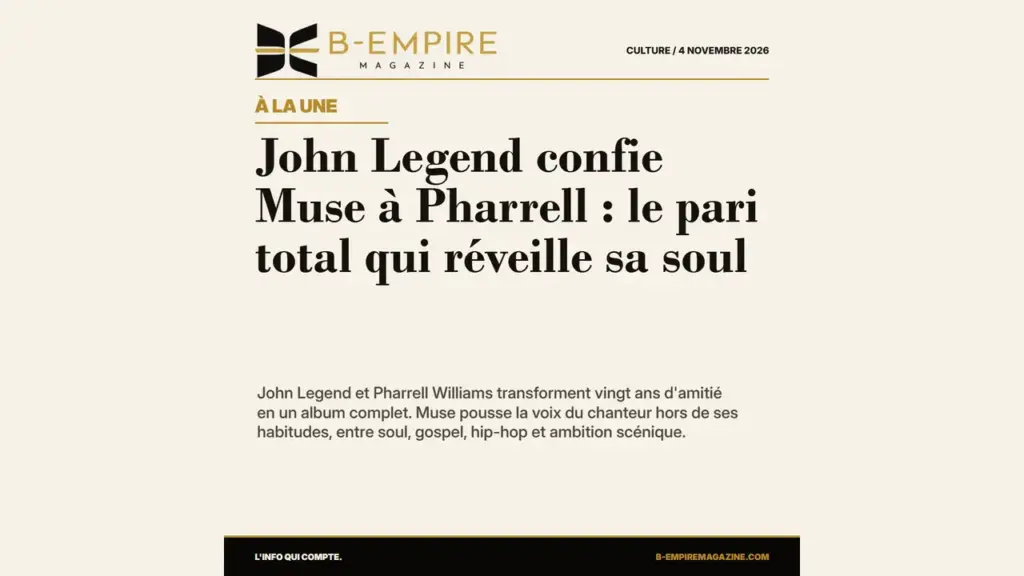
John Legend could have chosen safety: a piano, a sweeping ballad and a voice recognized within seconds. On Muse, released October 23, he does the opposite. The American singer gives all sixteen tracks to Pharrell Williams, who produces the entire project and co-writes the album. After more than twenty years of friendship, the two artists are not delivering a prestige cameo. They are testing what happens when an established voice agrees to change its frame, rhythm and, at times, its very way of singing.
A full album, not a luxury guest appearance
The defining feature of Muse is its method. Pharrell does not contribute two attention-grabbing singles; he builds the sound from beginning to end. John Legend’s official website confirms a sixteen-song track list, with several vocal appearances by Pharrell and a Clipse feature on “Bodies On The Floor.” Universal Music describes the record as a journey through traditions of Black music, including gospel, standards, doo-wop, classic soul, Afrobeat and hip-hop.
That unity creates a clear tension. Legend remains recognizable, but he cannot rely only on the force of his baritone. In an Associated Press interview, he explains that Pharrell sometimes pushed him toward a more conversational delivery. The idea sounds modest, yet it reaches the center of his public identity. Since “Ordinary People” and “All of Me,” his name has been linked to vocal power and piano balladry. Here, the producer also asks him to leave room for rhythm, texture and silence.
Pharrell turns a familiar voice into new material
The project grew from “The Birds Don’t Sing,” a Clipse track featuring Legend. According to the AP, that performance convinced Pharrell that a whole album could be built around the singer’s voice. Much of Muse was then recorded at Pharrell’s studio inside Louis Vuitton’s Paris headquarters. The setting links music, fashion and art direction: this record is designed less as a collection of unrelated songs than as one carefully composed environment.
The single “Daylight” opened that door in September and pointed toward a sound less fixed in romantic balladry. “Pray For Ya,” heard within the Louis Vuitton creative universe before the album arrived, brings gospel energy. “Bodies On The Floor” places Clipse inside a narrative where the language of conflict describes a relationship damaging itself. Elsewhere, “Fireflies,” “Next Time” and “Sail Off” move the record from memory to repair and finally toward a measure of calm.
Hip-hop is not a detour in Legend’s career
To a broad audience, John Legend is still the singer of weddings, television competitions and grand romantic gestures. That image hides part of his history. He emerged in direct contact with hip-hop and has worked with Kanye West, Lauryn Hill, Jay-Z, Rick Ross, Nipsey Hussle and many other rappers. In the AP interview, he recalls Jay-Z once telling him, “You’re our voice.” Muse therefore does not bolt rap onto a crooner’s career. It brings forward a lineage that has been present since the beginning.
Clipse’s presence matters in particular. Pusha T and Malice represent sharp, rhythmic writing historically tied to Pharrell’s production. Their arrival in the middle of a John Legend album creates contrast and continuity at once: the same producer, the same attention to diction and the same refusal to treat the voice as decoration. Legend does not become a rapper. He steps into a hip-hop architecture that forces his soul music to move differently.
A calculated refusal of nostalgia
The bet is risky because both men own enormous catalogs. They could have sold the project through early-2000s nostalgia. Instead, they confront their experience with the present. Pharrell now leads Louis Vuitton menswear creative direction while continuing his music career; Legend, already an EGOT winner, no longer needs to prove his legitimacy. The challenge becomes artistic: preventing mastery from hardening into comfort.
Legend puts the point plainly. He refuses to rest on past achievements and wants every project to have the possibility of being his best. That ambition does not guarantee that every song will satisfy every listener. It does explain the choice of one producer who can own both the triumphs and the rough edges. At a time when major albums often stack teams and credits, Muse claims an almost classical coherence.
A chapter larger than the album
The release arrives alongside another creative risk. Legend is composing his first original stage score for Imitation of Life, a musical headed to The Shed in New York. The work revisits a story about race, identity and the position of Black women, with a creative team seeking to place Delilah at its center. The proximity of the two projects shows an artist widening his language rather than a singer merely promoting another album.
For Pharrell, Muse also operates as a bridge across worlds: studio craft, fashion, gospel, rap and adult pop. The most interesting question may not be whether the album can repeat the immense success of “All of Me.” It is whether two stars who could easily rely on familiar formulas can make a total, exposed and identifiable collaboration matter. In an industry obsessed with the viral track, that decision restores value to the album as a long conversation.
What Muse ultimately signals
Muse contains sixteen tracks produced by Pharrell Williams, with appearances from Pharrell and Clipse. It does not erase John Legend’s voice; it places that voice back inside a broader history where soul speaks with hip-hop, gospel and Afrobeat. The record deserves attention because it embodies a rare choice: putting an already decorated career back into motion without denying what built it. This is not a theatrical rupture. It is a controlled transformation, and perhaps proof that after two decades, surprise is still possible.