


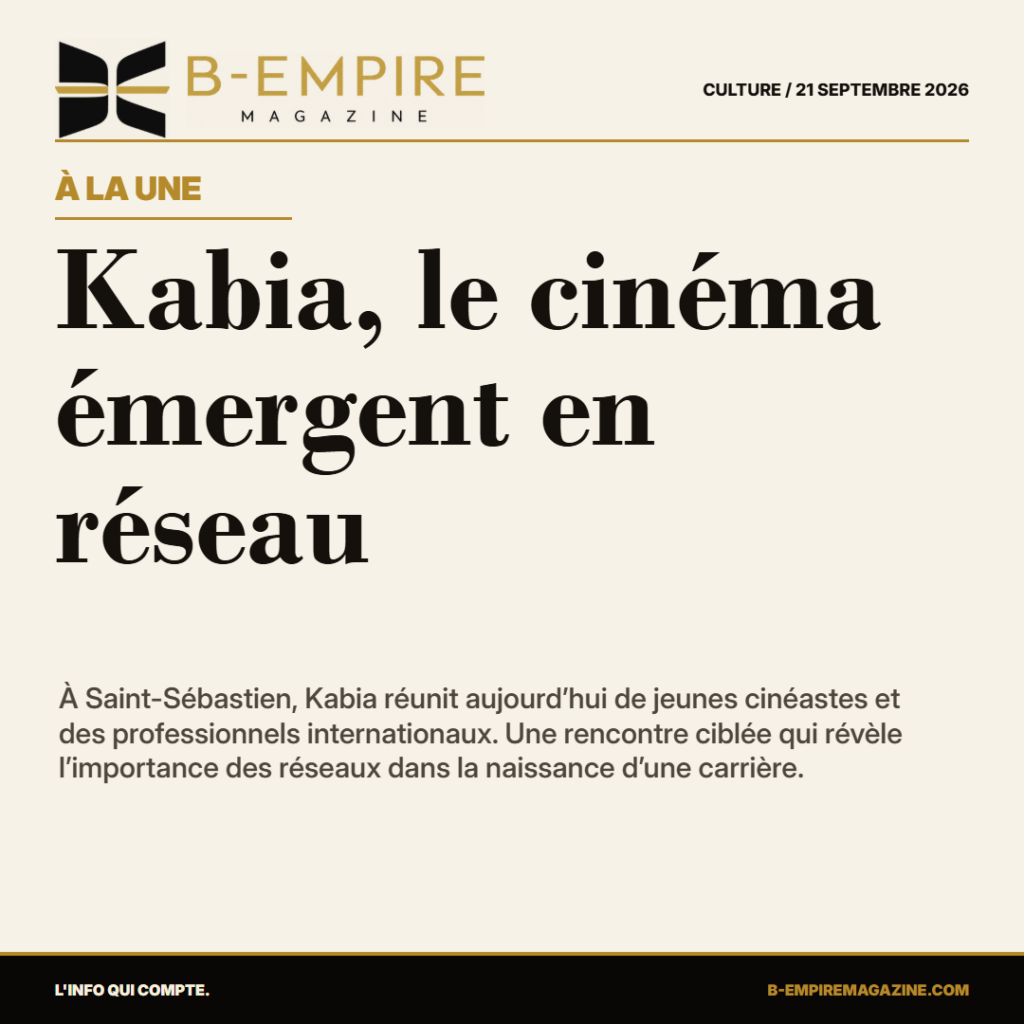
In cinema, a first film can reveal a voice; it does not always open the door to a career. On September 21, the San Sebastian Festival, Tabakalera and the Elías Querejeta Zine Eskola are holding the fourth edition of Kabia, a gathering designed to connect young filmmakers directly with professionals from the international industry. Two hours of discussions at Tabakalera’s Film and Audiovisual Lab will be followed by an evening reception.
The programme is deliberately focused and available by invitation. It brings together teams behind the fourteen short films selected for Nest, the Festival’s film-school competition, residents from Ikusmira Berriak, participants in Noka and 2deo Serieak, students from the Elías Querejeta school and filmmakers from other international training and development programmes.
The invisible link between school and market
Festivals are often understood through red carpets, competitions and awards. Yet another layer of activity takes place alongside them: project presentations, partner searches, meetings with programmers, feedback on scripts and first conversations with funders. For a filmmaker at the beginning of a career, this professional layer may matter as much as a public screening.
Kabia concentrates that function in a setting built for emerging talent. Announced guests include representatives from Torino Film Lab, Les Arcs, the Sarajevo Festival, Cannes Critics’ Week and the Berlinale, together with professionals responsible for funding, production and international promotion. The point is not simply to exchange contact details, but to understand how a project enters the international circulation of cinema.
The format allows participants to present their work, receive feedback and identify the programme best suited to the next step. A short film may lead to a residency; a residency may strengthen a first feature; a laboratory may help with rewriting, production or finding co-producers. Such continuity is essential in an industry where projects often develop over several years.
Nest has become an international talent pool
The 2026 edition of Nest received 503 short films produced at 232 schools in 61 countries, a record for the section. Fourteen works were selected. They explore family relationships, identity, displacement, desire, new masculinities, rural childhood and gender-based violence through forms ranging from fiction to essays and non-fiction.
Since its creation in 2002, Nest has welcomed more than one thousand filmmakers. Several former participants later presented feature films in San Sebastian and at other major festivals. That record does not mean selection guarantees a career. It shows instead that a student showcase becomes more valuable when it combines exposure, critical conversation and access to professional networks.
This year’s films also compete for the €10,000 Tabakalera Film and Audiovisual Lab-Nest Award. The amount can be decisive for a short film or an initial stage of development, but Kabia’s introductions answer a different need: building a path beyond one project.
An ecosystem operating throughout the year
Tabakalera does not limit its work to the Festival week. Its laboratory supports projects through residencies, workshops, presentations, technical resources and workspaces. Ikusmira Berriak supports the development of film projects; Noka notably accompanies emerging women directors; 2deo Serieak focuses on talent and projects for series.
This architecture matters. A single event can produce a fortunate conversation, but a lasting ecosystem allows filmmakers to return to the work, test a new version and gain access to other skills. The Festival adds an international window to that local, year-round support. Projects may also use a video-pitch initiative on San Sebastian’s online professional platform to broaden their visibility.
The model addresses a familiar weakness in independent cinema: talent is plentiful, but career routes are not equally legible. Knowing which lab to approach, how to present a film, when to seek a co-production or how to turn a short into a feature project requires social and professional capital that not every school or family can provide.
A network should remain a door, not a filter
Invitation-only access protects the quality of the conversations, but it also exposes the limit of every networking programme: those who are not selected remain outside. Transparent criteria, varied profiles, geographical openness and follow-up after the event are therefore essential. Otherwise, a network intended to reduce inequality may reproduce the same closed circles.
Kabia should consequently be judged less by the number of meetings than by what they make possible: a residency secured, a script strengthened, a producer found, a film distributed more effectively or a durable collaboration formed. Its fourth edition confirms a wider evolution among major festivals. They no longer want only to present completed works; they are moving earlier, into the fragile moment when a perspective becomes a project and a project tries to become a career.