


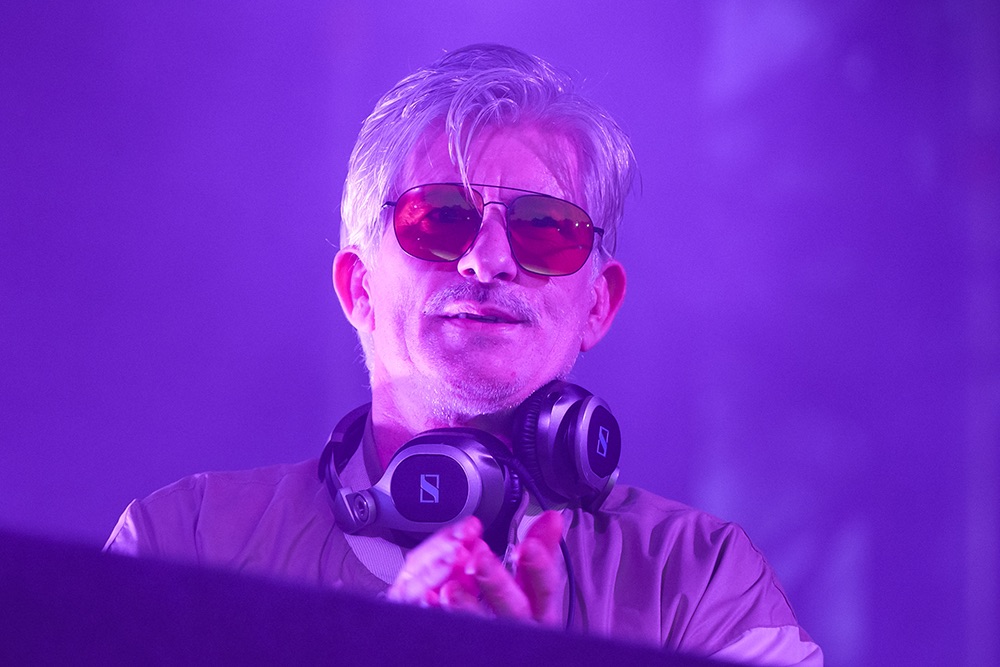
French electronic music has just lost one of its most mysterious figures. Kavinsky, whose real name was Vincent Belorgey, was found dead at his Paris home at the age of 50. The artist behind ‘Nightcall’, a track that has become inseparable from the film Drive and was heard by the entire planet during the closing ceremony of the Paris 2024 Olympics, leaves behind a brief yet immense legacy. An investigation into the causes of his death has been opened, with no suspicious elements reported at the scene by first responders, according to the Paris prosecutor’s office as cited by the Associated Press and Le Monde.
The news extends far beyond the French electro scene. It touches Hollywood, synthwave enthusiasts, the generation of the 2010s, and all those who have experienced a car speeding through the night to the sound of that hypnotic bass line. Kavinsky achieved one of the rarest feats in pop culture: creating a track that is instantly recognizable, capable of surviving its era and being reborn with each new image.
Kavinsky Found Dead in Paris: What We Know
Vincent Belorgey was found dead on the evening of Tuesday, July 28, 2026, at his Paris home. The Paris prosecutor’s office confirmed the opening of an investigation to determine the cause of death. Initial findings revealed no suspicious elements, reported the Associated Press and Le Monde. At this stage, no official cause should therefore be put forward.
This caution is essential. In the hours following the death of a public figure, social media often generates hypotheses faster than authorities can establish the facts. The only reliable framework remains that communicated by the prosecutor’s office: an investigation is underway, and the precise circumstances are not yet known.
Official tributes immediately highlighted Kavinsky’s unique place in contemporary musical heritage. President Emmanuel Macron hailed him as a source of French pride, while Culture Minister Catherine Pégard referred to a singular voice whose music will continue to transcend generations and borders. These reactions encapsulate the Kavinsky paradox: a discreet artist, almost hidden behind his persona, yet a bearer of a global sound.
‘Nightcall’, the Track That Changed His Destiny
Released in 2010, ‘Nightcall’ became the heart of Kavinsky’s universe. The track was produced with Guy-Manuel de Homem-Christo, a member of Daft Punk, and features the voice of Lovefoxxx, the singer from the Brazilian band CSS. Its restrained tempo, dark synthesizers, and the dialogue between a robotic voice and a human voice create a tension that is both romantic and unsettling.
A year later, the track opens Drive, the film by Nicolas Winding Refn starring Ryan Gosling. This association becomes historic. The nighttime road of Los Angeles, the neon lights, the driver’s jacket, and Kavinsky’s music merge to impose an aesthetic that will influence music videos, fashion, video games, and a segment of global electronic production.
‘Nightcall’ is not just a soundtrack hit. It is a gateway into a whole retro-futuristic imagination. The track helped bring synthwave out of its specialized communities and into popular culture. Years after its release, it continued to attract new listeners, proving that a track can become larger than its promotional campaign, its album, and even its era.
From French Touch to Global Synthwave
Kavinsky belongs to the great constellation of French Touch, alongside Daft Punk, Justice, Cassius, Air, and DJ Mehdi, while occupying a different territory. Where some built their identity around clubs, filtered house, or monumental shows, he invented a complete fiction. His character was a driver who died at the wheel of a Ferrari Testarossa in 1986, returned in zombie form to produce music.
This narrative, nourished by genre cinema, retro consoles, and car culture, provided immediate coherence to his covers, music videos, and performances. His first album, OutRun, released in 2013, took its name from the famous Sega racing game and transformed this mythology into a long electronic journey. The second, Reborn, released in 2022, marked his return after a long absence.
His influence lies precisely in this ability to connect multiple worlds. Kavinsky was French in his musical lineage, American in his cinematic imagination, Japanese in some visual references, and universal in the melancholy of his melodies. This combination explains why his work circulated so powerfully in Europe, America, Asia, and beyond.
The Paris Olympics: A Culmination Before the World
On August 11, 2024, Kavinsky appeared at the closing ceremony of the Paris Olympics at the Stade de France. ‘Nightcall’ was performed with Angèle and Phoenix, in front of a global audience. For an artist long protected by his sunglasses, illustrated covers, and fictional character, this moment felt like an open-air national recognition.
The performance also breathed new life into the track. TF1 Info reported the release of a recorded version with Angèle and Phoenix following the enthusiasm generated by the ceremony. Fourteen years after the original release, ‘Nightcall’ became a contemporary event once again. Few French electronic tracks have experienced such a long trajectory, spanning cult films, streaming platforms, and the Olympic stage.
In hindsight, that evening takes on a poignant dimension. It will remain the image of an artist receiving, in his own country, the tribute of a vast crowd and an international audience. It also showcases what France knows how to export best: a creation that does not renounce its strangeness or elegance to become popular.
A Legacy Greater Than a Discography
Kavinsky’s discography has never been abundant. It rests on several EPs, two albums, and a few iconic tracks. Yet, his significance is not measured by volume. He demonstrated that an artist could build a lasting cultural brand from a sound, a silhouette, and a perfectly aligned narrative.
This method preceded the current era where musicians think simultaneously about music, visual universes, storytelling, and digital communities. Kavinsky did not merely accompany images: his music seemed to already contain a film. This is why it found its place so naturally in cinema, advertising, video montages, and nighttime playlists around the world.
His journey also recalls France’s decisive role in the recent history of electronic music. After the Daft Punk wave, an entire generation proved that Paris could produce sounds capable of transforming global pop. Kavinsky extended this legacy without imitating his predecessors, choosing slowness, night, and nostalgia over mere dancefloor euphoria.
Why ‘Nightcall’ Will Continue to Resonate
Timeless songs are often those that leave space for the listener. ‘Nightcall’ tells of a presence in the darkness, a promise and a danger, without locking emotion into a single explanation. Each person can project a road, a separation, a city, or a memory onto it. This openness has allowed it to transcend languages and generations.
Kavinsky’s death transforms the listening experience today, but it should not reduce his work to sadness. His legacy remains that of a creator who made nostalgia dance and provided a soundtrack to modern night. From Paris to Los Angeles, from cinemas to stadiums, he proved that a French track could become a global language.
The final shot is therefore not one of silence. It is a road illuminated by neon lights, a pulse that returns, and that voice that millions of listeners recognize within the first few seconds. Kavinsky passes away at 50, but ‘Nightcall’ remains in motion. French Touch loses one of its most secret heroes; the world retains a music that seems designed never to see the dawn.
Sources
- Associated Press â confirmation of death, prosecutor’s investigation, and official tributes, July 29, 2026.
- Le Monde with AFP â known circumstances and Kavinsky’s journey, July 29, 2026.
- TF1 Info â new version of ‘Nightcall’ after the closing of the Paris Olympics, September 20, 2024.
- Universal Music â biography, ‘Nightcall’, OutRun, and Reborn.