


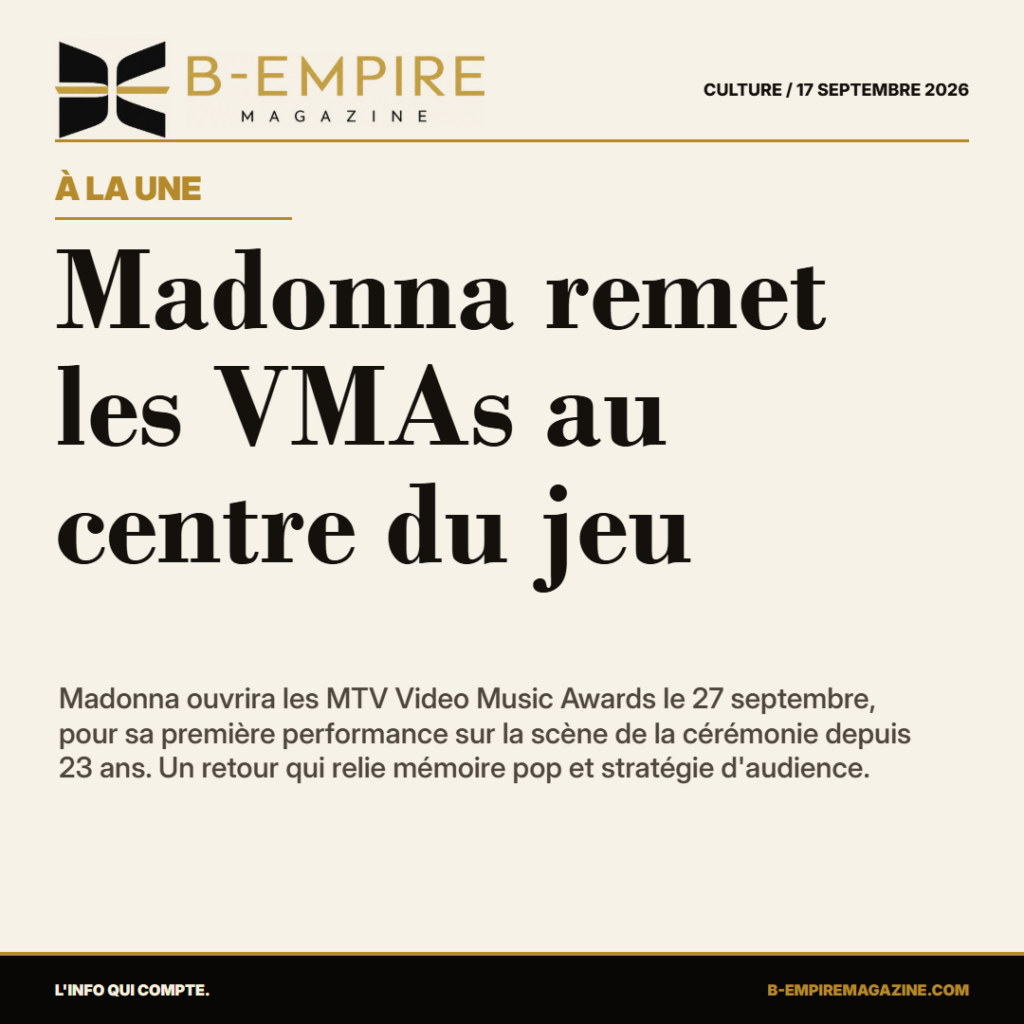
Madonna will open the MTV Video Music Awards in Los Angeles on September 27, twenty-three years after her last live performance on the ceremony’s stage. The announcement brings together two stories that grew up alongside each other: an artist who turned the music video into a cultural language, and an event now seeking to recover the collective power of music television.
The singer enters with a spectacular advantage. She is the most-nominated artist of the 2026 edition, earning a career-high eleven nods. She is competing for Video, Artist and Song of the Year, among other prizes, powered by the Confessions II era. Her opening will therefore be more than a nostalgic segment: it will place the night’s leading contender at the center of the show from its first minutes.
A stage tied to the Madonna legend
The relationship between Madonna and the VMAs belongs to pop memory. Her Like a Virgin performance at the inaugural 1984 ceremony helped define the program’s provocative identity. The stagings of Express Yourself in 1989 and Vogue in 1990 then showed that a televised appearance could work as an independent visual creation, designed to be discussed and replayed long after broadcast.
That history gives organizers instant narrative capital. Viewers who discovered those performances on television can reconnect with a central artist from their youth, while newer generations know the images through social media, archives and references made by contemporary creators. The return becomes a bridge between the culture of live broadcasting and the culture of the viral fragment.
Eleven nominations and a new power dynamic
Madonna already has nineteen competitive VMA wins. Her eleven 2026 nominations could alter the ceremony’s historical rankings. A complete sweep would put her level with the most-awarded artists, Beyoncé and Taylor Swift. That scenario is highly theoretical, but it adds stakes to every category and keeps Madonna central to the narrative throughout the night.
Taylor Swift follows with nine nominations. Ariana Grande and Sabrina Carpenter have seven each. The ranking brings several generations of pop stars into the same field and turns the evening into a symbolic measure of cultural longevity. Madonna is not being presented as a legacy guest receiving a tribute. She is competing directly with artists who dominate today’s platforms.
An audience tool for a multiplatform event
The decision to make her the opener also follows a media logic. The VMAs will air simultaneously on CBS and MTV and stream on Paramount+. After years of fragmented viewing habits, the goal is no longer simply to win one night of linear television. The show must bring fans to multiple screens, produce shareable clips and extend the conversation across platforms.
Madonna brings a multigenerational audience and strong event value. CBS can mobilize a broad public, MTV can reactivate its musical heritage and Paramount+ can turn attention into streaming use. The performance is also presented in partnership with Spotify, a sign that the ceremony is thinking simultaneously about spectacle, listening and digital circulation. Each partner receives a different gateway into the same cultural moment.
Scheduling the star first also reduces a classic awards-show risk: gradual audience erosion. Viewers know the promoted moment will arrive immediately. In return, the program must create enough tension after that first sequence to retain them. A monumental opening can refresh the brand, but it also raises expectations for everything that follows.
Los Angeles and Snoop Dogg complete the story
The ceremony returns to Los Angeles for the first time since 2017 and will take place at Peacock Theater. Snoop Dogg will host. The choice creates a bill anchored by two icons who have survived multiple cycles of the music industry: Madonna representing visual pop and Snoop Dogg representing hip-hop’s expansion across culture and business.
The combination is not an attempt to freeze the VMAs in the past. It uses instantly recognizable figures to frame a contemporary program. In a landscape where audiences gather within individual artist communities, major ceremonies need personalities who can cross those boundaries. Madonna and Snoop Dogg offer that broad recognition without erasing newer talent.
The music video as an event again
The VMAs were born when the music video was one of the main tools for discovering music. Today, images circulate in many formats: long-form video, vertical clip, short choreography, filmed performance or immersive campaign. The ceremony still has a distinctive role because it rewards the meeting point of song, directing, fashion, dance and technology.
Madonna’s nominations cover precisely that creative chain, from directing and visual effects to art direction, cinematography, editing and choreography. They are a reminder that pop is more than an audio file. A musical era can become a complete aesthetic system capable of generating images, performances, products and conversations.
A relevance test, not only an anniversary
The challenge will be to prevent the event from simply replaying its own archives. The return will be powerful if it demonstrates why Madonna remains active in 2026, not only why she was revolutionary in the 1980s and 1990s. The recent repertoire, staging and dialogue with current visual codes will determine whether the sequence becomes a new chapter or a polished celebration of the past.
The wager is equally clear for MTV and Paramount. An icon can generate a spike in attention, but lasting relevance depends on converting that spike into a shared appointment. On September 27, Madonna will not merely return to the VMAs. She will become a full-scale test of a central question in the cultural industry: how does a historic event become indispensable again in a world where everyone builds a personal schedule?