


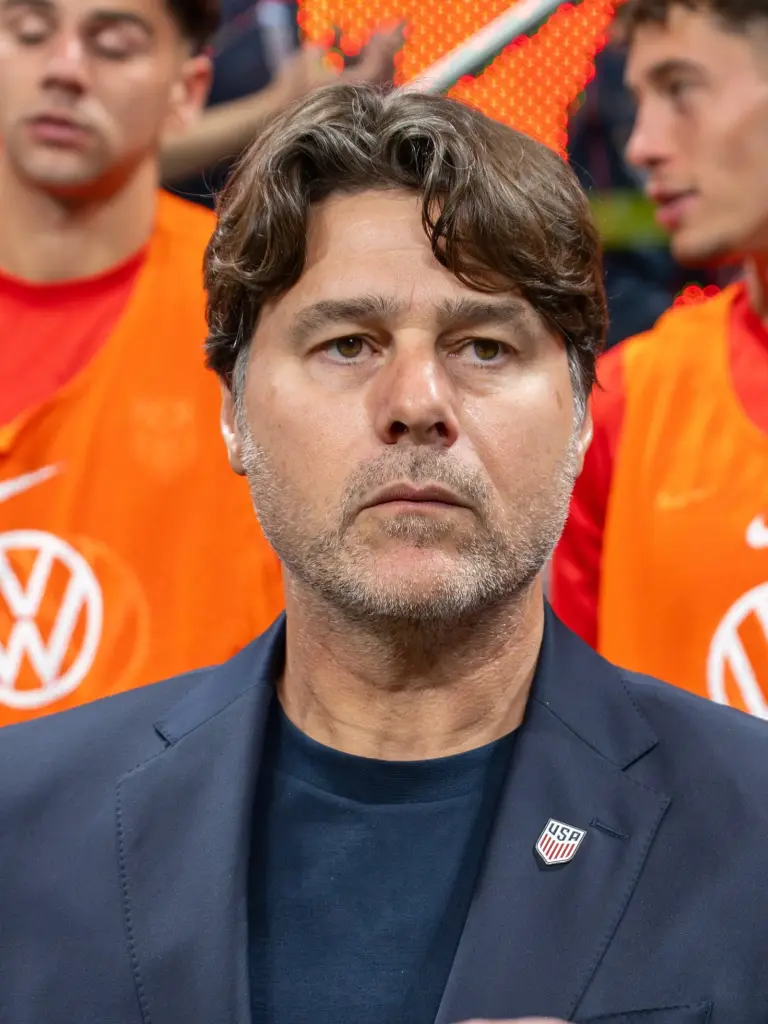
Manchester United could wait no longer. On Friday, November 13, 2026, the English club officially announced the arrival of Mauricio Pochettino as the first-team coach starting November 18. The Argentine leaves the United States national team to take over a giant entrenched in the Premier League relegation zone, following its worst start to a season in forty years. This is not just a simple appointment: it is an urgent gamble on the identity, authority, and sporting survival of a global institution.
The announcement has all the ingredients of a story with significant international ramifications. Manchester United remains one of the most powerful brands in football, Pochettino is one of the most recognizable coaches of his generation, and the American national team loses its technician just months after hosting a World Cup. Behind the emotion of the departure lies a monumental question: can the man who built modern Tottenham repair the most exposed club in England?
A Giant in Crisis Chooses a Builder
The official statement from Manchester United emphasizes the qualities that have built Pochettino’s reputation: intense and attacking football, the construction of cohesive groups, and player development. The message is not trivial. Since Sir Alex Ferguson’s departure, United has cycled through numerous coaches, recruitment phases, and promises of reconstruction without finding lasting stability.
Michael Carrick was dismissed after a catastrophic start to the season and the club’s worst league opening in four decades, according to the Associated Press. United finds itself in the relegation zone, a position almost inconceivable for a team whose revenues, global audience, and ambitions theoretically place it among the European elite. Pochettino, therefore, does not arrive in a comfortable project. He takes over a team under immediate pressure, where every match could exacerbate the crisis.
His profile, however, meets several needs. At Southampton, and especially at Tottenham, the Argentine demonstrated his ability to instill a demanding work culture, improve young players, and build a recognizable team. With Spurs, he achieved four consecutive qualifications for the Champions League and reached the final in 2019. He is also familiar with the constraints of a star-studded dressing room after his stints at Paris Saint-Germain and Chelsea.
Why Pochettino Left the United States
Pochettino’s departure from the American national team is another significant dimension of this story. In front of the press, the coach emotionally acknowledged that leaving his position was one of the most difficult decisions of his career. However, he also explained that an opportunity like Manchester United rarely presents itself and was hard to refuse.
The American Federation agreed to release Pochettino and his staff after their last responsibilities. FIFA specifies that he must still lead the United States in their double-header against Haiti in the quarter-finals of the CONCACAF Nations League before joining Manchester. This transition creates an unusual situation: for a few days, the future boss of Old Trafford remains focused on a national team he is about to leave.
His American tenure is not limited to this departure. Pochettino led the United States to the Round of 16 in the 2026 World Cup, held in North America. He worked with a generation subjected to considerable expectations and enormous commercial exposure. This experience could aid him at Manchester, where the weight of public narrative is almost as heavy as the weekend’s results.
The Tactical Challenge: Making United Identifiable
Pochettino’s first task will be tactical. Manchester United has too often given the impression of being a collection of talents without a stable collective mechanism. The Argentine prefers teams capable of pressing together, attacking quickly after regaining possession, and occupying the field with intensity. To implement this idea, he will need to gain the dressing room’s buy-in even before demanding new players.
The issue will not be resolved with a slogan. Effective pressing requires short distances between lines, appropriate physical conditioning, and shared discipline. If just one player breaks from the movement, the opponent finds spaces. Pochettino will therefore need to simplify initial instructions, secure the defense, and restore confidence before imposing the most ambitious version of his football.
His history with young players is another signal. At Tottenham, several players reached new heights under his guidance. United has a prestigious academy and a strong tradition surrounding homegrown talent. In a period where recruitment errors have been costly, the ability to develop the existing squad could become as important as the transfer market.
A Psychological Mission Above All
The crisis at Manchester United is also mental. A team under the constant gaze of the media can lose its freedom as results deteriorate. Every missed pass feeds doubt, every goal conceded revives comparisons with great teams of the past, and every decision by the coach becomes a referendum on the club’s direction.
Pochettino will need to create a protected working environment without denying the urgency of the league standings. His communication will be crucial. He must publicly support his players, establish a clear hierarchy internally, and convince supporters that the team has a credible path forward. At Old Trafford, the crowd can become an immense force, but they must first recognize effort, consistency, and a form of collective courage.
The appointment also carries risks for the coach. Pochettino has long been associated with the idea of the grand project he could finally accomplish. At Manchester, he will not have any period of quiet observation. If he succeeds, he could transform his reputation and bring a football monument back to the top. If he fails, his name will join an already long list of technicians swept away by the United machine.
The Signal Manchester United Sends to the World
By choosing Pochettino, United is not only betting on a track record. The club is betting on a method and a figure capable of carrying out a reconstruction in front of a global audience. The contract reported by Sky Sports extends over two and a half years, a horizon long enough to build but short enough to maintain strong pressure on results.
The schedule will quickly provide an initial answer. Pochettino is set to officially begin on November 18, after the international window. He will inherit a team that can no longer afford to consider survival a formality. The initial objectives will be simple: stop the negative streak, climb out of the relegation zone, and restore a readable structure to the group.
The future will be more complex. Manchester United will need to align sporting decisions, recruitment, and governance around a shared vision. No coach, no matter how charismatic, can sustainably compensate for an incoherent organization. The real test will therefore be collective: is the club ready to support the Pochettino method when the first difficulties arise?
Why This Gamble Could Change Everything
Football loves spectacular comebacks, but rebirths are rarely built overnight. Pochettino brings a deep knowledge of the Premier League, a proven ability to develop players, and a style compatible with the historical expectations of Old Trafford. Most importantly, he brings a new energy to a club that seemed imprisoned by its own fear.
Manchester United is on the brink, but that is precisely what makes this appointment so powerful. The Argentine does not take charge of a team already ready to win. He accepts the challenge of rebuilding an identity under the threat of relegation, in front of millions of supporters and with very little time. If Pochettino can make United coherent, intense, and courageous, his arrival will not merely be a change of coach. It could become the moment when the English giant finally stopped looking at its past to start building its future.
Sources
- Manchester United plc, official statement filed with the SEC, appointment and start date on November 18, November 13, 2026.
- Associated Press, Pochettino leaves the United States for Manchester United, sports context and statements, November 13, 2026.
- FIFA, Pochettino ends his tenure with the United States, record and last matches, November 13, 2026.
- Sky Sports, appointment of Mauricio Pochettino, announced contract duration and Manchester United situation, November 13, 2026.