


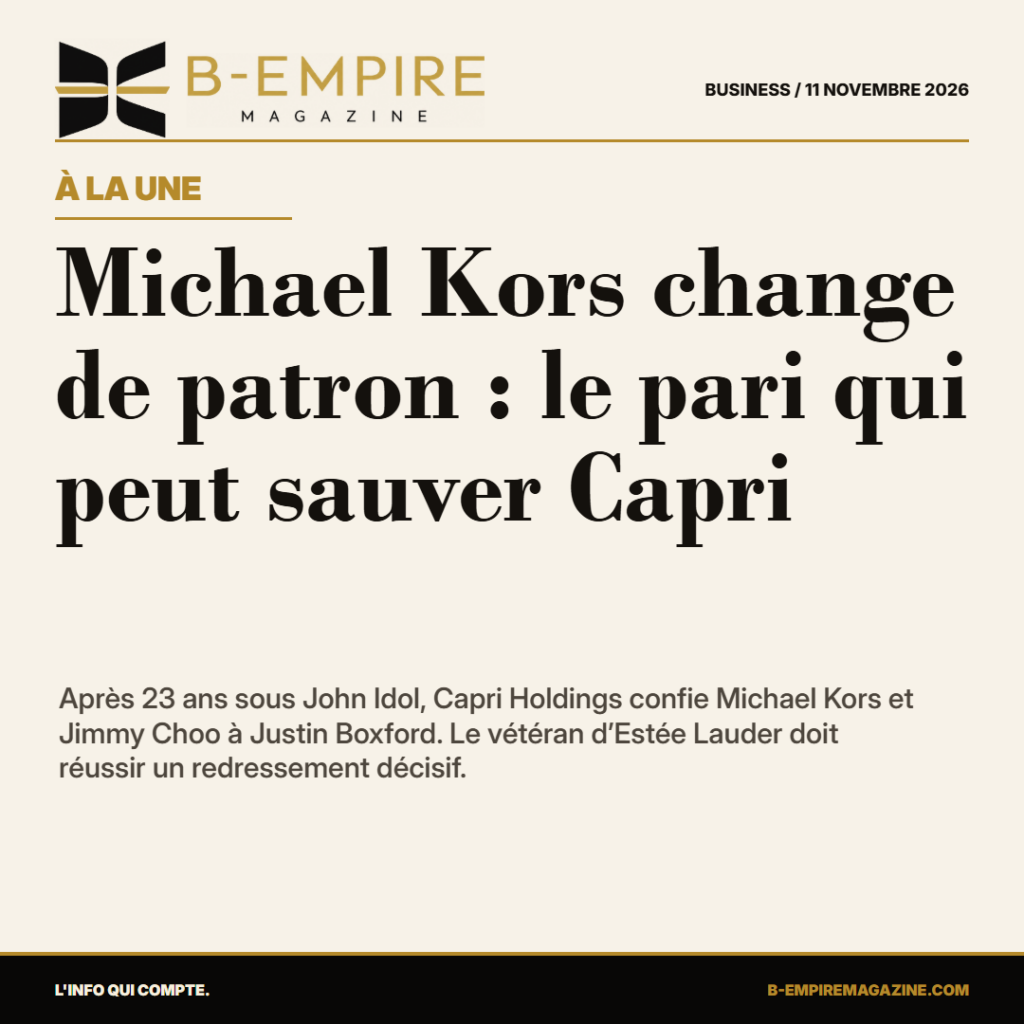
After twenty-three years under the same leader, Capri Holdings turns a significant page. The parent company of Michael Kors and Jimmy Choo has appointed Justin Boxford as CEO effective January 4, 2027. A veteran of Estée Lauder, specializing in premium beauty and international markets, he will replace John Idol with a mission that goes far beyond a mere change of leadership: to restore the group’s desire, growth, and credibility after several years of turbulence.
The announcement comes at a strategic moment. Capri is attempting to bring consumers back to Michael Kors bags and accessories, renovating its stores, investing in new products, and promising a return to growth. The group is also emerging from a tumultuous period marked by the failure of its $8.5 billion merger with Tapestry and the sale of Versace for $1.4 billion. Justin Boxford thus inherits a more streamlined portfolio but with considerable pressure.
A Change of Reign After 23 Years
John Idol has led Capri since December 2003. Under his leadership, Michael Kors became a multi-billion dollar global brand, while the group acquired Jimmy Choo and Versace. This expansion was intended to make Capri an American champion capable of competing with the major European luxury conglomerates.
However, the end of the cycle has been more challenging. Consumers, hit by inflation and becoming more selective in their spending, have responded less to accessible luxury offers. Michael Kors has struggled against the trivialization of its image, frequent promotions, and intense competition in the bag market. The operation with Tapestry, owner of Coach, was supposed to offer a spectacular exit before being blocked by U.S. courts for antitrust reasons.
Capri assures that the transition comes at the right time. John Idol will remain a senior advisor until March 31, 2027, while Robin Freestone will become the independent chairman of the board. The goal is to avoid a sudden break while giving Boxford enough space to impose his method.
Why Justin Boxford is the Chosen Profile
Justin Boxford brings nearly thirty years of experience in beauty and luxury, including over two decades at Estée Lauder. He recently held the position of global president of luxury beauty brands. Previously, he led Estée Lauder and AERIN Beauty, managed La Mer for five years, and worked on the development of Tom Ford Beauty in the Asia-Pacific region.
His track record at La Mer is one of his strongest arguments: according to Capri, he more than doubled the size of the brand, diversified its portfolio, and strengthened its global status in premium skincare. He also contributed to the turnaround of Estée Lauder, with a focus on innovation, fragrances, distribution, and customer experience, both online and in-store.
This profile precisely corresponds to the weaknesses that Capri needs to address. Michael Kors is not lacking in notoriety; the brand must regain desirability without sacrificing its global scale. Jimmy Choo possesses powerful glamour capital but needs to convert this visibility into sustainable growth. Boxford will therefore need to accomplish what he knows best: revitalizing famous names, clarifying their positioning, and recreating an emotional connection with customers.
Michael Kors at the Center of the Battle
The absolute priority will be Michael Kors. Reuters emphasizes that Capri seeks to attract buyers back to its expensive bags and accessories through redesigned stores, new collections, and increased marketing. The challenge will be to elevate desirability without alienating the core clientele that has made the brand a global success.
The “accessible luxury” market has become particularly complex. Consumers can choose from emerging brands that are highly visible on social media, more exclusive European houses, or cheaper offerings inspired by the same codes. In this context, a simple increase in advertising spending is not enough. Michael Kors must offer identifiable products, reduce its reliance on promotions, and make its stores more desirable.
Boxford is already familiar with the brand’s universe: he worked on Michael Kors fragrances while at Estée Lauder. This familiarity can accelerate decision-making, particularly in the beauty, fragrance, and accessories categories that often serve as gateways to a broader clientele.
Jimmy Choo Must Transform Glamour into Growth
Jimmy Choo is another major piece of the portfolio. The brand enjoys global recognition, fueled by red carpets, celebrities, and its evening shoe image. However, cultural power does not automatically guarantee profitable growth. Capri must expand its relationship with customers without diluting what makes Jimmy Choo distinctive.
Bags, accessories, fragrances, and collaborations can create new avenues, provided they remain consistent with the positioning. Boxford’s experience in premium beauty could play a decisive role here. Fragrances and cosmetics allow for reaching more consumers, but they require a high level of brand discipline to avoid transforming exclusivity into mere volume.
After Versace, a Smaller but Clearer Group
The sale of Versace has changed the nature of Capri. The group is no longer trying to manage three very different houses while preparing for a giant merger. It is now focusing on Michael Kors and Jimmy Choo. This refocusing reduces the size of the empire but can also make the strategy clearer and accelerate investments where they are most urgent.
The board insists that Boxford must build on the strengths of both brands and pursue growth opportunities. John Idol asserts that Capri is on track to regain sales growth in the fourth quarter. Reuters reports that the group raised its annual revenue and profit forecasts last month, supported by new collections and enhanced marketing.
These positive signals offer the new leader a starting point that is less fragile than it appears. They also raise expectations: if recovery is already underway, Boxford will need to quickly prove that he can make it sustainable and not just cyclical.
Asia and Digital Will Be Immediate Tests
Justin Boxford’s international journey will be closely watched. He has held positions in Hong Kong, led Estée Lauder’s development in China and the Asia-Pacific region, and worked on travel retail. Asia accounted for nearly 13% of Capri’s revenue during the 2026 fiscal year, according to Reuters.
In this region, brands must contend with highly informed consumers, stronger local competition, and sophisticated digital commerce. The recovery will not solely rely on new stores. It will require synchronizing influence, e-commerce, events, personalization, and customer service, while adapting launches to markets without fragmenting global identity.
The Signal Sent to the Entire Luxury Industry
Boxford’s appointment shows that the boundaries between beauty and fashion are becoming increasingly porous. Both sectors sell desirability, master global networks, and depend on constant storytelling. A leader from cosmetics can bring to fashion houses a culture of rapid innovation, customer knowledge, and multi-category launches.
However, the formula is not guaranteed. Fashion cycles are shorter, inventories heavier, and creation plays a different role. Boxford will need to work closely with creative teams and avoid letting the pursuit of growth transform the brands into platforms for interchangeable products.
January 4, 2027, will thus mark much more than a managerial transition. Capri enters a period where every collection, every store, and every campaign must demonstrate that Michael Kors can become essential again and that Jimmy Choo can grow without losing its luster. After expansion, the failed merger, and the sale of Versace, the group is now playing a simpler game to explain, but perhaps more difficult to win: proving that it knows how to reinvent itself alone.
Sources
- Capri Holdings, official announcement of the succession plan, November 11, 2026.
- Reuters, appointment of Justin Boxford and context of the turnaround, November 11, 2026.
- The Estée Lauder Companies, recent journey of Justin Boxford, September 3, 2026.
- Associated Press, blocking of the merger between Tapestry and Capri, October 24, 2024.