


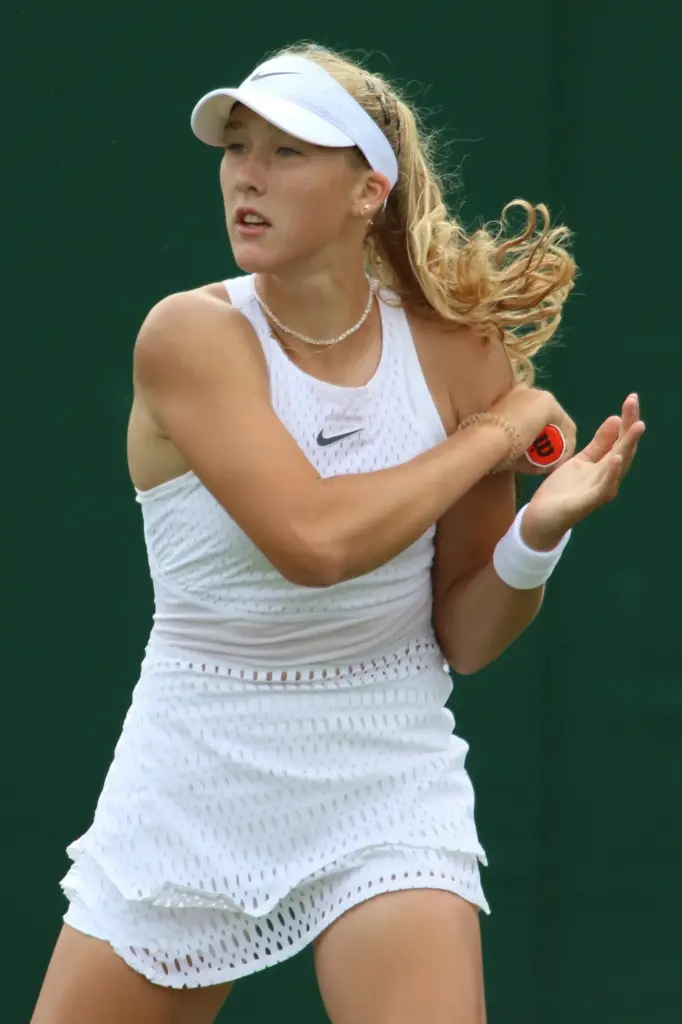
It took Mirra Andreeva just 62 minutes to transform a concerning start into a world-class demonstration. Trailing 4-1 against Aryna Sabalenka, the 19-year-old won the next eleven games to triumph 6-4, 6-0, securing her place in the semifinals of the WTA Finals in Indian Wells. Facing the world number 2 and four-time Grand Slam champion, the Russian not only won but produced one of the most striking sequences of this season’s end.
The score already tells a spectacular story, but the numbers illustrate the extent of the turnaround. After falling behind 4-1 in the first set, Andreeva won 45 of the last 55 points. She erased Sabalenka’s lead, clinched the first set, and then cruised through the second without dropping a single game. For a debutante in a tournament that gathers the eight best players of the year, the message is powerful.
Eleven Games That Turned the Match
Sabalenka had indeed taken control. Her power, early ball striking, and depth of shots seemed to set the expected scenario. At 4-1, the Belarusian had a comfortable margin, and Andreeva still needed to find her rhythm. The shift did not come from a single spectacular shot but from a series of correct decisions: more aggressive returns, varied trajectories, and a refusal to retreat in rallies.
The pressure then shifted sides. Andreeva strung together twelve consecutive points at the heart of her comeback, according to Tennis Majors’ report. Sabalenka, deprived of easy points, began to force her choices. The young Russian exploited every opening without letting up her intensity. By winning the last eleven games, she transformed a potentially dangerous group match into a one-sided victory.
This mastery is all the more remarkable given that the WTA Finals punish the slightest hesitation. The group format allows little time for recovery, and every set can count in qualification calculations. Andreeva responded to this demand with continuous acceleration, offering Sabalenka no foothold to regain control of the match.
At 19, Andreeva Joins an Exclusive Circle
With this victory, Andreeva becomes the youngest semifinalist at the WTA Finals since Caroline Wozniacki in 2009. Since the current format was adopted in 2003, she is only the fifth teenager to reach this stage, following Maria Sharapova, Ana Ivanovic, Wozniacki, and Coco Gauff. The comparison does not guarantee future success, but it highlights the rarity of her achievement.
Her journey in Indian Wells also confirms that her title at Roland Garros in June was not an isolated peak. The Paris champion arrives in California with a significant season already under her belt and approaches the Masters with apparent ease. She had defeated Elina Svitolina 6-4, 6-0 in her opening match. By once again winning a set 6-0, she becomes the first player in the tournament’s history to achieve such a score in both of her first two matches at the WTA Finals.
This continuity is essential. Women’s tennis has often seen young champions make a stunning breakthrough only to struggle to confirm it. Andreeva, however, is stringing together performances across surfaces, continents, and contexts. Her game does not rely solely on superior power: tactical reading, return quality, and the ability to change the rhythm provide her with multiple paths to victory.
A Victory That Goes Beyond the Score
Defeating Sabalenka in this context brings a particular validation. The world number 2 remains a benchmark for power and intensity, with four major titles to her name. Dominating her after being down shows that Andreeva can absorb a difficult start without abandoning her plan. She has especially proven that she can impose her will on an opponent accustomed to dictating rallies.
However, one must avoid jumping to conclusions too quickly. A group match is neither a final nor an official passing of the torch. Sabalenka possesses experience in major encounters, and the Masters format can still produce numerous turnarounds. Andreeva, for her part, will need to replicate this level when a spot in the final is directly at stake. The tournament continues until November 15, featuring a lineup where every opponent has the tools to punish a drop in intensity.
But this victory changes the perception of the draw. Andreeva is no longer just the young Roland Garros champion learning from the best. She has become a credible contender for the trophy. Two matches, two victories in straight sets, and two sets concluded 6-0 constitute an almost ideal start in a competition where mental pressure counts as much as shot quality.
The New Face of Women’s Global Tennis
The emergence of Andreeva fits into a season where the women’s hierarchy has thickened. Several established champions remain capable of winning the biggest titles, while a younger generation accelerates its establishment. The Masters serves precisely as a laboratory for this confrontation: only the most consistent players of the year participate, and no victory is insignificant.
The success in Indian Wells also adds an international dimension to her rise. Crowned on the Parisian clay, she now demonstrates her ability to dominate on hard courts in a year-end tournament. This versatility is often what separates a one-time champion from a player capable of establishing herself at the top for the long term.
For the public, the sequence offers a simple and memorable image: a teenager down 4-1 who does not lose another game. For her future opponents, she delivers a more concerning message. Even when she starts poorly, Andreeva can correct her positioning, take the return into her own hands, and completely close the door. This adaptability may become her most valuable weapon.
The Semifinal as the Next Test of Truth
The next step will reveal whether this demonstration was a peak or the beginning of a march toward the title. A Masters semifinal imposes another tension: there are no more group calculations or opportunities to recover. Andreeva’s ability to maintain her aggression while managing the stakes will be closely scrutinized.
Her team will likely seek to preserve the clarity that marked her comeback against Sabalenka. Rather than seeking the winning shot at all costs, Andreeva built pressure until she provoked riskier shots from across the net. This offensive patience can become decisive when legs feel heavier, and the prospect of the trophy draws nearer.
At 19, Mirra Andreeva has already won a Grand Slam. She has now signed a victory that resonates as a statement at the Masters. The title is not yet secured, but the eleven consecutive games inflicted on Sabalenka have shifted expectations. In Indian Wells, the youngest semifinalist in seventeen years is no longer a surprise guest: she has become the player that the entire draw must watch.
Sources
- WTA, official report on Andreeva’s victory over Sabalenka, November 12, 2026.
- WTA, official presentation of the WTA Finals 2026, accessed November 12, 2026.
- Tennis Majors, match analysis of Andreeva-Sabalenka, November 12, 2026.
- Le Monde, Andreeva’s first Grand Slam title at Roland Garros, June 7, 2026.