


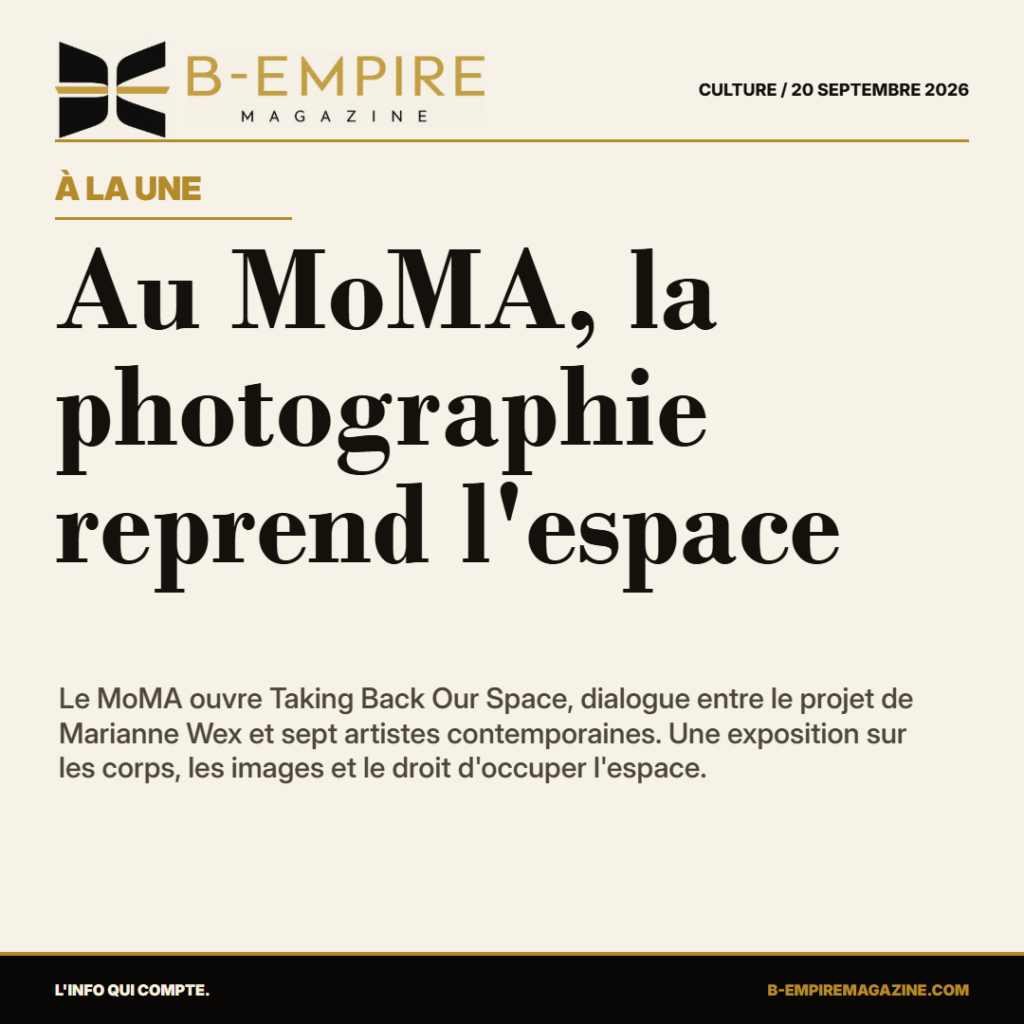
Who learned to take up space, and who learned to withdraw from it? That question runs through Taking Back Our Space: Photographic Perspectives, opening on 20 September 2026 at New York’s Museum of Modern Art. On view until 2 May 2027, it brings together eight artists around the relationship between bodies and space. Its starting point is an extensive photographic project by Marianne Wex, made in 1977, placed in conversation with works by seven contemporary artists. MoMA is offering more than a simple photography-history lesson: it asks how an image can record social habits and then challenge them.
Marianne Wex and the language of posture
Between 1972 and 1977, Marianne Wex photographed the positions of arms, legs, hands and heads on the streets of Hamburg. She also gathered images from advertising, magazines, newspapers, cinema and other media. Her work Let’s Take Back Our Space sorted this material by posture and gender category to show how bodies had been socialized to occupy space differently. The method draws on archives as much as montage: placing ordinary images together makes codes visible that an isolated glance might miss.
MoMA acquired the complete project in 2018. The museum now presents it as a work to revisit, not as a framework that can explain every body. A binary classification from the 1970s can expose the norms of its moment, while contemporary work can also make its limits clear. That is where the curatorial conversation becomes productive. Taking back space is not merely a matter of enlarging a figure within a frame; it also asks who defines categories, who owns images and who has the authority to narrate them.
Seven contemporary responses, not one definition
The artists shown alongside Wex are Nona Faustine, Martine Gutierrez, K8 Hardy, Yuki Kihara, Joiri Minaya, Paulina Olowska and Wendy Red Star. According to MoMA, their work explores the intersections of gender with other histories of representation, including race, sovereignty and colonial memory. The museum notes that these works are being displayed at MoMA for the first time. They are not simply illustrations of a conclusion reached in 1977; they move the center of the discussion.
In Indigenous Woman, Martine Gutierrez takes on several roles, from photography to editorial direction, and plays with the conventions of the magazine. K8 Hardy’s Position series builds an inventory of self-transformation that refuses a fixed identity. Yuki Kihara revisits images of Pacific islands using Samoan fa’afafine models, answering a history of outside gazes. These approaches do not use photography in the same way: one borrows from advertising, another from performance, and another from the reconsideration of an inherited artistic imagination.
Photography, archives and ownership
In her Accession series, Wendy Red Star combines drawings of Indigenous objects made for a museum collection with her own images of the Crow Fair. The pairing restores a contemporary life where an institutional inventory might freeze objects in the past. Joiri Minaya uses digital collage to work through stereotyped tropical representations. Paulina Olowska layers found photographs, ink and paint to connect bodily movement and language. In each case, an image is not a neutral window: how it was made and how it circulates both matter.
The question is also directed at the museum itself. To exhibit a photograph is to decide what to preserve, whom to credit, what to write on a label and which histories to bring together. The exhibition is organized by Roxana Marcoci with Caitlin Ryan; comparing Wex with the seven other artists is an editorial choice. A visit can therefore become an exercise in critical looking: study an artwork, then ask what its frame leaves outside and who benefits from that absence.
An opening that speaks to the present
The title Taking Back Our Space works at several scales. It refers to the physical space bodies occupy in a street, a room or a photograph. It also points to symbolic space within collections, media and historical narratives. MoMA has announced a related publication with a previously unpublished interview with Wex and conversations about the contemporary artists. That editorial extension matters because images often benefit from voices that clarify their contexts instead of being asked to speak alone on behalf of their subjects.
For B-EMPIRE, the significance of this opening lies in its shift of perspective. A pose is never only a pose when a society distributes visibility, mobility and the right to represent oneself unequally. The exhibition does not claim that placing eight names in one room resolves those inequalities. It offers a space to examine how photographers can reveal a norm, resist it or reclaim a story taken from them. Its strongest invitation may be to slow down and compare images that would ordinarily be encountered separately: an archival panel, a magazine page, a portrait and a contemporary collage can change the meaning of one another. At a time when images travel constantly and quickly, learning to see how they are constructed remains an essential cultural skill.