


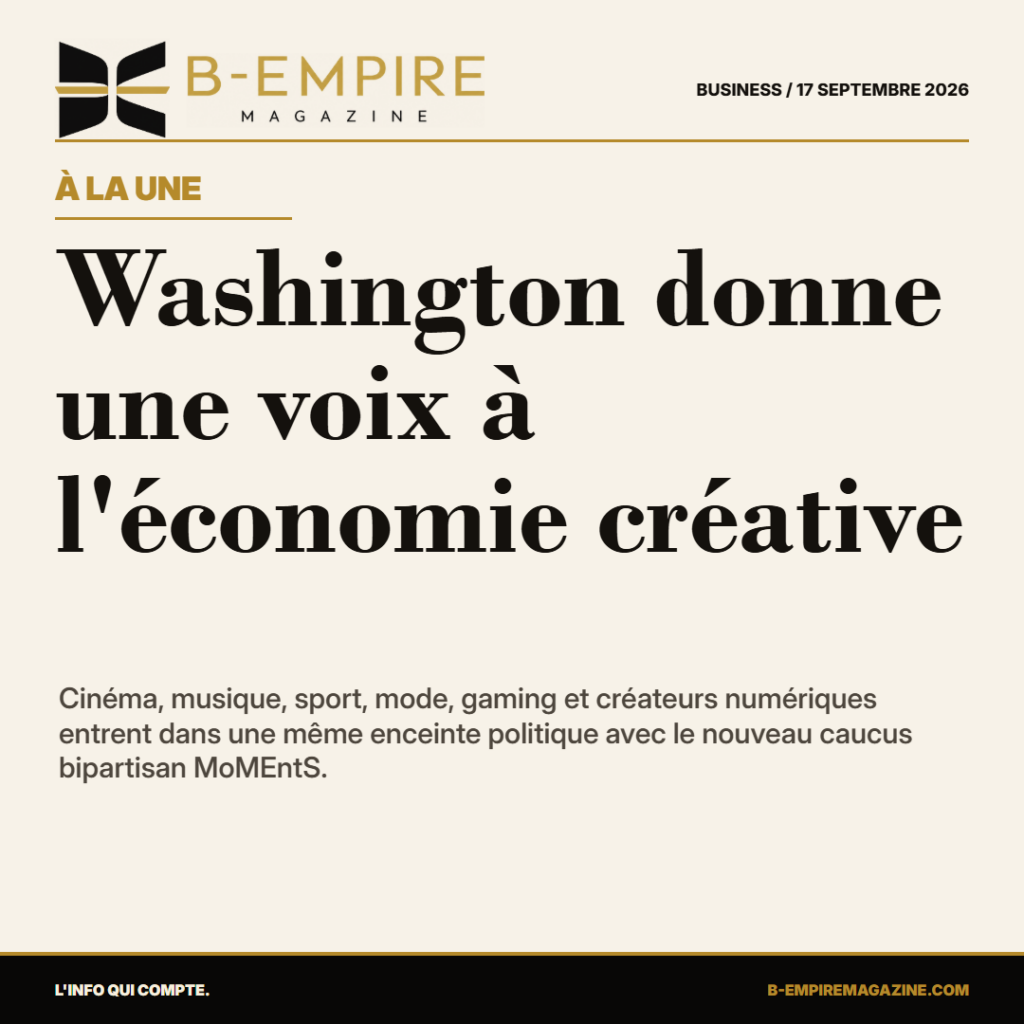
Culture has gained a new political entry point in Washington. On September 16, 2026, three members of the House of Representatives launched the bipartisan MoMEntS Caucus, short for Movies, Music, Entertainment, & Sports. Its scope is deliberately broad: it brings film, television, music, sports, live entertainment, fashion, beauty, gaming, esports, publishing, the arts and the creator economy into a shared conversation.
Democratic Representative Sydney Kamlager-Dove co-chairs the new forum with Republican María Elvira Salazar and Democrat Troy Carter. Other lawmakers from both parties have already joined. The signal matters because the boundaries between studios, platforms, brands, athletes and influencers are rapidly disappearing. A song becomes a global campaign, a tournament produces a content library, a runway show turns into direct commerce and an individual creator can operate a small media company.
An industry too large to remain fragmented
The launch announcement describes creative and entertainment sectors as economic powerhouses generating more than $1 trillion each year and supporting over five million jobs. Those figures align with the latest satellite account published by the Bureau of Economic Analysis. In 2023, arts and cultural production generated $1.17 trillion, equal to 4.2 percent of U.S. gross domestic product. The sector’s real activity grew by 6.6 percent, faster than the wider economy that year.
Yet that figure captures only part of the emerging ecosystem. Traditional cultural statistics identify studios, broadcasters, museums and publishing relatively well, but they still struggle to isolate the hybrid revenue of a streamer, an athlete who becomes a producer or a beauty brand born on a social platform. MoMEntS therefore arrives with a promise of greater clarity: treating this constellation as a value chain instead of a collection of unrelated occupations.
Artificial intelligence puts rights at the center
The caucus says it wants to strengthen workforce pathways and protect creative rights. In 2026, that language cannot be separated from generative artificial intelligence. The represented industries now face the same basic questions: who authorizes the use of a voice, face, catalog, style or performance to train and operate a system? How should rights holders be paid? How can synthetic content be identified without suppressing legitimate creative uses?
The complication is that interests are not perfectly aligned. Studios want to protect their assets while using automation. Platforms want to preserve flexibility. Established performers can negotiate sophisticated clauses, while independent workers may accept sweeping licenses because they lack market power. A common caucus can make those tensions visible, but it will have to prevent the largest companies from drowning out technicians, writers, athletes, small venues and emerging creators.
Platforms become an industrial-policy issue
MoMEntS lists innovation, competition and responsible platform practices among its goals. The wording is revealing. Cultural distribution no longer depends only on television networks, theaters or stores. It runs through recommendation engines, advertising marketplaces, streaming services and social applications that can alter a career within hours.
For a small creative business, the algorithm is simultaneously a storefront, distributor and referee. A change in compensation or visibility can erase a market without public debate. Conversely, overly rigid regulation can entrench companies large enough to absorb compliance costs. The caucus’s real challenge will therefore be less about celebrating creators and more about understanding the infrastructure on which they depend: data, payments, ticketing, advertising, discoverability and access to capital.
From soft power to the competition for talent
The agenda also includes cultural exchange and American leadership abroad. Hollywood, hip-hop, the NBA, video games, Broadway and platforms have long operated as informal U.S. diplomacy. But that symbolic dominance is fading. K-pop, Turkish series, Chinese games, Indian industries, Afrobeats and African cinema are establishing their own networks and narratives.
This competition is not a threat to contain; it is reshaping the global market. Collaborations linking Lagos, Seoul, Paris, Miami and Los Angeles show that influence now travels in multiple directions. To remain attractive, the United States will need to facilitate visas, co-productions, training and professional mobility while ensuring that exchange does not become the extraction of foreign talent or catalogs.
A test for an unusually broad coalition
Public support from TikTok USDS Joint Venture and TKO Group, which owns major sports and entertainment assets, shows that companies already view MoMEntS as a place of influence. Their participation brings genuine expertise, but it also underlines the need for transparency. A congressional caucus is not a legislative committee and does not directly pass laws. It organizes discussion, develops priorities and brings lawmakers together around a sector. Its value will therefore depend on the range of voices it hears and the precision of the issues it selects.
The breadth of its mandate is both its strength and its main risk. Bringing fashion, sports, music, publishing and gaming together helps defend shared concerns such as intellectual property and training. Yet an overly broad list can produce a general message without measurable results. The first discussions will need to turn slogans into practical questions: portable benefits, digital revenue transparency, image rights, access to public procurement for smaller organizations and support for workers whose jobs are being changed by AI.
Culture recognized as infrastructure
The most significant change may be conceptual. By grouping entertainment, creation and sports under an economic banner, MoMEntS argues that culture is not decorative. It generates jobs, exports, technology, tourism, intellectual property and social cohesion. It operates as an invisible infrastructure connecting cities, communities and markets.
Washington will not solve the creative economy’s imbalances through one caucus. But the creation of MoMEntS changes the level of the conversation. Artists and athletes are no longer invited merely to illustrate a cause; their industries are becoming objects of economic policy in their own right. If the forum genuinely listens across the value chain, from freelancers to global groups, it could give the cultural economy the institutional representation its weight already demands.