


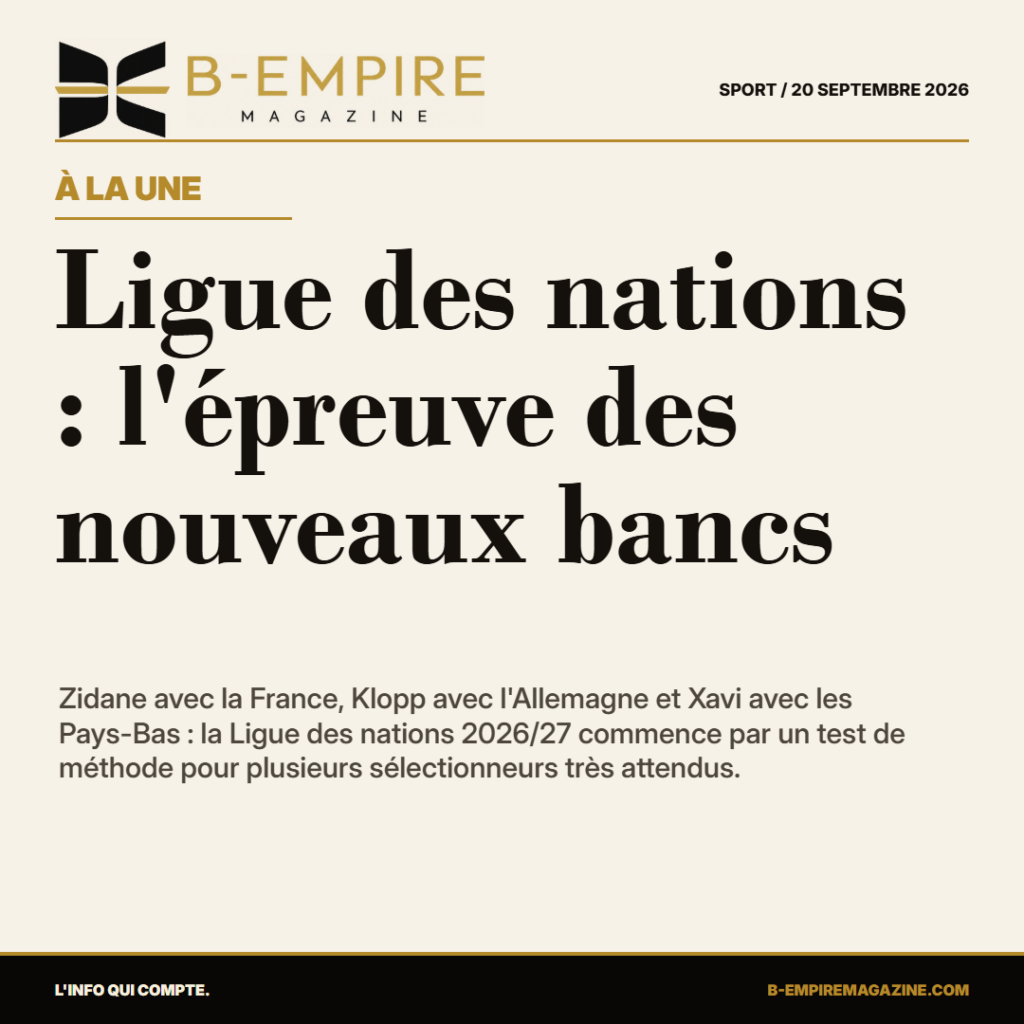
The 2026/27 UEFA Nations League begins on September 24 with an unusual feature: several major national teams are changing voices at the same time. Jürgen Klopp’s Germany and Xavi Hernández’s Netherlands meet immediately; Zinédine Zidane’s France opens its campaign away to Türkiye on the 25th. Italy welcomes Roberto Mancini back, while Portugal starts with Jorge Jesus. These names command attention, but the sporting question is less about celebrity than about how quickly a coach can communicate a way of playing during the short windows available to national teams.
One opening night, two new projects
The Netherlands-Germany meeting on September 24 captures the character of this edition. UEFA presents it as Klopp’s first international match in charge of Germany and Xavi’s debut on the Dutch bench. Both bring strong club identities shaped in environments where daily training can refine every movement and routine. A national side works differently. A few sessions must be enough to establish priorities among players arriving from different clubs and prepare them for a specific opponent.
The coaches’ prestige does not guarantee an instant transformation. Klopp won major honors with Dortmund and Liverpool; Xavi coached Barcelona after a playing career shaped by Spanish football and Dutch influences. Those paths offer clues, not certainty about what their teams will look like in September. The match should reveal which principles can be installed quickly: pressure without the ball, positions during buildup and reactions after possession is lost. A good result would help, but it could not settle the question of an entire project.
France begins a new chapter
For France, expectations center on Zinédine Zidane. UEFA lists his first match away to Türkiye on September 25, followed by a meeting with Belgium three days later. The former player and Real Madrid coach arrives with a history already woven into French football, but reputation cannot choose a team or establish its balance. Positions, attacking roles and solutions against opponents who deny space will have to emerge on the pitch. The national side cannot be assessed through the image of its new leader alone.
The trip to Türkiye is a distinctive first examination. Playing away makes it harder to control the tempo through home support. The team must manage periods without possession and avoid leaving too much room in its eagerness to score. It will be tempting to read every Zidane decision as a definitive statement. Yet early games often help a coach observe combinations, assign responsibility and measure responses in real conditions. Caution is needed before declaring either a revolution or a failure.
Returns and handovers
Italy has brought Roberto Mancini back for a second spell after the European title won at EURO 2020. It hosts Belgium on September 25. A return does not automatically recreate the conditions of a first tenure: players, expectations and the competition’s context have changed. Belgium also enters with a new coach, Mark van Bommel. Their meeting may therefore match two teams still under construction rather than two fully established systems.
Portugal begins its title defense under Jorge Jesus against Wales on September 24. The coach has extensive club experience, including in Portugal, Brazil and Saudi Arabia. He must still adapt familiar habits to far more condensed preparation. That contrast runs through the entire opening round: personalities known for their methods find themselves in a setting that limits the time available to put them in place. The national coach’s real skill is not copying a former club side, but choosing what can work immediately with the players at hand.
A schedule that calls for restraint
According to UEFA, the first four matchdays run from September 24 to October 6, followed by two more in November. That rhythm will provide answers quickly, but not the equivalent of a full season’s work. It encourages observers to watch sequences of games rather than reduce each side to its opening score. Lineups may evolve, injuries may alter plans and one opponent may reveal problems another left unseen. Even a major fixture such as the September 26 rematch of the EURO 2024 final between England and Spain belongs within that longer process.
The Nations League also has its own purpose: progressing through a group and reaching the decisive stages scheduled for 2027. It is neither a string of friendlies nor a verdict on a country’s entire football system. Coaches must reconcile the urgency of results with building a team that can endure. The most revealing signs may therefore be quiet ones. A better coordinated defensive line, clearer buildup or a collective response after conceding can sometimes tell us more than a tactical slogan announced before kickoff.
Finally, the pitch
As of September 20, none of these opening matches has been played. Premature verdicts should be resisted. The appeal of this edition lies in the meeting between strong reputations and the ordinary constraints of international football. Klopp, Xavi, Zidane, Mancini and Jesus are not all starting from the same place, but each must turn ideas into shared behaviors. The names make the marquee; playing time will show whether their teams are beginning to become recognizable.