


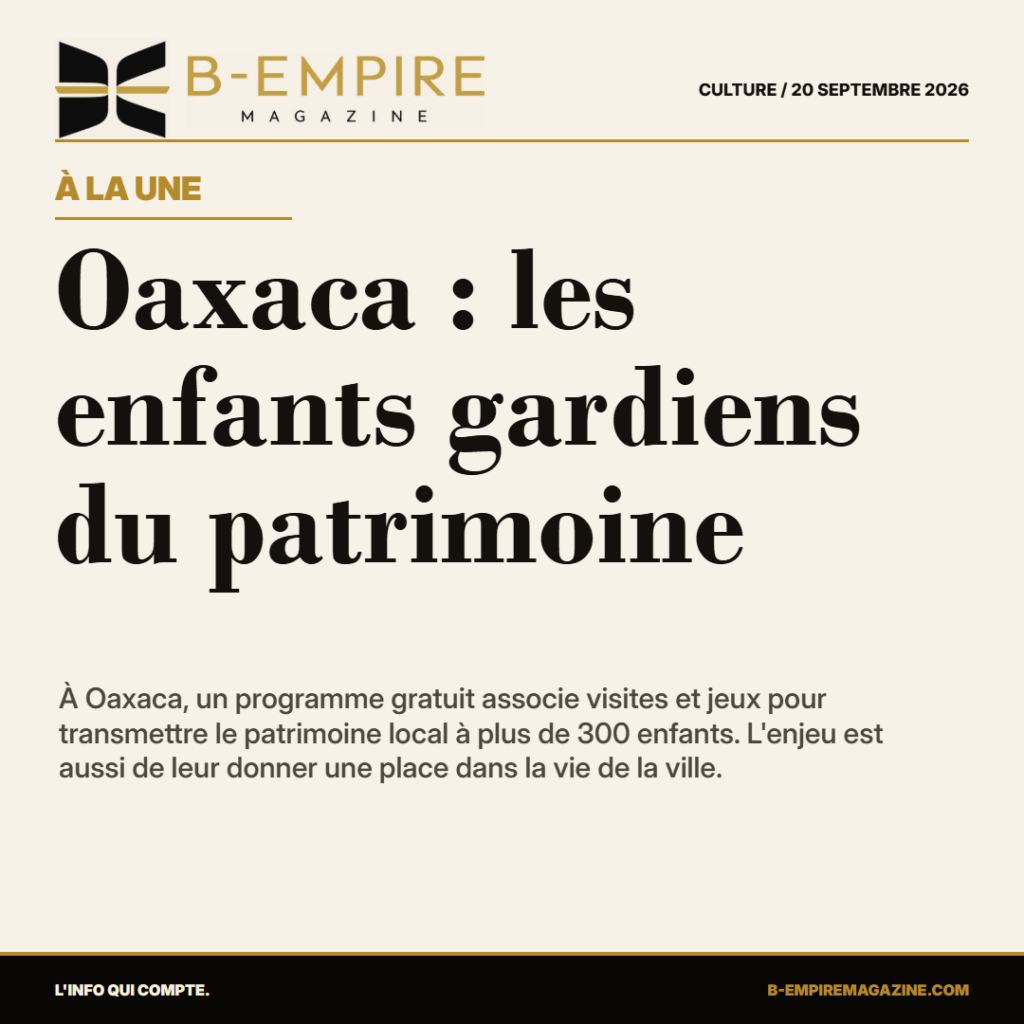
People protect a city more effectively when they first learn how to look at it. In Oaxaca de Juárez, Mexico, a municipal initiative supported by UNESCO invites children to explore the historic centre through walks, games and conversation. Called Guardianes del Patrimonio, or Guardians of Heritage, it aims to make heritage more than a list of monuments to memorise. In a September 18, 2026 report, UNESCO says the programme, first offered free of charge during the summer, is now expanding to more than 300 girls and boys from five primary schools. Its central idea is simple: the city’s youngest residents are not merely future visitors to a famous site. They already belong to its story.
Reading a city on foot
Oaxaca’s historic centre and the archaeological site of Monte Albán together form a World Heritage property inscribed in 1987. They are not a single landmark. The World Heritage Centre describes the street plan and architecture of the old city on one hand, and a pre-Hispanic site shaped by successive civilisations on the other. Connecting the two requires telling several histories at once. An educational walk can help children ask what a facade, a square, a street grid or an archaeological remnant says about the people who lived there, instead of treating heritage as a postcard backdrop.
The activities described by UNESCO combine tours of the historic centre with playful materials, including a booklet, a lotería game and a version of snakes and ladders. Play is not simply a concession to supposedly short attention spans. It creates space to ask questions, compare details and revisit ideas without turning the city into a classroom. Guides received training in teaching methods and heritage interpretation before designing their own tours. That preparation matters: a good guide does more than deliver dates. They connect a place to the experiences of the people walking through it.
Heritage lives beyond stone
The initiative also encourages children to notice intangible heritage: skills, practices, stories and social ties that shape local life. This shift helps avoid a familiar trap. When a city attracts visitors, its streets and monuments may become highly visible while knowledge held by residents receives much less attention. A child who asks how an object is made or why a celebration matters to a neighbourhood learns that culture is not only what has been preserved behind a barrier. It is also what people continue to do, adapt and pass on.
That insight does not erase the difference between an educational activity and a conservation policy. Understanding a site does not, by itself, pay for maintenance, manage crowds or protect the practices around it. Education can nevertheless make such choices more intelligible to residents. It can also create room for questions: who decides what deserves to be shown, whose stories are left out, and how can everyday neighbourhood life coexist with heritage protection? These are not measured outcomes that UNESCO attributes to the programme. They are reasonable questions raised by its approach and a demanding horizon for its future.
Beyond the tourist route
The initiative belongs to UNESCO’s Communities for Heritage programme, supported by Saudi Arabia’s Ministry of Culture through a cash-for-work component. In Oaxaca, this framework links the safeguarding of intangible heritage with urban planning, visitor management and more responsible tourism. It gives the project an economic and civic dimension. The value of a guided walk lies not only in what it shows tourists, but also in the skills it builds locally and the room it leaves for residents to shape the account of their own city.
The figure of more than 300 children shows that the programme is growing; it is not yet evidence of lasting impact. An assessment would ask whether schools can continue the activities, whether guides have stable work and whether families feel welcome beyond a single visit. Free entry is a useful starting point, but access also depends on schedules, transport, language and the ability to welcome children with different needs. Successful cultural mediation does not reserve the discovery of heritage for households already comfortable with cultural institutions.
Who owns the story being told?
The programme’s value will also depend on the range of voices it makes audible. The historic centre and Monte Albán have international recognition, but a global label cannot replace local memory. The accounts of craftspeople, teachers, families and communities can enrich a site’s interpretation without being reduced to illustrations of an official narrative. Giving children tools to observe and question their surroundings also recognises their ability to interpret them. They can learn that heritage is worth protecting precisely because it remains alive, shared and sometimes debated.
Guardianes del Patrimonio will not single-handedly decide the future of Oaxaca’s old centre. It offers a tangible, repeatable first experience between school and street. At a time when historic cities are often narrated from the visitor’s point of view, Oaxaca reminds us that transmission also begins with the people growing up there. The programme’s success will not be captured only by participant numbers, but by children’s ability to return, ask new questions and recognise the city as a place that concerns them.