


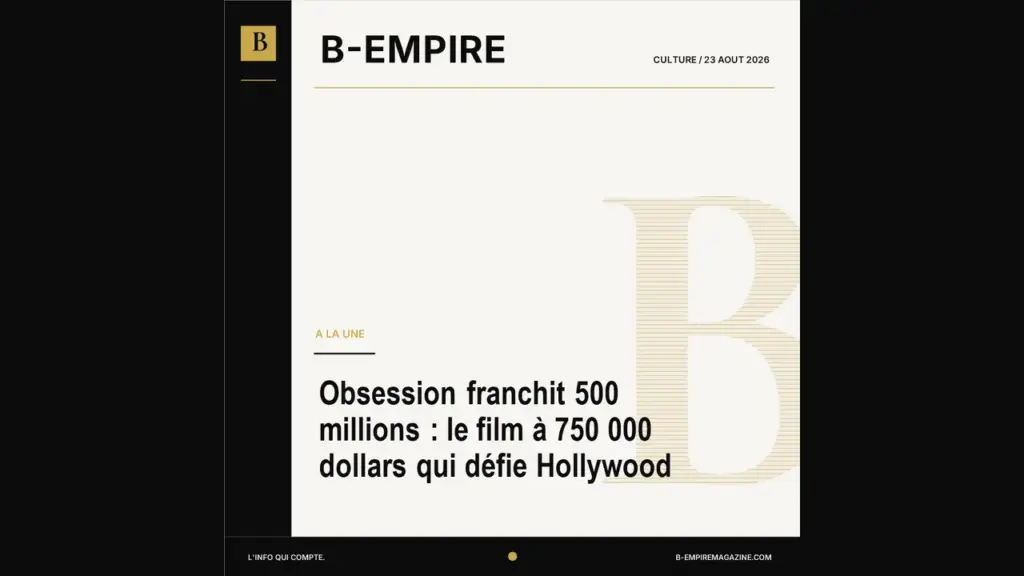
Hollywood has just received a $500 million lesson. Obsession, a horror thriller shot for approximately $750,000 by young director Curry Barker, has crossed the half-billion mark at the global box office. No Hollywood film based on an original story has reached this threshold since the early 2020s.
The figure is spectacular, but the ratio of cost to revenue is even more impressive. Without superheroes, established sagas, or a star capable of guaranteeing a massive opening, Obsession has transformed a disturbing idea, exceptional word-of-mouth, and the power of digital communities into a global phenomenon. The film now surpasses the $494.6 million of Elemental, Pixar’s original feature released in 2023.
The Record That Changes the Conversation in Hollywood
According to figures reported on August 23 by TheWrap, Obsession has become the first original Hollywood film of the 2020s to surpass $500 million in global revenue. To find a greater original success, one must look back before the pandemic, far from the adaptations, sequels, and shared universes that currently dominate studio calendars.
This distinction matters. A film can be technically âoriginalâ while being backed by a famous director, a lavish cast, and a global campaign. Here, Curry Barker was making his feature film debut after gaining recognition on YouTube. His film was developed from a fresh proposal, with a budget closer to that of a high-end advertisement than a blockbuster.
The crossing of the $500 million mark extends a series of records. As early as June, Focus Features announced that the film had surpassed $200 million and had become its biggest global success. In July, Variety confirmed the crossing of $400 million. At each stage, Obsession has pushed the limits that the industry imagined for an independent thriller acquired at a festival.
A Simple, Dark, and Immediately Shareable Idea
The story revolves around a selfish wish that turns into a nightmare. Bear wants Nikki to fall in love with him. Magic grants his request but transforms the young woman into an obsessive, possessive, and murderous partner. This premise can be understood in seconds, giving it a rare strength in trailers, short videos, and conversations among viewers.
However, the film does not settle for a viral concept. It questions the desire to control another, the boundary between love and possession, and the price of a fantasy turned real. Inde Navarrette, in the role of Nikki, and Michael Johnston, as Bear, carry a story capable of being both uncomfortable, romantic, violent, and sometimes very dark in its humor.
This combination explains part of the word-of-mouth. Viewers can debate Bear’s responsibility, Nikki’s choices, and the meaning of the ending. A film that provokes interpretations, reactions, and recommendations has a longer lifespan than a product consumed and forgotten over its opening weekend.
The Rarest Box Office Phenomenon: Growing After Release
Obsession opened at $17.2 million in North America. This result was already remarkable for its scale, but the real breakthrough came afterward: for four consecutive weekends, the film earned more than during its opening weekend. The Associated Press highlighted this unusual trajectory as the thriller held its ground against a Steven Spielberg release.
In modern commercial cinema, revenues are typically concentrated in the first days. Advertising creates the event, fans rush in immediately, and then attendance drops. Obsession took the opposite path. Each wave of viewers convinced another, giving exhibitors a reason to keep the film and expand its presence.
France participated early in this dynamic. The film started there with around $1.4 million during its first international weekend, before its global expansion and release in China extended its run. Its success is therefore not solely American: it rests on international curiosity for a genre cinema that is easily identifiable yet sufficiently unique to surprise.
$750,000 Budget, But a True Global Machine
Directly comparing a $750,000 budget and $500 million in revenue would be misleading if one forgets distribution costs, marketing, theater commissions, and acquisition price. Focus Features reportedly purchased the rights for over $14 million after the film’s presentation at the Toronto Film Festival. The studio then financed its international launch.
Even with these costs, the disparity remains extraordinary. It showcases the economic value of a work whose initial risk is contained and whose campaign can rely on organic reactions. For producers, the message is not that every small film can become a jackpot. It is that a single success of this magnitude can offset many more modest bets.
The case also serves as a reminder of a less glamorous reality: a financial triumph always reignites the discussion about value sharing. Contracts, bonuses, and team compensations are negotiated before anyone knows the extent of the success. When an independent film generates hundreds of millions, the question of who truly benefits from this growth becomes inevitable.
YouTube Is No Longer the Waiting Room for Cinema
Curry Barker belongs to a generation that did not wait for studio permission to learn storytelling. He experimented online, built an audience, and produced visible projects immediately. His journey aligns with that of other digital creators who arrive in cinema with a language, a community, and an instinctive understanding of image circulation.
The 2026 phenomenon is not limited to Obsession. Backrooms, directed by Kane Parsons from his YouTube universe, has also shaken up the horror box office. Together, these films demonstrate that platforms are no longer just for spotting influencers: they are becoming informal schools of directing, editing, and direct audience engagement.
For studios, this shift creates new competition. Young directors no longer necessarily arrive with an isolated script. They can bring proof of concept, engagement data, and a community already curious. Talent remains decisive, but the ability to test an idea before mobilizing millions changes the way risk is measured.
The Signal That Franchises Cannot Stifle
Hollywood will not abandon sequels and franchises. They offer immediate recognition, merchandise, and international visibility that investors appreciate. But Obsession proves that dependence on known brands is not a foregone conclusion. The audience can still transform an unknown story into a global event when the promise is clear and the experience memorable.
The danger now would be to copy only the surface of success: multiplying low-budget horror films, recruiting creators because they have followers, or artificially manufacturing âviralâ campaigns. The real lesson lies deeper. The film grew because it offered an identifiable voice, an easily transmissible concept, and an execution that made people want to talk.
With $500 million, Obsession is no longer a charming anomaly. It is becoming a global case study. A filmmaker from YouTube, a rising actress, and a minuscule production have just beaten the best score of an original Hollywood film since the pandemic. In an industry obsessed with brands, the biggest surprise of 2026 may simply be this: a fresh idea can still win.
Sources
- TheWrap, August 23, 2026, crossing the $500 million mark and record among original films of the 2020s.
- NBCUniversal / Focus Features, June 8, 2026, studio record and historical progress of the film.
- Variety, July 6, 2026, budget, acquisition, and crossing $400 million at the global box office.
- Associated Press, June 14, 2026, exceptional trajectory of word-of-mouth and North American revenues.
- Peacock, July 2026, synopsis, cast, and journey of the phenomenon before its streaming arrival.