


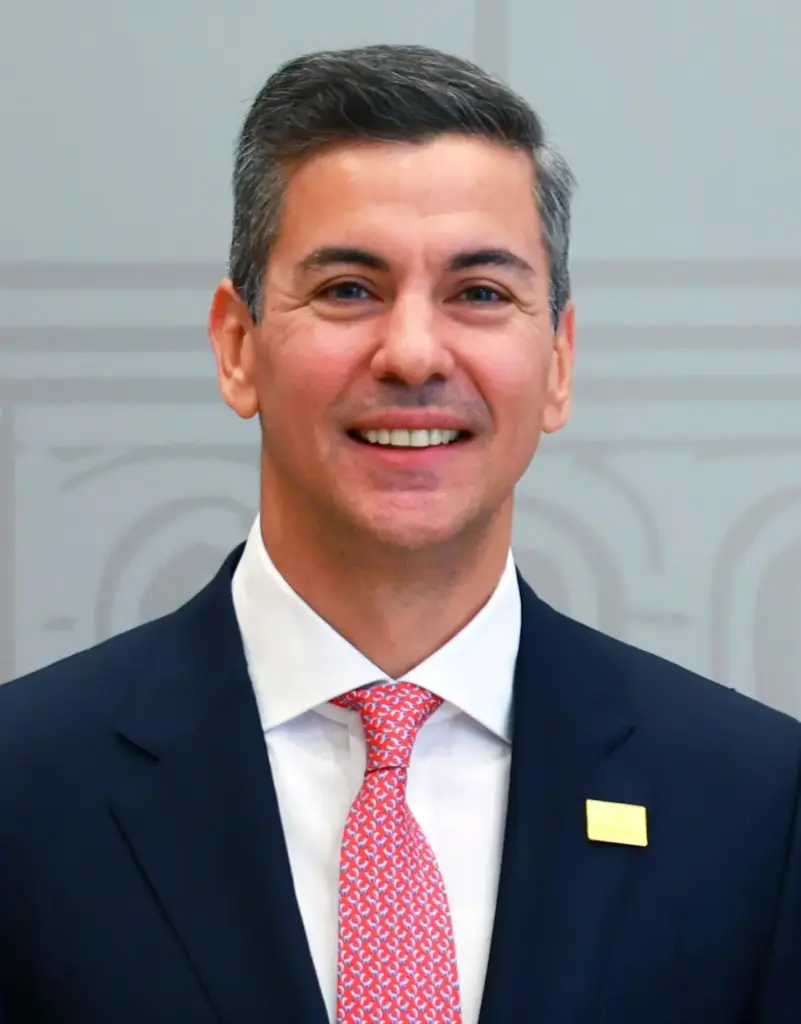
In just a few hours, Paraguay witnessed its president fall, its vice president sworn in, and a banking crisis transform into a historic political rupture. Santiago Peña was impeached on Friday, November 6, by the Senate, and subsequently placed under house arrest as part of an investigation into allegations of breach of trust and influence peddling. Pedro Alliana immediately succeeded him. At the heart of this sequence: the collapse of Ueno Bank, which has blocked access to the savings of millions of Paraguayans.
The shock extends far beyond a simple change of government. According to the Associated Press, nearly half of the country’s approximately six million inhabitants have been deprived of access to their savings following the crisis of the digital bank. The affair has sparked protests, fractured the powerful Colorado Party, and transformed a financial scandal into a national ordeal. The new president thus inherits a country where the immediate priority is not only institutional: it consists of returning money to depositors and restoring trust.
A Unanimous Impeachment That Changes Power in Paraguay
The Paraguayan Senate declared Santiago Peña guilty of mismanagement in the exercise of his duties and removed him from power following a unanimous nominal vote by the senators present. The official website of the upper house confirms that the procedure, initiated on November 5, was conducted in accordance with the constitutional mechanism for political judgment. All 44 senators present voted for the impeachment, according to the AP.
This unanimity reflects the isolation reached by a leader who was, nonetheless, a member of the Colorado Party, the dominant force in Paraguayan political life for most of contemporary history. Peña had offered his resignation the day before, but the chambers chose to continue the impeachment process. The political message is powerful: Congress did not merely want to organize a departure but to officially pronounce the institutional responsibility of the president.
Ueno Bank: The Spark That Turned the Country Upside Down
The crisis erupted around Ueno Bank, a rapidly growing digital bank linked to several figures of power. The Central Bank of Paraguay took control of the institution on November 3, following concerns about its solvency. Customers then found themselves unable to access their accounts, while retirement funds and small entrepreneurs feared losing part of their assets.
The social dimension explains the speed of the outbreak. This is not an abstract crisis reserved for the markets: families, retirees, employees, and merchants have seen their savings frozen. Gatherings in front of Congress brought together depositors demanding both reimbursement of funds and sanctions against those responsible. In a country that sought to strengthen its image as a stable destination for investors, the fall of such a visible financial player becomes an economic warning.
Santiago Peña Under House Arrest After His Fall
The impeachment did not close the case. Shortly after leaving power, Santiago Peña was placed under house arrest. The AP reports that the former head of state is suspected of breach of trust and influence peddling. This measure does not constitute a conviction: it occurs while the judiciary examines the responsibilities in the bank’s collapse and the links between the institution and public officials.
The prosecution has opened several investigations into the crisis. The challenge will be to distinguish between supervisory errors, potential conflicts of interest, and facts that may fall under criminal law. This step will be scrutinized beyond Paraguay, as the credibility of the new power will depend as much on the transparency of the investigation as on its ability to protect savers.
Pedro Alliana Takes Power, but Inherits Suspicion
Pedro Alliana was sworn in before Congress to complete the 2023-2028 term. The official websites of the Senate and the Chamber of Deputies confirm the succession. In his first message, the new president promised stability, pacification, and transparency. Constitutional continuity has thus been ensured without a prolonged vacancy of power.
However, Alliana does not benefit from a guaranteed grace period. The Associated Press highlights that he is also under investigation related to the banking case. He will need to convince that he can lead the investigation and financial restitution without protecting his camp. For the Colorado Party, the situation is precarious: retaining the presidency is not enough if public opinion believes that the same networks remain in control.
Why This Crisis Matters for All of Latin America
Paraguay is an economy landlocked between Brazil, Argentina, and Bolivia, but its political and financial stability is of interest to the entire region. A banking crisis of confidence can slow investment, weaken consumption, and provoke a flight to other institutions or currencies. It can also rekindle the debate on the oversight of digital banks, whose rapid growth sometimes exceeds the control capacities of authorities.
The impeachment also serves as a reminder of the power of political judgment in Latin America. Santiago Peña is the second Paraguayan president to be ousted in this manner since the end of Alfredo Stroessner’s dictatorship in 1989. The precedent of Fernando Lugo, impeached in 2012, sparked regional controversy over the speed of the procedure. This time, the unanimity of the vote and the extent of social anger provide a different context for the decision, without erasing questions about the respect for defense rights.
The Real Test Begins Now
Three urgent matters now await the Alliana government. The first is to secure deposits and present a credible timeline for restitution. The second is judicial: investigations must progress without vendettas or impunity. The third is economic, as the country must prevent the fall of Ueno Bank from contaminating the rest of the financial system and permanently degrading its reputation.
Paraguay has avoided institutional vacuum, but it has not yet resolved the crisis that toppled its president. The speed of the succession may reassure foreign partners; it will not replace the money frozen in accounts or the answers awaited by families. The fall of Santiago Peña will remain historic. Pedro Alliana’s ability to return funds, establish responsibilities, and restore trust will determine whether this day marks an exit from the crisis or merely the beginning of a new episode.
Sources
- Associated Press, impeachment and house arrest of Santiago Peña, November 6, 2026.
- Agence France-Presse, political crisis and presidential succession, November 7, 2026.
- Senate of Paraguay, official decision of impeachment, November 6, 2026.
- Chamber of Deputies of Paraguay, inauguration of Pedro Alliana, November 6, 2026.