


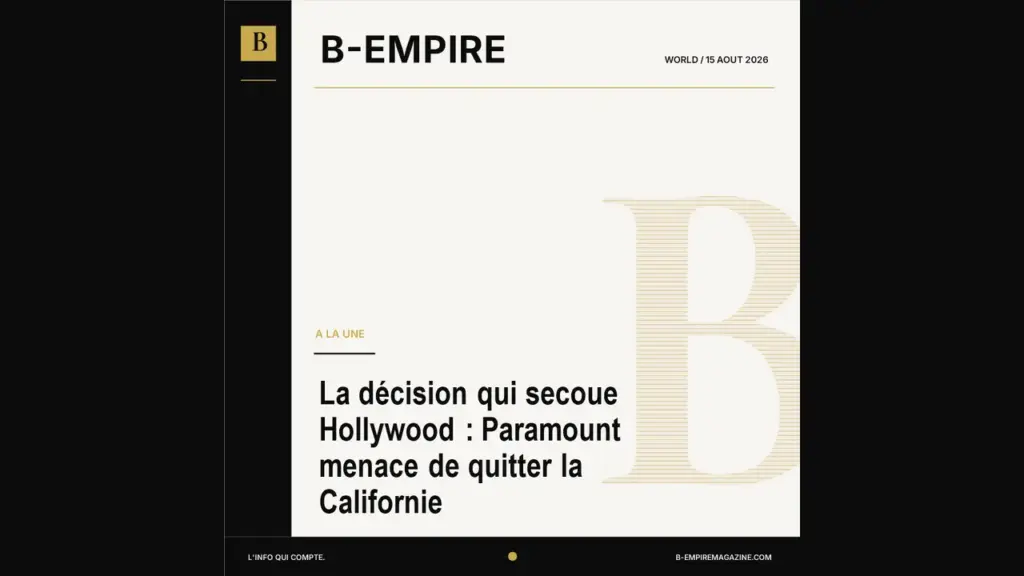
Could Hollywood lose one of its most iconic studios? Paramount Skydance is considering leaving California as its proposed acquisition of Warner Bros. Discovery faces a legal offensive from several U.S. states. This possibility, long seen as a pressure tactic, has taken on a much more concrete dimension after the group’s head, David Ellison, mentioned a potential move to his executive team, according to Axios.
The threat is spectacular because it goes beyond a mere administrative address. Paramount has been associated with Los Angeles for over a century, tied to its studios, talents, and an entire creative economy. A departure would impact California’s image as much as its economy. It would also open a new battle among several U.S. states eager to attract investments in film, television, and streaming.
A Threat at the Heart of a Giant Merger
The conflict originates from the merger between Paramount Skydance and Warner Bros. Discovery. The project, presented as a response to the power of Netflix, Amazon, and Disney, would bring together major assets in film, television, news, and streaming under one roof. It would combine Paramount Pictures, CBS, and Paramount+ with Warner Bros., HBO Max, and CNN.
A coalition of twelve attorneys general, led by California’s Rob Bonta, has initiated action to block the deal. Authorities believe that the merger would reduce competition among major historical studios and could lead to fewer productions, higher prices, and a more unfavorable power dynamic for creators. The California Department of Justice has officially requested the courts to suspend the operation while the case is reviewed.
Paramount rejects this interpretation. The group argues that the concentration would provide it with the scale necessary to compete with the tech platforms that now dominate global distribution. The company also contends that the delays imposed by the legal proceedings favor the largest streaming players at the expense of traditional studios and their partners.
Why Paramount Might Really Leave California
According to Axios, David Ellison raised the possibility of relocating Paramount’s operations out of California if no compromise is reached with Rob Bonta. Semafor previously reported that close associates and advisors of the executive were encouraging him to consider relocating the headquarters and redirecting some planned expenditures to another state.
Tennessee frequently appears in the scenarios due to Ellison’s economic ties and Oracle’s establishment in Nashville. Texas and Georgia also present strong arguments: more favorable taxation for certain businesses, growing audiovisual infrastructures, and aggressive incentive policies. However, no definitive choice has been officially announced, and a complete relocation would still be a lengthy, costly, and socially sensitive operation.
The message sent to California is nonetheless clear. Paramount wants to demonstrate that Hollywood’s historical geography is no longer intangible. Studios can shoot elsewhere, tech teams can work remotely, and competing states are ready to fund production complexes. The threat thus transforms an antitrust battle into a confrontation over employment, taxation, and economic attractiveness.
Thousands of Jobs and a Local Economy Under Strain
A studio is not just its executives and stars. Surrounding Paramount and Warner are technicians, screenwriters, set designers, costume designers, visual effects companies, caterers, transporters, and independent contractors. A significant reduction in California operations could weaken this chain, already strained by strikes, declining television orders, and international competition.
The Writers Guild of America has also initiated proceedings against the merger. The writers’ union believes that the concentration would give too much power to an even smaller number of employers. For workers in the sector, the debate thus revolves around both where films will be produced and how many companies will be able to finance and distribute their works.
California retains advantages that are difficult to replicate: a vast talent pool, unique infrastructures, renowned schools, and a supplier network built over generations. But these assets are no longer automatically sufficient. Production has become internationalized, while the UK, Canada, Australia, and several U.S. states offer tax credits and modern studios.
What This Battle Means for Global Audiences
For viewers, the case may seem distant from their screens. However, it directly impacts the diversity of films and series available. If the merger is approved, Paramount and Warner could pool their catalogs, platforms, and budgets. This power could finance major global projects, but it could also reduce competition for acquiring scripts, compensating talent, and programming riskier works.
If the operation remains blocked, both groups will have to continue separately in their race against digital giants. They might then reduce certain investments or seek other alliances. In both scenarios, the battle reveals an industry caught between two imperatives: achieving global scale and preserving enough competitors to keep creation alive.
A Signal That France and Europe Should Watch
The American standoff also concerns France and Europe. Decisions made in Hollywood influence broadcast windows, investments in local productions, rights acquisitions, and the place of European works on platforms. A more powerful Paramount-Warner entity could have greater leverage in negotiations with theaters, channels, and regulatory authorities.
France defends a model based on funding creation and obligations imposed on broadcasters. It is simultaneously seeking to attract international shoots through its studios, technicians, and tax credits. If major American groups redistribute their investments, Paris and several European regions could capture new projects, provided they remain competitive without weakening their cultural rules.
The Next Step Could Redefine Hollywood
At this stage, Paramount’s departure is not confirmed. It is an option raised in an extremely tense negotiation. The judicial timeline, the possibility of an agreement, and the conditions proposed by other states will determine whether the threat becomes an operational project.
However, the mere fact that a studio of this importance could consider breaking away from California already serves as a warning. Hollywood remains a global cultural capital, but its economic power is dispersing. Behind the duel between David Ellison and Rob Bonta, one question now dominates: will the next age of American cinema still be built in Los Angeles, or in a network of new hubs capable of challenging its center of gravity?
Sources
- Axios, August 11, 2026: Paramount’s departure plan and Rob Bonta’s reaction.
- Semafor, July 12, 2026, updated July 13: relocation scenarios and investment redirection.
- California Department of Justice, July 13, 2026: official request to block the merger.
- Writers Guild of America, July 2026: union action against the merger.
- Paramount, July 2026: official position of the group on the antitrust issue.