


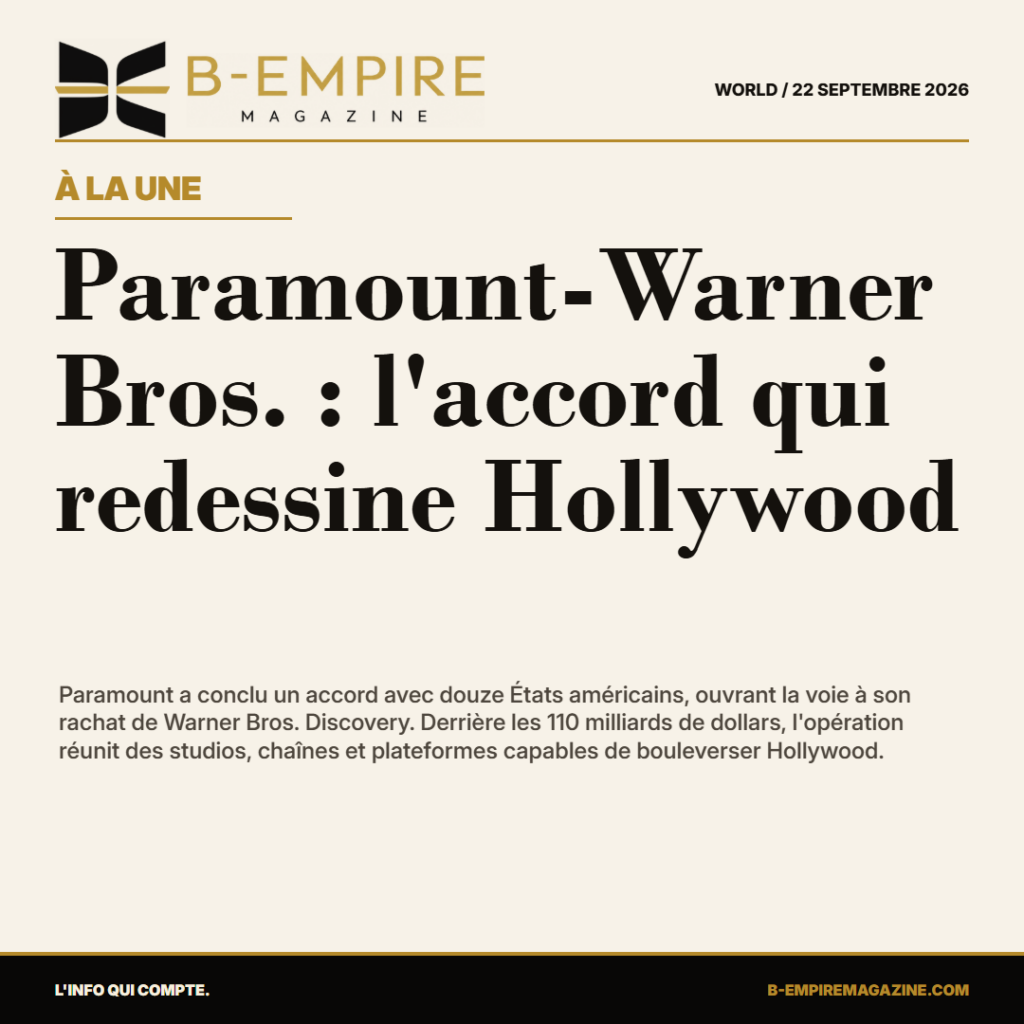
Hollywood is poised for a major transformation. Paramount Skydance has reached an agreement with a coalition of twelve U.S. states that sought to block its acquisition of Warner Bros. Discovery. This $110 billion transaction, as reported by Reuters, has thus cleared its last major legal hurdle, although the settlement still requires judicial approval. Behind this spectacular figure lies an unprecedented concentration of films, news channels, franchises, and streaming services.
The future entity would bring together Paramount Pictures, Warner Bros., CBS, CNN, HBO, Paramount+, and HBO Max. It would also control catalogs featuring Harry Potter, DC superheroes, Game of Thrones, Top Gun, Mission: Impossible, and numerous television productions. For the global audience, the question is not just whether the deal will close, but how it will transform subscription prices, the diversity of films, and access to major cultural brands.
The Last Major Hurdle Has Been Cleared
The agreement announced on September 21 ends the lawsuits filed by the attorneys general of twelve states, led by California, as well as the conflict with writers’ organizations. The plaintiffs argued that the merger could weaken competition, eliminate jobs, and grant too much power to a single group over both content production and distribution.
Paramount has agreed to several commitments. For five years, the merged group must maintain an annual film release schedule in the United States. The agreement stipulates a target of thirty films per year and a penalty of $30 million for non-compliance, according to Reuters. Paramount must also invest $1.5 billion in domestic film production and contribute to a fund for workers affected by the merger.
California Attorney General Rob Bonta presents the settlement as a means to protect jobs, creativity, and editorial independence. Separate oversight mechanisms are announced for CBS News and CNN. This is a sensitive point: by bringing two major American newsrooms closer together, the merger extends far beyond entertainment and directly impacts the pluralism of information.
An Empire Built for the Streaming World War
The merger responds to a clear industrial logic. Platforms are facing rising production costs, fierce competition, and subscribers increasingly quick to cancel. Netflix, Disney, and Amazon already wield global power. By combining HBO Max and Paramount+, the new entity could offer a broader catalog, spread its investments across more markets, and negotiate more forcefully with distributors, advertisers, and talent.
This scale can offer advantages to the public: more resources to finance ambitious films, better international distribution, and the ability to sustain works that would be too costly for a standalone player. However, it can also produce the opposite effect. When fewer groups control more brands, they have greater latitude to raise prices, bundle offers, or remove titles to cut costs.
The issue is global. Paramount claims to have obtained the necessary approvals in nearly seventy countries. The European Union and the United Kingdom had already validated the acquisition during the summer. The affected catalogs circulate everywhere, from French cinemas to African televisions, from Gulf subscriptions to Asian markets. A decision made in Hollywood will therefore alter release windows, licensing agreements, and dubbing strategies far beyond the United States.
Promises on Films Do Not Close the Debate
The commitments obtained by the states provide measurable guarantees, but their critics deem them insufficient. Producing thirty films per year says nothing about their budget, diversity, or actual exposure in theaters. A company can meet a volume target while concentrating its resources on a few global franchises and reducing riskier projects, debut films, or works aimed at specific audiences.
The promise to invest $1.5 billion seems massive but must be compared to the overall size of the operation and the savings the group will likely seek to realize post-merger. Major media consolidations are often followed by reorganizations, job cuts, and team consolidations. Writers, technicians, independent producers, and theater operators will therefore monitor budgets and schedules more closely than statements.
CNN and CBS Place Information at the Heart of the Merger
The coexistence of CNN and CBS News creates another level of accountability. Both brands have their histories, newsrooms, and identities. The independent editorial boards outlined in the agreement will need to demonstrate that they can withstand economic or political pressures. Independence enshrined in a settlement is only valuable if journalists have the means, protections, and autonomy necessary to investigate.
This dimension is also of interest to Europe, where authorities are increasingly scrutinizing media concentration and the power of platforms. A giant capable of producing a film, promoting it on its channels, distributing it through its streaming service, and covering its industry in its media possesses a considerable advantage. Transparency in decision-making and the separation between information, promotion, and commercial interests will become essential.
What Viewers Should Watch for Now
The first indicator will be the fate of Paramount+ and HBO Max. Will the two platforms remain distinct, be sold together, or eventually merge? Each scenario has implications for pricing, interfaces, and territorial rights. Subscribers will also need to observe content removals: in recent years, several groups have pulled films and series from their catalogs to cut expenses.
The second indicator will be the theater release schedule. The U.S. commitments protect a number of releases, but exhibitors will want to know the duration of exclusivity before streaming arrives. In France, where the media chronology imposes particular rules, the power of the new group could weigh in future negotiations without allowing it to circumvent the legal framework.
Finally, attention must be paid to who decides. The integration of two corporate cultures, two massive catalogs, and dozens of brands is not merely about adding franchises. The decisions regarding studios, newsrooms, and platforms will reveal the true strategy. Paramount-Warner Bros. could become a powerhouse capable of competing with the largest global players. It could also accelerate a concentration that leaves fewer choices for creators and the public. The settlement opens the door; the decisions of the coming months will reveal what Hollywood lies behind it.