


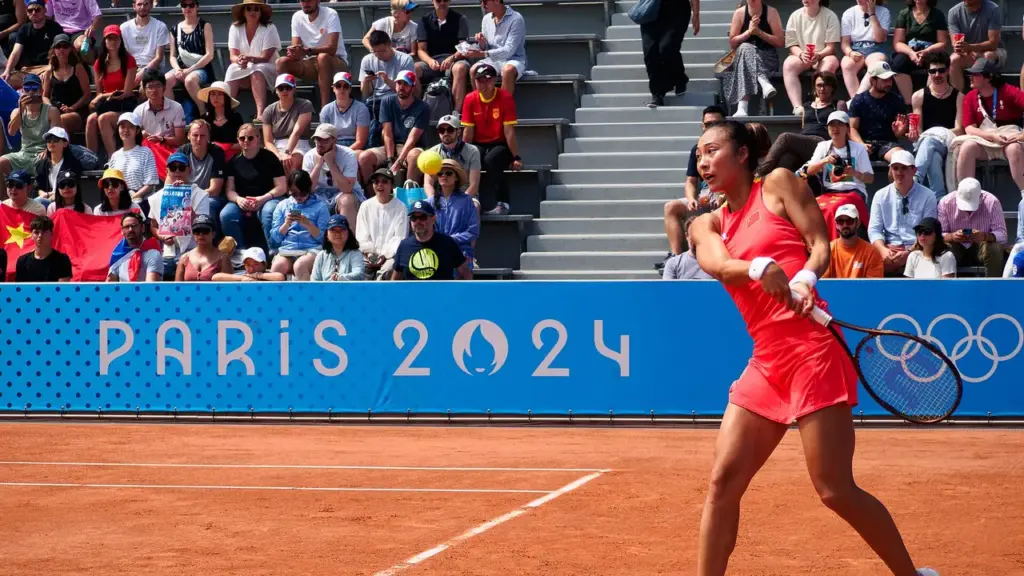
At 0-5, the opening set looked over. Qinwen Zheng turned it into the beginning of a night New York will not forget. The Chinese star won seven consecutive games, stole the set 7-5 and then defeated Iga Swiatek 6-3 in the second to reach the US Open quarterfinals. In one hour and 56 minutes, a qualifier ranked No. 121 in the world overturned a six-time Grand Slam champion.
The result is dramatic, but the story around it is even bigger. Zheng is returning from surgery, lost her seeded position and had to earn a place in the main draw through qualifying. Just two days before facing Swiatek, she had erased another 5-0 deficit in the deciding set against Madison Keys. Repeating that escape against one of the world’s best players turns a surprise into a statement: the Paris 2024 Olympic gold medalist is again capable of disrupting the order of women’s tennis.
Seven games that changed the entire night
Swiatek had built a 5-0 lead and appeared headed toward an eighth victory in nine career meetings with Zheng. The Polish champion controlled the rhythm, rushed her opponent and dominated the exchanges. Then the match changed temperature. Zheng held serve, found more depth and made Swiatek play one additional shot. Every recovered game transferred more pressure to the favorite.
At 5-3, the comeback became possible. At 5-5, it became psychological. Zheng was no longer playing merely to survive the set. She dictated patterns and moved with the confidence of a player who had already lived this exact situation forty-eight hours earlier. Seven straight games produced an almost unreal 7-5 scoreline. Swiatek never fully recovered control. Zheng closed the second set 6-3 and left the 2022 champion in tears.
Two comebacks from 0-5 in three days
The repetition makes the achievement exceptional. In the third round, Zheng trailed Madison Keys 5-0 in the deciding set and faced match point. She found the composure to come back and win. Against Swiatek, she again captured seven consecutive games from 0-5, this time in the opening set. It can no longer be dismissed as one strange scoreline. It reveals an ability to remain engaged when every visible sign says the set is lost.
Tennis is often decided in the seconds between points. A comeback of this size requires accurate hitting, but it also demands acceptance that five games cannot be repaired at once. Zheng reduced the problem point by point. That discipline eventually drew Arthur Ashe Stadium into her effort and made every exchange feel heavier for Swiatek.
From surgery to qualifying, a return without shortcuts
Zheng had climbed as high as world No. 4 before physical problems interrupted her momentum. Surgery and a long absence pushed her down the rankings. In New York, her No. 121 position sent her into qualifying, far from the protected status that her ability and Olympic title once provided. She had to begin the US Open before the main-draw stars arrived, on courts where there is no margin for error.
That qualifying route changes the meaning of her run. According to the WTA, Zheng is the first qualifier to reach the US Open women’s singles quarterfinals since Emma Raducanu in 2021. She is also the first qualifier or lucky loser to defeat Swiatek at a Grand Slam. The Polish player had previously won all fifteen of her major matches against opponents from those categories.
Why this victory is bigger than an upset
Zheng is not new to major occasions. Her Olympic title in Paris in 2024 already proved that she could defeat Swiatek on an enormous stage. New York tells a different story: the rebuilding of an athlete whose current ranking no longer represents her true level. Beating two Grand Slam champions, Keys and Swiatek, after surviving qualifying places her return among the central stories of the tournament.
The victory also travels far beyond the United States. Zheng is one of the leading figures in Chinese sport and in the global growth of women’s tennis. Her powerful game, personality and Olympic journey have given her a vast audience across Asia. A deep US Open run in the center of the world’s largest sports media market can expand that reach and give the tournament a genuinely international story.
Swiatek faces a season that suddenly looks fragile
For Swiatek, the defeat begins a difficult period of questions. She had recently regained momentum with a title in Toronto, but her year remains uneven compared with the standards she established. The US Open notes that she will complete a calendar year without a major title for the first time since 2021. Her previous dominance makes every decline more visible, and the New York scenario is especially painful because the match appeared secure before escaping one game at a time.
Swiatek acknowledged that she allowed Zheng back into the contest. That assessment does not reduce her opponent’s performance. It describes the mechanism of every great comeback: one player opens a door and the other turns it into a passage. Zheng raised her level exactly when Swiatek tried to finish the set, then protected the initiative through match point.
Rybakina is the next test for a global story
The next obstacle is Elena Rybakina, who defeated Naomi Osaka in straight sets. It will be a different challenge. Rybakina owns a serve that can shorten exchanges and power that offers little time to build a comeback. Zheng must avoid needing a third spectacular rescue. Her tournament has nevertheless proved that no score is enough to remove her mentally from a match.
In New York, the greatest stories often begin when the draw stops respecting the rankings. Qinwen Zheng entered the tournament at No. 121, but she is moving like a former No. 4 and Olympic champion. Her qualifier label describes the fall; her consecutive comebacks describe the return. That tension has made her one of the players the world is now watching at the US Open.
Sources
- US Open — Swiatek reaction, score and match narrative, September 7, 2026.
- WTA — comeback, records and Zheng’s quarterfinal berth, September 7, 2026.
- WTA — official 2026 US Open draw, accessed September 8, 2026.
- Diario AS — context on Zheng’s comeback and next quarterfinal, September 7, 2026.