
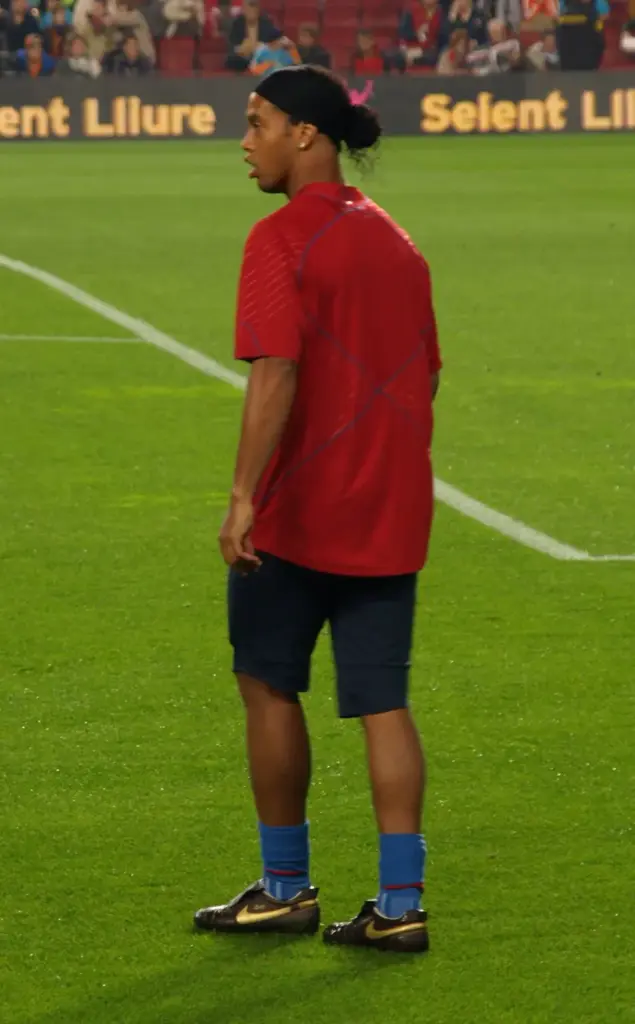
It took just a smile, a number 10, and 45 minutes to transport an entire generation back twenty years. At 46, Ronaldinho played an official match with Ravenna in Italy’s third division, eleven years after his last competitive appearance. The Brazilian did not score, but his return in a derby won 2-0 against Forlì transformed a Serie C match into an event followed far beyond Italy.
The scene felt like a time travel experience. The 2005 Ballon d’Or started the match, contributed to the build-up of the first goal, and left the pitch at halftime to applause. The score was then 1-0 in favor of Ravenna. His team later doubled the lead to conclude an evening that mattered as much for the standings as for the global football imagination.
Ronaldinho Starts, Eleven Years After His Last Official Match
The return was not a mere appearance at a gala or an old-timers’ match. Ronaldinho was named in the starting lineup for an official Serie C match against regional rival Forlì at the Bruno Benelli Stadium. He played the first half before being substituted at halftime. This nuance explains the magnitude of the attention: the Brazilian legend returned to a professional competition, with a result and points at stake.
According to Reuters, this was his first competitive match in eleven years. His last official adventure dated back to 2015 with Fluminense in Brazil. In the meantime, Ronaldinho participated in numerous exhibition matches, commercial events, and appearances with former stars, but he had not returned to this specific context: a locker room, a match sheet, and the tension of a championship.
After the match, the Brazilian told Sky Sport Italia that he enjoyed being back in the locker room and the feeling of playing. He did not completely close the door on another appearance, explaining that he would return if the club president asked him to. However, caution is warranted: this evening does not yet mean he will play regularly this season.
Why a Serie C Derby Became a Global Event
Ravenna-Forlì did not, on paper, have the media power of a Champions League fixture. However, Ronaldinho’s presence changed the scale of the match. Fans from around the world followed the images, gestures, and exit of the Brazilian. The match was broadcast live for free on Sky Sports Football’s YouTube channel, a choice that allowed the return to immediately transcend Italian borders.
Ronaldinho holds a special place in collective memory. A world champion with Brazil in 2002, a Champions League winner with FC Barcelona in 2006, and a Ballon d’Or winner in 2005, he is not only associated with trophies. His legacy also rests on a way of playing: unpredictable dribbles, no-look passes, free kicks, visible joy, and a direct relationship with the public.
This emotional capital explains why his return provoked a reaction disproportionate to the sporting level of the match. Fans were not merely watching a 46-year-old player trying to keep up. They were reconnecting with a symbol of a more spontaneous football, at a time when every performance is measured, dissected into statistics, and analyzed in real-time.
A 2-0 Victory Without Goals, But With Immediate Impact
Ronaldinho neither scored nor officially provided an assist. This is an important point to avoid transforming the emotion into an exaggerated narrative. Nevertheless, he participated in the sequence that preceded the opening goal and helped draw attention to Ravenna. Sportingly, his playing time was limited to one half, reflecting the physical reality of a return at this age after such a long interruption.
The victory for Ravenna matters more than individual statistical sheets. A prestige operation can become burdensome for a team if it diverts attention from the collective objective. The 2-0 success avoids this contradiction: the club achieved the expected result, the public experienced their moment, and Ronaldinho exited before fatigue took over.
This management renders the event credible. The Brazilian did not claim to become the player who lit up Camp Nou again. He offered a competitive, framed, and assumed interlude, in which nostalgia did not completely erase the demands of the match.
Ravenna Transforms a Legend into a Global Strategy
For Ravenna, the effect is spectacular. A third-division Italian club suddenly enjoys international exposure, attracts broadcasters, and enters mainstream media. Signing an icon can accelerate the notoriety of an institution faster than a traditional advertising campaign, provided the project maintains sporting coherence.
Modern football is well aware of this logic. Stars at the end of their careers do not just sell tickets: they bring a digital audience, partners, subscribers, and a story immediately understandable in multiple languages. Ronaldinho possesses a rare advantage here. His popularity spans Europe, Latin America, Africa, the Middle East, and Asia, well beyond the supporters of Barça, AC Milan, or the Brazilian national team.
However, the risk exists. If the legend becomes more important than the team, the operation can reduce other players to mere decor. Ravenna will thus need to find the balance between media opportunity and championship objectives. The first evening passed this test: the club won, the derby retained its stakes, and the guest respected the collective framework.
This Return Says Something About Our Time
Ronaldinho’s return occurs in a football landscape where careers are lengthening. Preparation methods, recovery, and medical follow-up allow some players to remain competitive longer. But the case of the Brazilian is different: this is not the continuity of an athlete who has remained at the highest level. It is a reappearance after eleven years without an official match.
This is precisely what makes the story universal. It speaks of time, memory, and the desire to see once more what has amazed us. At 46, Ronaldinho no longer runs like he did at 25 and cannot repeat the accelerations of his best seasons. Yet, a touch, a body orientation, or a pass is still enough to recognize the player he once was.
Social media amplifies this emotion. A few seconds of action can circulate across all continents before the match even ends. Nostalgia thus becomes an instant media product, but it remains based on a real experience: a champion has indeed returned to a professional pitch and contributed to his team’s victory.
A Historic Night, Without Impossible Promises
Ronaldinho did not announce a new career, and Ravenna did not present this match as the beginning of a return to the top. The strength of the evening lies precisely in its simplicity: after eleven years, one of the most beloved players of his generation started an official match again, played 45 minutes, and won.
The future remains open. Another appearance is possible, but no regularity is guaranteed. Whatever happens, the derby against Forlì will remain as the night when a third-division Italian fixture captured the world’s attention. Football sometimes needs great headlines and records. This time, it sufficed with a familiar smile to awaken a global emotion.
Sources
- FIFA, “Inside Ronaldinho’s Ravenna return aged 46”, November 15, 2026.
- Reuters via The Japan Times, “Soccer great Ronaldinho plays in first competitive match in 11 years at age 46”, November 16, 2026.
- The Guardian, “Ronaldinho makes debut for Italian side Ravenna after 11-year hiatus”, November 15, 2026.
- Sky Sports, coverage of Ronaldinho’s return with Ravenna, November 15, 2026.