


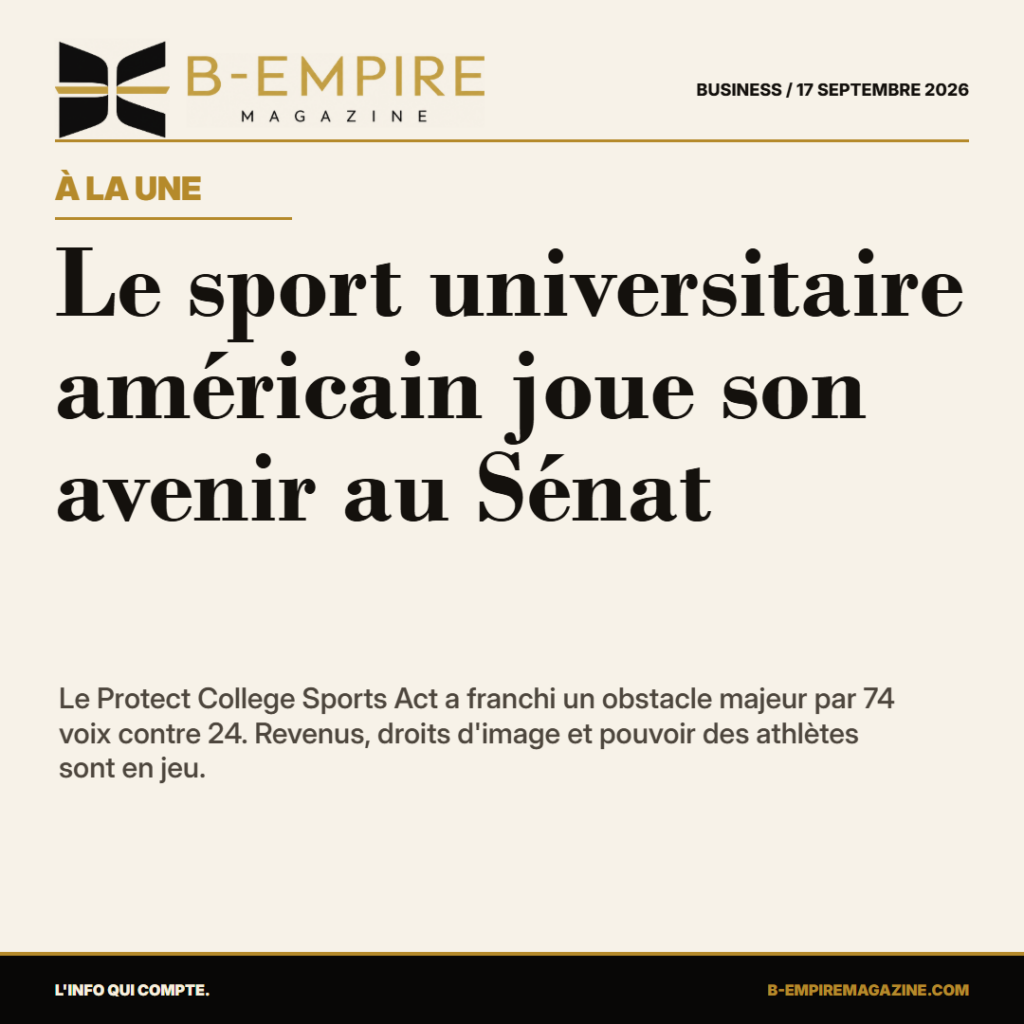
American college sports is approaching a historic change in its rules. On September 15, 2026, the Senate voted 74-24 to end debate on the motion to consider the Protect College Sports Act. That procedural vote does not yet turn the bill into law, but it shows that a sufficiently broad bipartisan coalition is prepared to impose a national framework on an industry that has become too wealthy, too litigious and too fragmented to keep operating through temporary compromises.
Bill S.4668 addresses student athletes’ name, image and likeness rights, revenue sharing, transfers, scholarships, health protections and agents. It seeks to stabilize a system transformed since athletes gained the ability to earn money from their commercial identity. Behind the legal language lies a simple question: who should control money, careers and risk in a market where players produce the spectacle without being ordinary employees?
NIL opened an economy without one rulebook
NIL rights ended an untenable contradiction. Universities, conferences, broadcasters and sponsors could earn billions around competitions while athletes were prevented from monetizing their own fame. But opening the market created a patchwork of state laws, school rules, commercial agreements and court decisions. The best-funded programs built sophisticated networks, while others struggle to keep pace.
The Protect College Sports Act would place athletes’ right to receive compensation for their identity into federal law and create guardrails around revenue sharing with schools. Its stated goal is to replace uncertainty with national standards. For schools and brands, uniformity could lower legal costs. For players, it could clarify contracts, remedies and the accountability of intermediaries.
An industry caught in a spending spiral
Democratic Senator Maria Cantwell, who wrote the bill with Republican Ted Cruz and other lawmakers, released a report describing a spending spiral since NIL payments expanded. Donor-backed collectives, coaching contracts, facilities and recruitment fuel a race in which programs spend to avoid losing their position. The market increasingly resembles a professional league without a general collective bargaining agreement.
This inflation does not affect only football and basketball. Revenue from those sports often finances Olympic disciplines and women’s teams that command fewer media-rights dollars. Supporters of the bill argue that a stable framework will preserve those programs. Yet the opposite risk exists: if spending limits primarily protect institutions, they may preserve inequality while indirectly capping the value paid to athletes.
Protections promised to students
The bill emphasizes scholarship protection, certain health rights and stronger oversight of agents. These measures address real vulnerabilities. An injury can end a career before it begins, a bad contract can surrender rights for years and a poorly advised transfer can cost a season of eligibility. In a young market, information asymmetry naturally favors experienced intermediaries.
The legislation also seeks to organize the transfer portal, which has become a permanent recruiting market. Greater predictability would help coaches build rosters and students plan their education. But mobility remains one of the few individual levers available to athletes. Any restriction therefore deserves caution: stabilizing teams should not trap a player in an academic or athletic situation that no longer works.
Antitrust protection drives the opposition
Critics, led in part by Senator Chris Murphy and supported by labor and civil-rights groups, argue that the bill gives too much power to universities and conferences. Their central concern involves antitrust protections that could allow the industry to coordinate limits without facing the lawsuits that have opened pathways to greater compensation.
Opponents say the proposal could legalize exploitation in the name of order. They want athletes to be able to bargain collectively and their professional status to be addressed more directly. The debate therefore extends beyond NIL details. It pits two models against one another: college sports retaining an educational identity with regulated exceptions, or an industry fully recognizing that its most important talent performs economic labor.
Media and fans are part of the equation
The bill requires at least one free local broadcast option for certain football and basketball games involving participating schools. That provision recognizes that college sports derives value from communities, alumni and regional traditions, not only national subscriptions. As competitions migrate toward paid platforms, access is becoming a sports-policy issue.
The measure also has commercial logic. A free audience sustains attachment, exposes sponsors and renews generations of supporters. Locking every game behind multiple subscriptions may increase short-term revenue while weakening the product’s cultural base. Congress is therefore intervening in an architecture where media rights, player compensation and the survival of smaller sports are directly connected.
A decisive vote, but not a final victory
The 74-24 result comfortably exceeded the 60 votes needed to clear the procedural obstacle. It gives supporters important momentum in the Senate. But the bill must still pass and then find a path through the House of Representatives, where other college-sports proposals have failed. The compromises that made the coalition possible may also fray when amendments touch transfers, women’s sports, Olympic programs or bargaining power.
The moment is significant nonetheless. College sports can no longer pretend that the old amateur model will return. Athletes have secured recognized commercial value, conferences are realigning around media and universities are making commitments comparable to entertainment companies. The question is no longer whether the system will change, but who will write the rules and who will benefit.
The next battle is about balance
A national law can reduce chaos without resolving the underlying conflict. Schools want budget certainty, broadcasters want a stable product, fans want simple access and athletes want a fair share of the value they create. None of those goals is illegitimate, but they do not align automatically.
The Protect College Sports Act will be judged less on its ability to restore order than on the quality of that order. If it genuinely protects scholarships, health, mobility and player income while sustaining less profitable sports, it could become the architecture the industry has awaited for years. If it uses stability to limit athlete power, litigation will return in another form. The Senate score opens the door; it has not decided the game.