


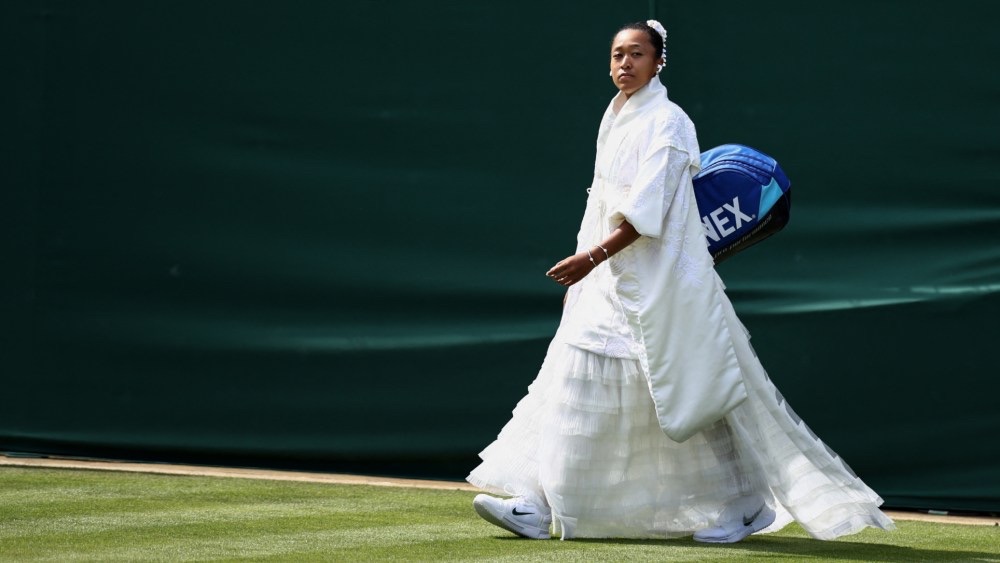
Wimbledon 2026 isn’t just about scores, serves and draws. The tournament is also telling a story of image, desire and staging. And on that front, Naomi Osaka is delivering one of the fortnight’s most powerful narratives. According to Vogue, as early as July 1, 2026, the Japanese star turned heads with an all-white entrance outfit designed as a tribute to Japanese ceremonial dress. Then, on July 3, 2026, The Guardian showed just how much these walk-on fits have become a genuine talking point at Wimbledon, far beyond hardcore tennis fans. The signal is strong: Osaka isn’t just playing a match anymore, she’s building a global cultural moment.
This story is almost ideal for B-EMPIRE Magazine’s editorial line. First, it’s worldwide, because Wimbledon remains one of the sporting world’s great gatherings and Naomi Osaka remains one of the most visible athletes on the global circuit. Second, it sits at the crossroads of several zeitgeist worlds: sport, fashion, social media, identity, brands and storytelling. Finally, it has real Google Discover potential because it rests on a simple, immediate image: a major champion turns her court entrance into a style statement, without ceasing to be dangerous racket in hand.
A white outfit that changed the conversation around Wimbledon
According to Vogue, Naomi Osaka chose a white silhouette for Wimbledon 2026 inspired by Japanese ceremonial dress, with elaborate textures, embroidery and transformable layers. The magazine explains the outfit was designed with stylist Hana Yagi and creative director Marty Harper, built around one central idea: turning the transition between ritual and competition into a real visual statement. In a tournament known for its strict dress code, this choice isn’t trivial. It shows that the constraint of white can also become a tool of sophistication and distinction.
The Guardian, on July 3, 2026, goes further, explaining that these walk-on outfits have become a moment in their own right for fashion and for brands. The paper cites Osaka as one of the central figures of this movement, alongside other players who understand that even before the first rally, there’s already a photo, a visual impact, social media circulation and commercial promise. This isn’t a backstage detail. It’s a change of logic: the match now begins before the first point.
Why Naomi Osaka is the perfect person to embody this shift
Naomi Osaka isn’t an ordinary player in the attention economy. For years, she has been one of the rare tennis stars able to speak simultaneously to sports fans, fashion audiences, pop culture and business. That versatility matters enormously. Many great players sell tickets or audiences. Few can turn a court entrance into a global cultural conversation. Osaka can do both. That’s precisely what this Wimbledon 2026 sequence confirms.
The most important thing is that this visual dimension isn’t happening in a vacuum. The Guardian also reports that Osaka dominated Daria Kasatkina 6-1, 6-3 on July 3, 2026 to reach the second week of Wimbledon for the first time. That detail changes everything. When style accompanies performance, it stops being mere polish. It becomes an extension of sporting power. Osaka isn’t watched just because she’s photogenic or because she inspires brands. She’s watched because she wins, and because she wins with a very strong visual signature.
Wimbledon becomes a field of luxury, branding and symbolic power
The most interesting point in The Guardian’s article may lie elsewhere: these entrance outfits are increasingly conceived as a form of armour, and therefore as a tool of confidence, storytelling and affirmation. That’s an important reading. In modern sport, clothing is no longer just functional. It signals identity, status and ambition. On a court as symbolically charged as Wimbledon, every centimetre of fabric can carry a message about the person, the brand and the era.
It’s worth clearly separating what comes directly from the sources from what is editorial inference. The sources show very clear facts: Osaka’s outfit was designed as a cultural gesture, it was widely discussed, and Wimbledon is increasingly becoming a stage where fashion takes a more visible role. From there, the reasonable inference is this: major world tennis tournaments increasingly function as luxury and branding platforms, at the crossroads of premium sport and global visual culture. For a brand or an athlete, the image value of a Wimbledon run is no longer decided by the final scoreboard alone.
Tennis’s most conservative tournament opens up to a new modernity
This might be the most fascinating contradiction of the story. Wimbledon is probably the major tournament that most embodies tradition, restraint, white, codes and an almost institutional idea of elegance. And yet it has also become the ideal place for an ultra-contemporary demonstration of style. Because restriction paradoxically produces more creativity. When everything must stay white, every difference in texture, cut, layering or cultural reference becomes more visible. That’s exactly what Osaka understood.
The result is powerful: far from breaking Wimbledon, this boldness modernises it. It lets the tournament keep existing in the global conversation without losing its DNA. That’s also why this story goes beyond tennis. It’s about how historic institutions learn to survive in an era of fast images, narrative luxury and total personalisation. Osaka acts here as a bridge between old prestige and 2026’s visual grammar.
Why this story can interest audiences well beyond tennis fans
The great strength of this story is its readability. Even a reader who doesn’t follow the tournament daily instantly understands the stakes. A global star arrives at tennis’s most codified tournament with a spectacular entrance outfit, inspired by a strong cultural imagination, validated by Vogue, and then keeps winning on court. It’s a simple, visual, highly shareable narrative. It activates several communities at once: tennis fans, fashion enthusiasts, branding watchers, pop culture lovers, and audiences following the world’s great female sporting figures.
For B-EMPIRE, this is a real plus. The article can move beyond pure sports coverage and reach a broader, more premium, more international readership. It can also speak to France without forcing an artificial angle. Why? Because Europe’s fashion and luxury world, along with major tournaments, watches this kind of moment closely. London holds the stage today, but the entire premium fashion ecosystem, from Paris to Milan, understands very well the value of these images. So the story is global, European and culturally rich without becoming a purely French affair.
The real signal of Wimbledon 2026
The real signal isn’t just that Osaka pulled off a striking entrance. The real signal is that world tennis is increasingly accepting that performance and image move forward together. For a long time, part of the sport tried to suggest you had to choose between style and game. Naomi Osaka’s week at Wimbledon says exactly the opposite. Yes, appearance matters. Yes, visual storytelling matters. Yes, brands, photographers and fashion magazines watch the tournament as a showcase. But all of this becomes even more powerful when the champion converts that attention into results.
As of July 4, 2026, it’s fair to say Naomi Osaka embodies one of Wimbledon’s most contemporary faces. Vogue documents the cultural construction of her outfit. The Guardian shows these entrances have become a genuine fashion moment while the player keeps advancing in the draw. From these facts, one conclusion stands: Wimbledon is no longer just a temple of tennis. It’s also a global stage where desirability, symbolic power and the commercial value of stars are negotiated.