


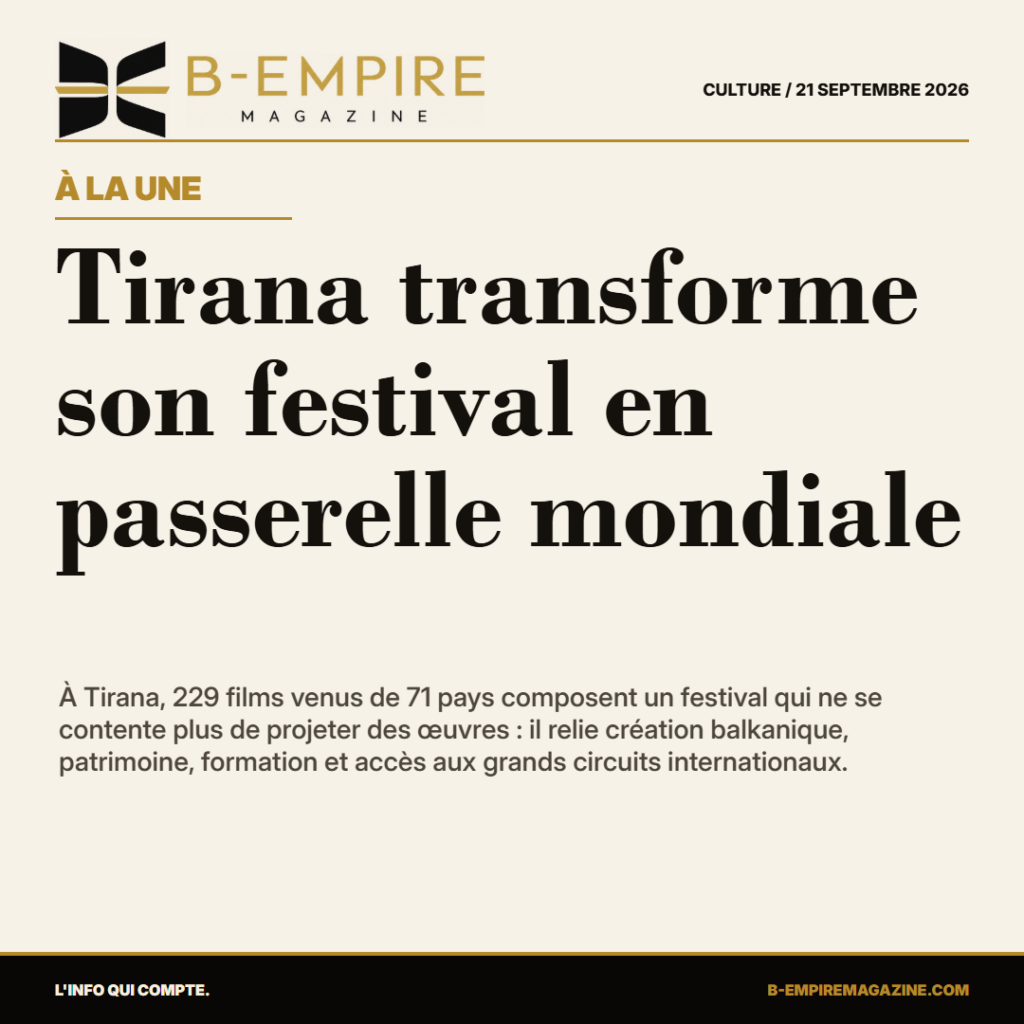
On September 21, Tirana opens a week of cinema whose significance extends far beyond the number of screenings. For its 24th edition, the Tirana International Film Festival brings together 229 films, including 27 features and 202 shorts, from 71 countries. In a capital seeking to consolidate its place on Europe’s cultural map, the festival is above all building infrastructure: a place where films travel, screenplays meet producers, and Albanian heritage enters into conversation with contemporary creation.
The chosen theme, Bring It Back! Humanography, gives the event a clear editorial direction. At a time when synthetic images and artificial intelligence tools are rapidly changing audiovisual production, Tirana is putting human gestures, contradictions and stories back at the center. This position is not a rejection of technology: the program also includes an AI 3.0 section. Instead, it argues that innovation only becomes meaningful when it serves an author’s vision, experience and responsibility.
A Small National Market With an International Gateway
The figures reflect the event’s growing appeal: 3,319 submissions, including 3,228 films and 91 scripts, from 120 countries. The competition selection includes 179 films and twelve screenplay projects. Most importantly, every programmed work is presented as a world, international, regional or national premiere. Scarcity becomes an advantage here: attending Tirana means discovering films before they are absorbed into the global content stream.
The festival’s status strengthens this gateway function. TIFF is listed among the festivals that qualify films for the Academy Award for Best Short Film and belongs to the European Film Academy’s short film network. For a filmmaker from a territory where production and distribution resources remain more limited, selection is therefore more than a line in a biography. It can create a path toward academies, international sales agents and other festivals.
Films That Shift Dominant Narratives
The opening film, Mother by North Macedonian director Teona Strugar Mitevska, sets the tone. Presented as a national premiere, it examines the person behind the myth of Mother Teresa. The choice is especially relevant in Tirana: it views a global figure from the Balkans and refuses to reduce the region to a peripheral setting or a fixed identity.
The program continues this process of shifting perspectives. Shame and Money by Visar Morina, which the festival says won the Grand Jury Prize at Sundance 2026, joins the special screenings. A focus on North Macedonia and a Swiss short film selection broaden the European connections, while artist Dora García introduces another visual language through a video art program. Together, these works reveal a festival less concerned with enforcing a single identity than with movement between national cinemas, diaspora, experimentation and memory.
Memory as a Development Tool
The closing night illustrates another strength of the project: restoration. The festival will host the world premiere of a restored 4K version of Mimoza Llastica, the 1973 Albanian film directed by Xhanfise Keko, in partnership with Albania’s Central State Film Archive. Restoring a film is not merely about saving a reel. It returns a work to new audiences, renews its ability to circulate and places a national cinema within a visible history.
The tribute to Luchino Visconti complements this heritage approach, but the most strategic gesture may be the link between past and future. The StudenTIFF program connects the arts universities of Tirana and Prishtina, while the fifth Screenplay ContesTIFF supports twelve scripts and arranges their presentation to industry professionals. The festival therefore does not only celebrate completed films: it works on the conditions that will allow the next film to exist.
One Week of Screenings, a Year of Connections
Spread across six Tirana venues through September 27, TIFF combines screenings, meetings, masterclasses, workshops and TIFForum discussions about identity, representation, production and new forms of storytelling. That density matters. In the creative economy, a festival’s value is measured as much by the conversations it creates as by the tickets it sells.
For Albania and its neighbors, the challenge is twofold: retain talent by providing a credible local network, then offer it an international route. Tirana does not have the budgets or media power of Cannes or Venice. Its strength may come precisely from elsewhere: a more accessible scale, specialization in short film and the ability to connect heritage, first features and regional co-productions.
This 24th edition demonstrates how a festival can become an instrument of cultural policy without losing its passion for cinema. Behind the 229 films lies an architecture of trust: filmmakers entrusting a premiere, institutions recognizing the selection, archives reopening their collections and producers listening to projects that are still fragile. That may be the real Humanography promised by Tirana: putting people back at the center while also giving them the structures their stories need to travel.