


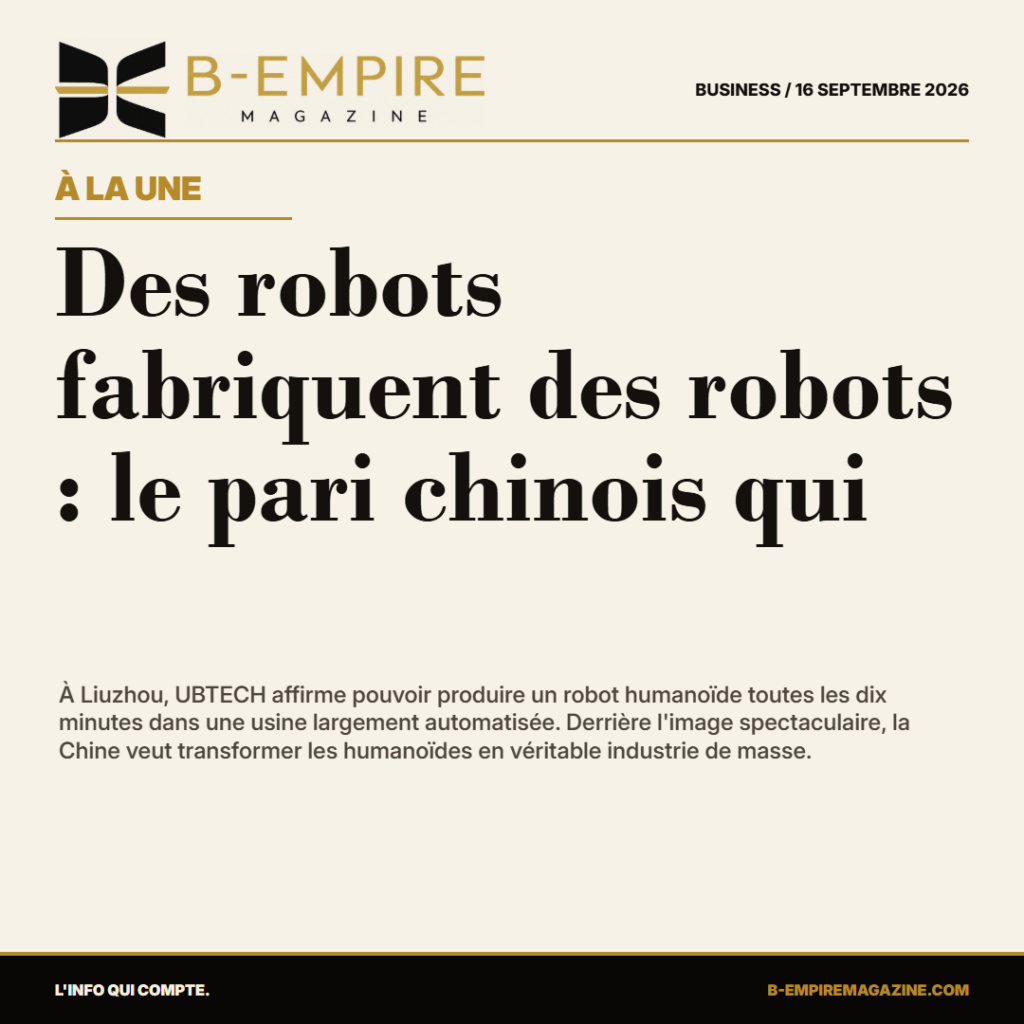
A scene once confined to science fiction is acquiring an industrial dimension: robots are now helping to manufacture other robots. In Liuzhou, southern China, UBTECH Robotics has opened a plant dedicated to industrial humanoids and announced a striking target rate of one completed machine every ten minutes. The facility is designed for annual capacity above 10,000 units. That does not mean 10,000 robots have already been delivered. It does signal an important shift: the global humanoid race is no longer limited to laboratories and demonstration videos. It is moving onto production lines.
A factory built to move from prototypes to series production
The plant began operating on September 12, 2026, in Liuzhou, Guangxi, and covers roughly 14,000 square meters. It is expected to assemble mainly Walker S robots designed for industrial work, along with Cruzr machines, mobile platforms already used in reception and service settings. According to information released by UBTECH and reported by several specialist outlets, planned annual capacity exceeds 10,000 units.
The phrase “robots building robots” is compelling, but it needs context. This is not a completely autonomous factory emptied of people. Production combines automated stations, guided vehicles, digital systems and human operators. Humanoids may take part in some material-handling or inspection flows, while specialized machinery performs operations that demand speed and precision. The real break is therefore not the instant replacement of workers, but the gradual integration of flexible robots into the chain that makes them.
One robot every ten minutes: promise or proven rate?
UBTECH presents a theoretical pace of one unit every ten minutes. This is an industrial target, not an independently audited record of continuous output. The site has only just started operating. Actual performance will depend on demand, component supply, line efficiency, quality checks and the long-term reliability of its equipment.
Early indicators nevertheless show that the company has moved beyond pure prototypes. EWeek reports that UBTECH delivered 921 full-size humanoids in the first half of 2026. Over the same period, the company posted an interim loss of 339 million yuan on revenue of 1.27 billion yuan. In other words, volume is rising, but profitability remains a challenge. Producing more machines will not be enough. They must complete useful, repeatable tasks at a cost that keeps factory customers coming back.
Digital tools at the center of the line
UBTECH used tools from Siemens Digital Industries Software to design the site. The production line was modeled as a digital twin reproducing workstations, storage racks and autonomous guided vehicles. The simulation can test movements, identify bottlenecks and adjust the layout before teams physically modify the workshop.
This approach matters for humanoids. Unlike a robot arm fixed to the floor and programmed for a single movement, a biped combines motors, sensors, batteries, vision systems and onboard computing inside a compact body. Assembly is complex and tolerances are tight. The ability to repeat that process quickly while maintaining quality may be the factory’s most consequential innovation.
Why China is accelerating now
China has a clear advantage: a dense ecosystem of motor, battery, sensor, electronics and mechanical-component manufacturers. It also has an enormous industrial base in automobiles and electronics, two sectors where humanoids are being tested to move parts, inspect equipment and perform strenuous work.
UBTECH has announced deployments or collaborations involving companies such as BYD and Foxconn. Walker S is designed to operate in spaces originally built for human employees. That is the central promise of the humanoid format: using existing tools, aisles and stations without rebuilding an entire factory. Its flexibility still has to be demonstrated at scale. For many operations, a specialized machine remains faster, cheaper and more robust.
A global race with immediate consequences
The Liuzhou launch comes as humanoid projects multiply across the United States, Europe and Asia. Tesla is advancing Optimus, Hyundai and Boston Dynamics are developing their platforms, and several Chinese companies are announcing production lines. The competition concerns software, but also the ability to manufacture thousands of reliable machines at an acceptable cost.
For workers, the important question is not simply whether a robot can walk or pick up an object. It is which tasks will be automated, how quickly that change will arrive and what safeguards will accompany it. Repetitive or dangerous jobs may be transformed first. New roles will emerge in maintenance, supervision, programming and safety. Companies must also confront difficult issues involving accident liability, images collected by sensors, cybersecurity and dependence on proprietary platforms.
The signal global industry can no longer ignore
UBTECH’s new factory does not prove that humanoids are ready to conquer every production site. It does prove that their industrialization has become an immediate, funded and measurable objective. The figure of one robot every ten minutes is a message to investors as much as to competitors: China wants to impose its speed before the market settles.
The real test begins now. Observers will need to track the number of units actually produced, their utilization at customer sites, their total cost and their reliability after months of work. If those indicators match the announcements, Liuzhou may be remembered as the moment the humanoid robot stopped being a technology attraction and became an industrial product. If they do not, the plant will be a reminder that a theoretical rate and an economic revolution are separated by a long chain of evidence.