


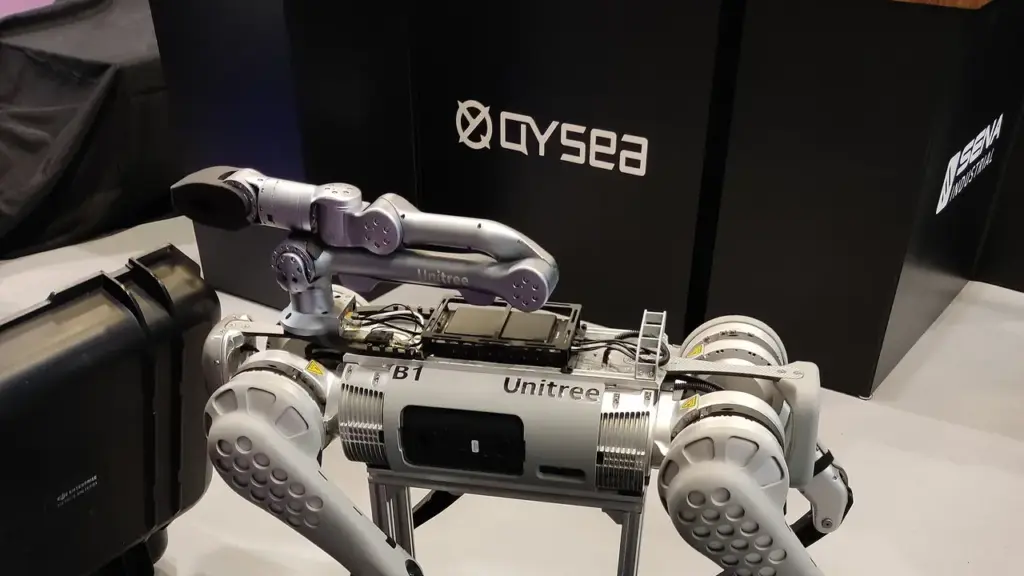
The technological war between Washington and Beijing has just crossed a spectacular frontier: after chips, telecoms, electric vehicles, and drones, robots capable of walking, seeing, and acting in the real world have now entered the red zone. The United States has blocked the authorization of new foreign models of humanoid and quadruped robots, a measure that effectively targets the Chinese ecosystem. Behind national security lies the next major industry of artificial intelligence.
The Federal Communications Commission, the American communications regulator, has added “advanced robotic devices” to its list of equipment deemed to pose an unacceptable risk. The decision concerns new connected and mobile models, not machines already purchased or previously authorized references. Nevertheless, it strikes at the heart of a still young market: Chinese companies are already offering cheaper robots that are quick to develop and increasingly visible in laboratories, factories, and viral videos.
A Ban Targeting Much More Than Spectacular Machines
A modern humanoid robot is not just a simple automaton programmed to repeat a gesture. It combines cameras, microphones, depth sensors, network connectivity, artificial intelligence software, and physical capabilities. It can map a building, learn a task from images, grasp objects, and transmit large amounts of data. This accumulation of functions explains Washington’s central argument: a connected and mobile machine can become both a sensor, a computing terminal, and a physical actor.
According to the American justification reported by Reuters, these capabilities create vulnerabilities that could allow for surveillance, data theft, or remote takeover. The most concerning scenario is not that of a science fiction robot spontaneously rebelling, but rather that of a compromised device circulating in a factory, warehouse, research center, or critical infrastructure.
Unitree, a Symbol of Chinese Advancement Now Under Pressure
The name Unitree is at the center of this battle. The Chinese company has become one of the most recognizable brands in mobile robotics thanks to its robot dogs and humanoids capable of running, dancing, or executing complex movements. Reuters indicates that it holds just under one-fifth of the global humanoid market, according to Counterpoint Research. Its strength is both industrial and media-related: it knows how to produce quickly, display aggressive pricing, and turn every demonstration into a global event.
This visibility is precisely what makes the American decision so significant. By cutting off access for new models to the U.S. market, Washington buys time for domestic players, including Tesla with Optimus, Agility Robotics with Digit, and Figure AI. The security measure thus has a clear economic effect: it protects an American ecosystem that is investing heavily but faces Chinese competition capable of reducing prices much more rapidly.
The New Front of AI is No Longer Just on Screens
For three years, the global AI competition has focused on language models, chips, and data centers. Robotics changes the nature of the balance of power. It takes artificial intelligence out of screens and places it in factories, logistics, hospitals, retail, and perhaps homes. Companies speak of “embodied AI” or “physical AI”: systems that no longer merely generate a response but perceive an environment and perform an action within it.
The economic potential is immense. A versatile robot could fill labor shortages, take on dangerous tasks, and operate in spaces designed for the human body without requiring complete reconstruction of buildings. However, the same versatility amplifies questions of liability, safety, and employment. The machine that knows how to move a box can also manipulate a door, a command, or a tool. Its software thus becomes as strategic as its motor.
Washington Resumes the Method Used Against Huawei and Drones
The regulatory mechanics resemble the American restrictions imposed on telecom equipment, routers, and drones. The FCC does not seize robots already in circulation; it refuses the necessary authorization for the marketing of the new models in question. A waiver process is intended to allow certain manufacturers to prove that they do not present the identified risk, notably with the support of the Pentagon or the Department of Homeland Security.
This architecture allows the American administration to display a broad ban while accommodating exceptions for allied companies or products deemed essential. It also avoids a sudden halt for laboratories already using foreign platforms. The political signal, however, is unambiguous: the United States now considers the robotic supply chain as a strategic infrastructure.
A Possible Shock for Universities and Startups
Protecting a national industry can, however, slow down those who need affordable equipment to innovate. Chinese robots have gained ground in research because they offer relatively accessible platforms, compatible with open software tools and available without waiting for still limited American production. For a university or a startup, the price difference can determine whether an experiment is feasible or not.
The risk is therefore twofold. Washington wants to avoid future dependence on China, but an overly broad restriction can reduce immediate access to the machines necessary to train American systems. Exemptions will be crucial. If they are slow or unpredictable, large groups may absorb the shock while small laboratories lose time, budgets, and sometimes their scientific edge.
China Could Accelerate Instead of Retreating
American controls on semiconductors have already shown that a ban does not always produce the expected effect. It can hinder access to technology but also push the targeted country to invest more in its own components, standards, and alternative markets. For Chinese robot manufacturers, opportunities in Asia, the Middle East, Africa, Latin America, and Europe remain considerable.
Beijing has made humanoid robotics an industrial priority. Its companies benefit from an exceptional network of suppliers for batteries, motors, sensors, electronics, and mechanical parts. Even deprived of the American market for its upcoming models, China thus retains a manufacturing advantage that is difficult to replicate. The possible consequence is a gradual separation: two robotic ecosystems, two sets of standards, and two data circuits that become less and less compatible.
Europe and France Face an Impossible Decision to Ignore
For the European Union, this American decision poses an immediate question. Should it follow Washington in the name of cybersecurity, open the market to accelerate automation, or build a European path with strict requirements on data and remote control? Europe has a strong tradition of industrial robotics, particularly in Germany, France, Italy, and Switzerland, but it does not yet have a humanoid champion capable of matching the visibility of American and Chinese groups.
France has recognized laboratories, AI engineers, and an industrial fabric that could benefit from this shift. However, it will need to move from demonstrators to production. The challenge is not limited to inventing an excellent prototype: it requires large-scale manufacturing of actuators, sensors, and batteries, securing software, training operators, and convincing companies to adopt these machines without sacrificing employee protection.
The Decision That Transforms the Robot into a Sovereignty Issue
The American gesture marks a turning point because it comes before the massive dissemination of humanoids. Governments no longer want to wait for millions of devices to be installed to decide who controls their software, data, and updates. The robot is now treated like the smartphone, the drone, or the 5G antenna: a commercial product whose origin can become a matter of national power.
This anticipation also reveals the fear of missing the next industrial revolution. If humanoids become truly capable of performing varied tasks at a competitive cost, the country that dominates their manufacturing will control an essential part of global productivity. Washington has just sent its clearest message: it refuses to let this position be occupied without resistance by China. The world thus discovers that the battle for AI will not only be fought in the cloud. It will soon walk on two legs.
Sources
- Reuters via Boursorama â American restrictions, scope of the measure, and Unitree’s position, July 28, 2026.
- Le Monde with AFP â Implementation of the ban on foreign humanoid robots, July 29, 2026.
- U.S. House of Representatives Special Committee on the Chinese Communist Party â Risks invoked and GUARD Act, June 2026.
- U.S.-China Economic and Security Review Commission â Recommendation on autonomous Chinese humanoid robots, 2026.