


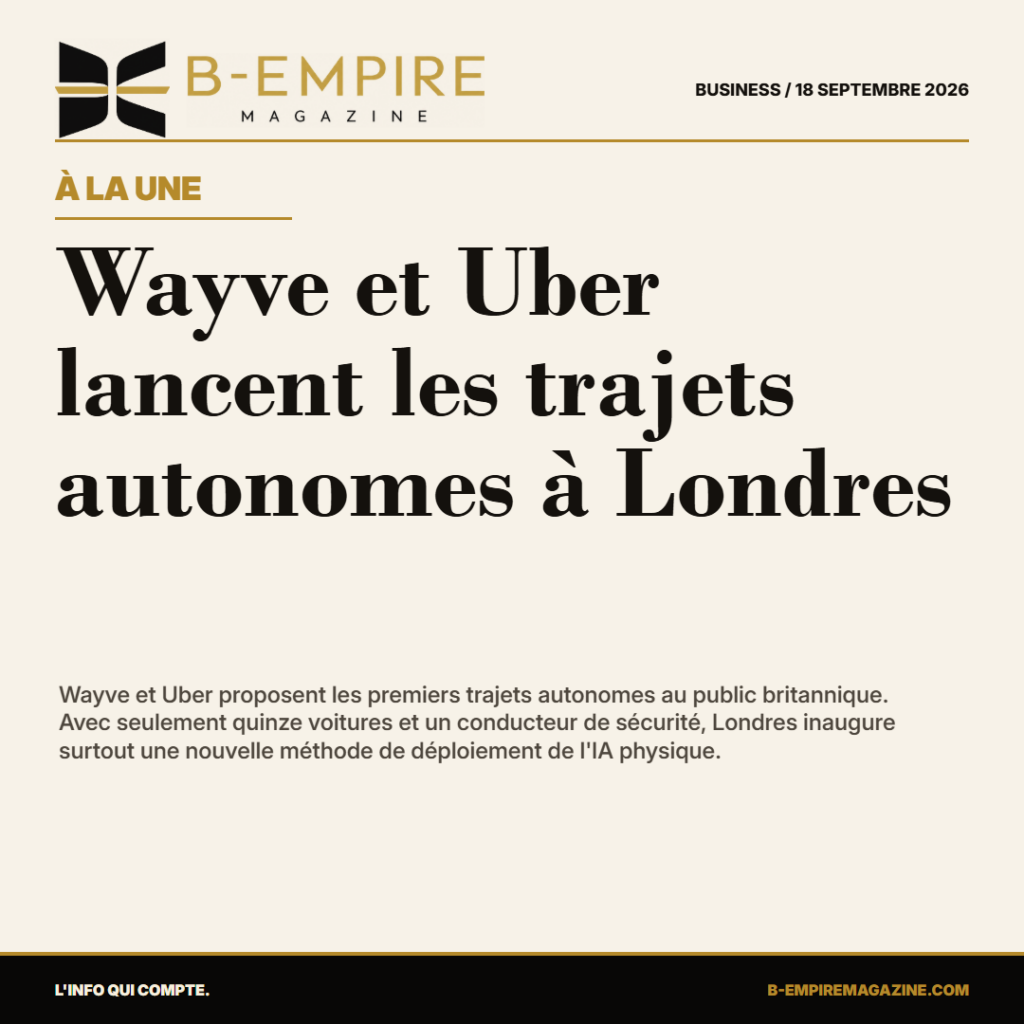
The autonomous taxi has arrived in London, but it still keeps a human pair of hands close to the wheel. Since early September, Uber users can be matched with an electric Ford Mustang Mach-E fitted with Wayve’s driving system. The trip is priced like a normal ride, and the passenger can decline the vehicle. A driver licensed by Transport for London nevertheless supervises the machine and can take control. That human presence does not make the launch insignificant. It shows how a spectacular technology gradually becomes an ordinary service.
Fifteen cars in a city of nine million people
The initial deployment is tiny: fifteen vehicles, according to information released at launch, within a London Uber network numbering tens of thousands of cars. The chance of randomly receiving a Wayve vehicle remains low. Yet fleet size alone does not measure the operation’s importance. For the first time in the United Kingdom, ordinary passengers are paying for a journey during which an automated system performs most of the driving on the capital’s complex streets.
London is an unusually demanding test bed. Buses, bicycles, pedestrians, construction, narrow streets, roundabouts and changing weather require rapid decisions in an environment that is rarely uniform. Since 2018, Wayve has developed a machine-learning approach designed to interpret the road scene and adapt, instead of relying exclusively on highly detailed maps and locally coded rules. The public launch brings that promise into contact with everyday unpredictability.
Autonomous does not yet mean driverless
The language needs careful handling. These rides are autonomous in the sense that the Wayve AI Driver controls the vehicle during the journey. They are not yet fully driverless. The professional in the driving seat provides safety supervision, passenger support and compliance with the current licence. A separate authorization will be required before that supervision can be removed.
This distinction protects the public from an inflated promise and also protects the companies. Every mile traveled with passengers produces data about rare situations, customer reactions, pickup locations and human interventions. The safety driver is therefore both an operational backstop and a source of learning. Wayve’s challenge is not simply to prove that its AI can drive. It must show that the system can drive predictably, explainably and consistently enough to earn regulatory trust.
Uber wants to own demand, not necessarily the cars
The partnership also reveals Uber’s strategy. The platform is no longer trying to develop all autonomous technology on its own. It is building alliances with specialists and offering what it already controls: a huge customer base, pricing, payments, support and ride allocation. Under this model, several autonomous systems can coexist with human drivers inside the same app.
This hybrid architecture addresses a major economic problem. An autonomous fleet is expensive to buy, equip, clean, charge, maintain and reposition. Its return depends on how many hours the vehicles actually carry customers. A platform able to direct immediate demand toward each car can improve utilization. Uber thus becomes the distributor of autonomous mobility, while Wayve supplies driving capability and fleet owners carry the physical assets.
Regulation moves in layers
The United Kingdom opened applications in May for a program allowing automated taxi and shuttle services to be tested. Full commercial access, however, does not rest on one permission. The vehicle, operator, transport service and driverless use are subject to different controls. Transport for London granted private-hire vehicle licences to the modified Mustangs; that does not yet amount to general approval for a service with no human aboard.
This layered progression may appear slow, but it distributes responsibility more clearly. After an incident, authorities must know who is accountable for the decision: the manufacturer, system developer, fleet operator, platform or the person in the vehicle. Rules must also cover cybersecurity, software updates, data retention and failure reporting. An autonomous car is simultaneously a transport device, a connected computer and a financial service.
Work does not vanish; it moves
Public debate often focuses on the future elimination of drivers. In the near term, the London launch tells a more complicated story. It creates demand for supervision, maintenance, remote support, cleaning, operational mapping and safety analysis. At the same time, conventional drivers may fear pressure on their income if automated fleets gradually capture the most profitable rides.
The social question cannot wait until an empty car arrives. Authorities need to monitor ride allocation, prices, working conditions and access across neighborhoods. If automation truly lowers costs, some of that gain could improve late-night service or coverage in less profitable areas. If it only strengthens platform concentration, technical progress will not necessarily become urban progress.
Trust will be the decisive product
For the passenger, the experience must become almost unremarkable: a clean vehicle, smooth driving, an understandable route, available assistance and the ability to decline. Extraordinary technical performance fascinates engineers; customers mainly judge braking, comfort and their sense of control. One confusing experience can outweigh thousands of uneventful miles because the reputation of autonomous systems is built in public.
London’s fifteen Mustangs do not yet represent a transport revolution. They are a full-scale commercial test of the relationship among British AI, a global platform and a highly regulated city. If that relationship works, Wayve can argue that its technology is exportable to other cities, while Uber can strengthen its marketplace role. If it fails, the problem may not be the car’s ability to turn or brake, but the companies’ ability to explain, insure and govern the machine.