


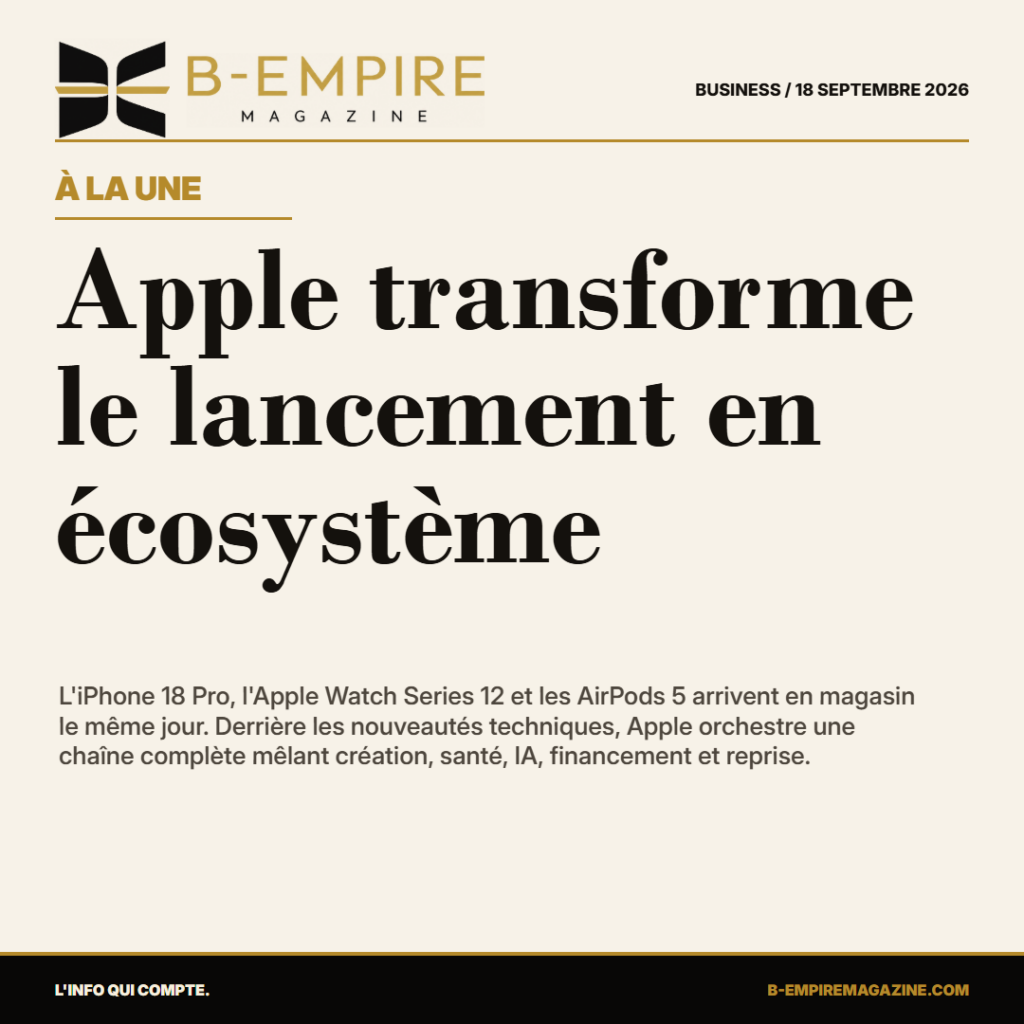
On September 18, 2026, Apple is not simply placing three new devices on shelves. The company is launching an entire day for its ecosystem. iPhone 18 Pro and iPhone 18 Pro Max, Apple Watch Series 12, Apple Watch Ultra 4 and AirPods 5 are reaching Apple Store locations around the world at the same time. In New York, company executives are greeting early customers on Fifth Avenue; elsewhere, the same products, software and services are rolling out through an almost identical choreography.
That synchronization is the day’s real product. Each device has its own upgrades, but their value increases when they are used together. The iPhone becomes a center for computing and creation, the watch follows the body and the earbuds open a permanent voice interface. Around them, trade-in, financing, personal setup and subscriptions extend the relationship long after checkout.
The iPhone wants to become a physical camera again
The most visible change in iPhone 18 Pro is its 48-megapixel Fusion Main camera with variable aperture. Six mechanically controlled blades allow the system to adjust light and depth of field. Apple is adding manual controls for aperture, shutter speed, white balance and exposure. The smartphone is borrowing the vocabulary of a professional camera just as computational photography appeared to have made mechanics secondary.
This return to physical movement is strategic. Annual image improvements have become difficult to explain through additional pixels or another algorithm alone. A moving aperture can be seen and understood, and it gives the creator a decision to make. Apple turns a technical function into an experience of control while allowing automated processing to continue working in the background.
Trust becomes a camera feature
iPhone 18 Pro also introduces Apple Reference Image, a system designed to produce an authenticatable reference using signed sensor data. Users can compare that reference with an edited version. Apple is also adding metadata and says it plans to support the SynthID standard to improve identification of content generated or altered by artificial intelligence.
The shift matters: the camera is no longer promising only a beautiful picture but information about its origin. In an environment saturated with synthetic content, authenticity becomes a commercial advantage. Photographers, journalists and brands need to prove what was captured, what was changed and through which chain. Apple is attempting to build that trust directly into hardware instead of leaving it to an outside platform.
Power must be sustained
The A20 Pro chip, built according to Apple on a two-nanometer process, is paired with a new vapor chamber. The goal is not merely to hit a speed peak but to maintain performance while the device records video, runs games or executes AI models over time. This distinction between instant and sustained power reveals the smartphone’s transformation into a mobile production computer.
Apple connects this architecture to Siri AI and Apple Intelligence in iOS 27. A growing part of the phone’s value therefore depends on invisible calculations: personal-context understanding, computational photography, language processing and energy management. Hardware becomes a promise of privacy and availability because more operations can happen locally or inside secured infrastructure controlled by the company.
The watch claims the readiness market
Apple Watch Series 12 and Ultra 4 arrive with a new health sensing system. Apple is announcing more frequent heart-rate measurement, enhanced heart-rate-variability tracking and a readiness score. The score translates several signals into a simple indication of a user’s capacity to face the day or complete a workout.
This kind of score moves the watch from retrospective tracking toward daily recommendation. It is no longer enough to count what happened; the device attempts to influence the next decision. For Apple, that creates a more regular relationship with the user. For the user, it requires understanding that a consumer indicator is not a medical diagnosis and that useful guidance depends on data, context and interpretation.
AirPods become an interface
At $129 in the United States, AirPods 5 lower the entry price for active noise cancellation in Apple’s open-ear format. The company says the system removes up to 50 percent more external noise than AirPods 4 with Active Noise Cancellation. A $149 version adds wireless charging, longer battery life and on-stem volume control.
The earbuds’ most decisive role, however, lies in access to Siri AI and Live Translation. AirPods are no longer merely an audio output; they become an always-available, hands-free interface connected to context stored on the iPhone. Sound attracts the customer, but the assistant strengthens the ecosystem.
The store sells continuity
The worldwide launch also stages a commercial infrastructure. Apple offers trade-in, financing, carrier promotions and personal setup. Each service removes friction around purchase price, data transfer, plan selection or onboarding. The physical store exists less to distribute a box than to guarantee continuity between the old device and the new one.
This logic increases loyalty. A watch, earbuds, health data, photos, a storage subscription and a financing plan make departure for another platform more complex. The ecosystem is convenient because it removes steps; it is powerful because every removed step brings the customer closer to the company.
One launch day, several markets
September 18 therefore shows how Apple distributes growth. The phone targets creators and premium users. The watch deepens health and fitness. The earbuds broaden access to the assistant and translation. Services monetize the relationship over time. Even recycled materials and charging become parts of a common industrial narrative.
The strategy’s success will not be measured only by lines outside stores. It will depend on AI reliability, availability across languages and regions, the real usefulness of new sensors and whether customers perceive lasting difference. The launch message is nevertheless clear: Apple no longer wants to sell the best isolated device. It wants to sell the system that is hardest to leave because its objects have learned to behave like one experience.