


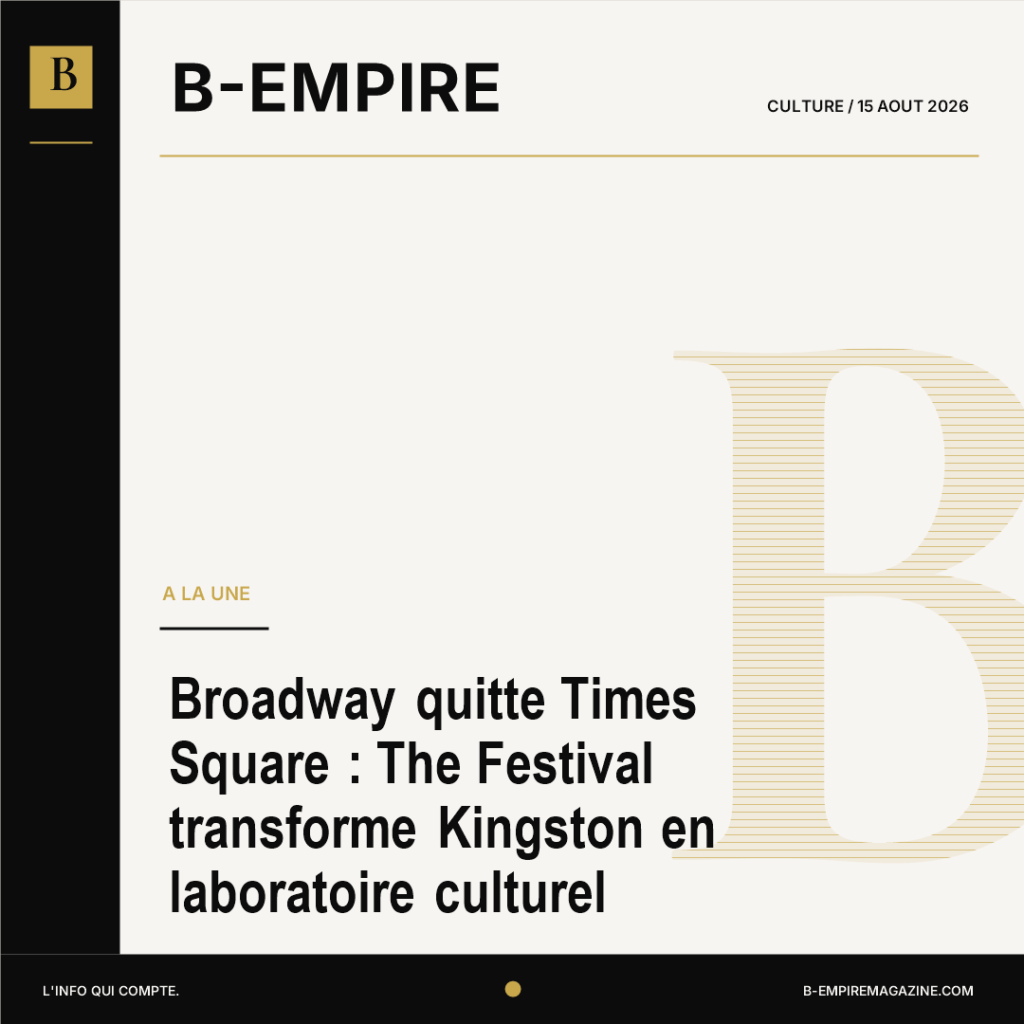
Broadway is leaving its historic district and testing a stage much larger than the theater itself. From August 14 to 16, 2026, The Festival brings three days of outdoor musical theater to Hutton Brickyards in Kingston, in the Hudson Valley. The event gathers major artists, a Rent-related reunion, multiple stages, concert-style formats, and a simple promise: turning Broadway culture into a weekend destination.
This is not just a fan poster. It is an industrial test. Broadway has long sold an address, a few blocks around Times Square, a room, a seat, a curtain. The Festival sells something else: time, travel, community, landscape, and an experience programmed like a major music festival. That difference matters because it shows how live theater is looking for new growth channels without giving up its emotional power.
A Broadway Festival, Not Just a Giant Gala
The official website presents The Festival as a three-day music festival celebrating Broadway’s biggest stars, with Hutton Brickyards as its setting. Broadway Direct details programming beginning Friday, August 14 with Christopher Jackson, Adrienne Warren, Alex Newell, Betty Who, Eva Noblezada, Mandy Gonzalez, Reeve Carney, and Solea Pfeiffer. Saturday and Sunday extend that logic with Kelli O’Hara, Renee Elise Goldsberry, Audra McDonald, Brian Stokes Mitchell, Denee Benton, and other names capable of drawing a national audience.
The project’s value lies precisely in that concentration. A classic Broadway show isolates one production; The Festival aggregates voices, memories, and audiences. The Rent-linked reunion brings the memory of a generation, while newer artists make the format legible to an audience shaped by TikTok, cast recordings, filmed performances, and international fandoms. Broadway is no longer simply waiting for spectators: it is going after them in a format where they are willing to stay for several hours, sometimes several days.
Why Kingston Becomes Strategic
The choice of Hutton Brickyards is not random. The former industrial site, now an event destination on the banks of the Hudson, offers what major cities often struggle to produce: space, a strong visual identity, and a feeling of escape without breaking the connection to New York. The Festival’s practical pages emphasize shuttles, limited parking, partner hotels, and the visitor journey. In other words, logistics are not a secondary detail; they are part of the cultural product.
This dimension matters directly to the entertainment business. When a spectator buys a festival ticket, they rarely pay only for a performance. They pay for the trip, food, lodging, the images they will post, encounters, belonging, and scarcity. For Kingston, the event can become a tourism showcase. For Broadway, it can become proof that its brand capital travels better than many assume.
The Coachella Model Applied to Musical Theater
Playbill describes the project as a way of taking codes from major music festivals and adapting them to the Broadway repertoire. People also highlights the ambition to build a fan weekend, with a logic of paths and choices. The Coachella comparison is not merely a marketing shortcut. It signals that Broadway wants to exist in the same attention economy as pop, luxury, sport, and large fan gatherings.
The question is delicate. Musical theater relies on precision, acoustics, the intimate relationship to the room, and the discipline of a performance. A festival lives through movement, unpredictability, noise, queues, and phone-captured moments. If The Festival succeeds, it will prove Broadway can change containers without losing intensity. If it fails, it will remind the industry that not every culture automatically becomes a festival.
A Signal for Paris, London, and Creative Capitals
The story also speaks to Europe. Paris is multiplying immersive formats, London exports its musicals, and Madrid and Milan are trying to attract international audiences. The real issue is no longer only filling a theater, but extending the life of a work around the theater: concerts, limited editions, meetings, short-form content, cultural tourism, and hospitality. The Festival gives that strategy a concrete form.
For producers, the advantage is clear: a festival can concentrate revenue over a weekend, pool audiences, and create an annual appointment. But the risk is real: weather, production costs, transport, security, fees, insurance, and dependence on a highly prestigious lineup. The Broadway brand attracts, but it is expensive to move. Success will therefore depend as much on the emotion onstage as on execution offstage.
Live Theater Searches for Its New Public
The Festival arrives at a moment when cultural industries are fighting for audiences that are less loyal, more mobile, and more demanding. Streaming has accustomed viewers to abundance, but it has also made the physical event more precious. Traveling to Kingston to hear voices associated with Broadway becomes an act of presence: the audience is not only consuming a song, it is entering a temporary community.
That may be the real lesson of this weekend. Broadway is not abandoning Times Square; it is testing an extension of its territory. If the experience works, other cities, producers, and disciplines will look at Kingston as a prototype. Musical theater may find there a new way to speak to the festival generation: less vertical, more collective, more photogenic, but still built on one thing the algorithm does not yet manufacture as well as a stage full of human voices: the thrill of live performance.
Sources
- The Festival, official information on dates, venue, and main programming.
- Broadway Direct, programming details published in June 2026.
- Playbill, editorial context on the festival’s ambition and its comparison with major music gatherings.
- People, recent interview on the project, its fan-weekend model, and its annual vision.
- The Festival – Travel, practical information on shuttles, parking, and accommodations.