


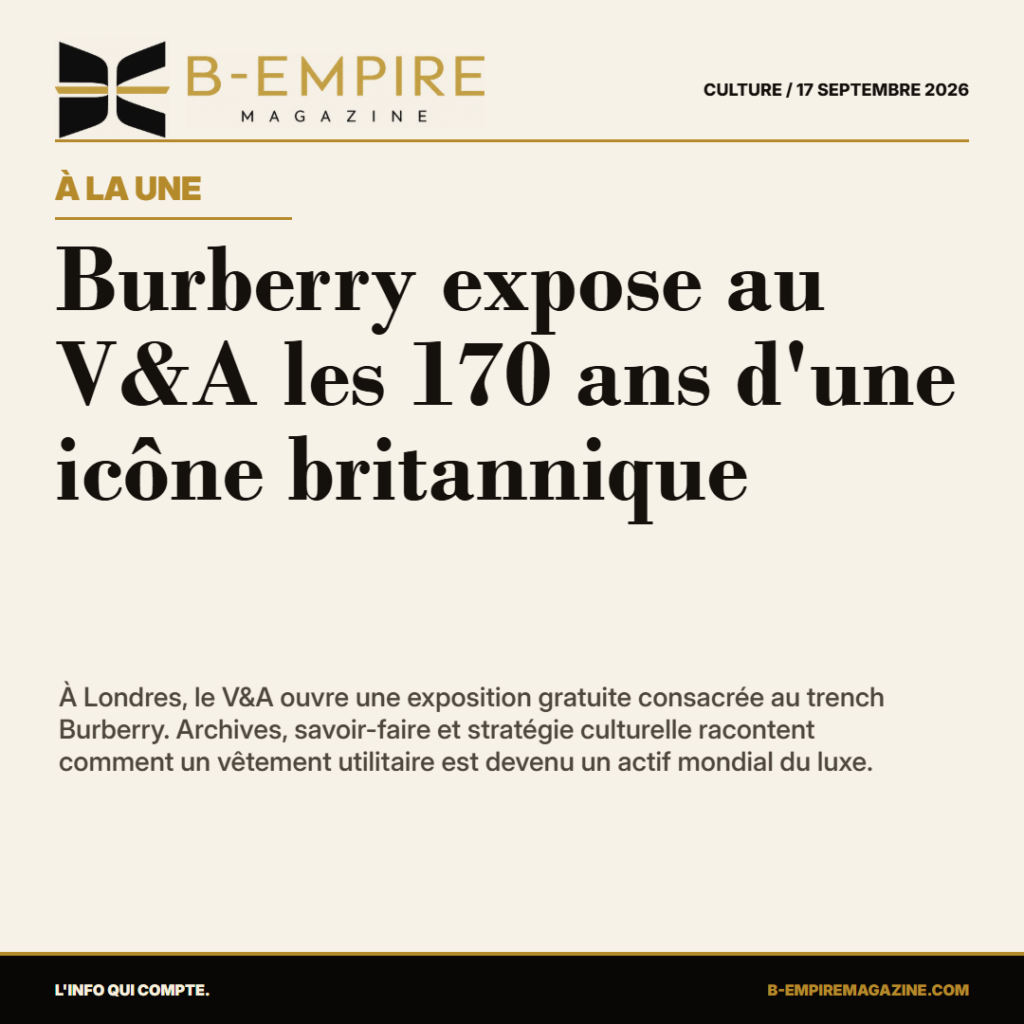
At Burberry, a trench is never merely a coat. As the British house marks its 170th anniversary, it is turning this practical garment into a public story at London’s Victoria and Albert Museum. The free display The Burberry Trench: Crafting an Icon, running from September 21, 2026 to January 3, 2027, brings together rare documents from the brand’s archive and pieces held by the V&A. Its purpose extends beyond nostalgia. The exhibition asks how an object designed to offer protection from bad weather acquired the symbolic force of a logo without always needing to show one.
Staged in the Prince Consort Gallery at V&A South Kensington, a space rarely seen by visitors in this form, the display follows the trench from practical and military outerwear to contemporary fashion. The museum lists a womenswear catalogue from around 1937-1944, a 1979 coat owned by designer Hardy Amies, a men’s pink metallic silk trench from Spring/Summer 2013, a mirror-embroidered version from Autumn/Winter 2015 and a purple baroque-print fringed design from Winter 2025. The timeline makes a useful point: the permanence of an icon depends less on staying still than on absorbing the visual language of each period.
From protection to visual signature
Founded in 1856, Burberry built a decisive part of its reputation around gabardine, the weather-resistant fabric associated in the late nineteenth century with a new approach to outerwear. The trench later condensed several narratives into one object: military discipline, exploration, cinema, urban elegance and popular culture. Its recognisable cut, shoulder straps, belt and functional details form a vocabulary that successive generations could quote, alter or simplify. The garment became an interface between British memory and international desire.
The V&A selection does not present that history as a simple straight line. The metallic pink trench, mirrored coat and baroque version demonstrate how the house repeatedly subjected its most stable product to experiments in colour, material and proportion. Innovation here does not mean erasing the original. It means making the tension between a familiar pattern and a new attitude visible. For a luxury business, that tension is crucial: excessive repetition turns heritage into a uniform, while complete rupture destroys accumulated recognition.
The museum as a strategic space
Placing a commercial garment inside a major museum of decorative arts changes its status. The trench can be read simultaneously as a design object, a social document, a textile achievement and evidence of how styles circulate. This cultural legitimacy clearly benefits Burberry, but it also places a responsibility on the museum. The V&A must provide context, explain uses and allow the objects to reveal their contradictions. The partnership is especially significant because Burberry is the principal supporter of the V&A’s future permanent fashion gallery, scheduled to open in 2028. The temporary display therefore acts as a prelude to a longer institutional relationship.
Free admission also changes the experience. It opens the history of a luxury product to visitors who may never be customers. That accessibility expands the brand’s cultural reach without turning the museum into a store. Visitors can examine archival details, personalised labels, catalogues and runway silhouettes as fragments of an industrial history. At a time when digital imagery makes every collection instantly visible, the physical presence of a seam, lining or textured surface remains an advantage that screens reproduce poorly.
A lesson in the value of heritage
Contemporary luxury speaks constantly about heritage, yet not every inheritance can be activated in the same way. A cultural asset becomes powerful when it can be recognised quickly, explained in depth and reinterpreted without losing coherence. The trench meets all three conditions. It is legible from a distance, carries enough technical history to sustain an exhibition and remains flexible enough to appear in cotton, silk, vivid colour or deconstructed form. Burberry therefore owns a product capable of linking its past, current creativity and commercial future.
This logic matters beyond fashion. Businesses that survive for several generations do more than preserve archives; they learn how to activate them. A dormant archive protects memory, while an edited archive produces meaning. By selecting pieces that span nearly a century, Burberry and the V&A are not only recounting the evolution of a coat. They show how an organisation can renew its language without erasing evidence of change. Making those variations visible strengthens continuity instead of weakening it.
Why the timing matters
The display opens just after London Fashion Week and at the start of the season when coats return to daily life. The timing creates a dialogue between the urgency of the runway and the slower rhythm of museum collections. Fashion continually proposes new silhouettes; the museum reminds visitors that certain forms last because they continue to solve a practical problem. The trench protects the wearer, structures the body and adapts to very different social settings. Its relevance does not depend solely on the fame of the label sewn inside.
The real success of Crafting an Icon will depend on preserving this double reading. Visitors should be able to admire the garments while understanding the technical, economic and cultural decisions that produced their aura. The Burberry trench is a textbook example: clothing born from function, amplified by history, adopted by the collective imagination and repeatedly edited by luxury. At 170, Burberry is not simply placing its past behind glass. It is using the museum to argue that an icon remains alive only when it accepts new readings.