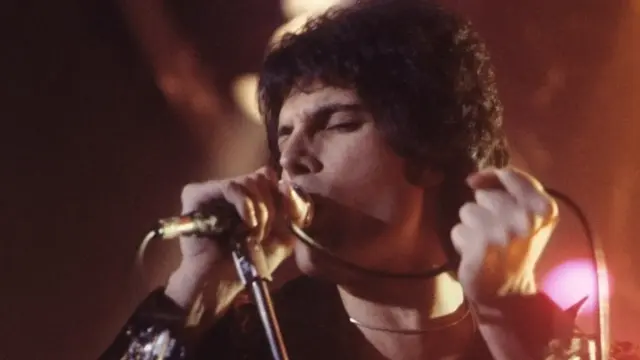
It only takes a crown, a cape, and a silhouette for the world to almost hear the crowd. Thirty-five years after the passing of Freddie Mercury, the Victoria and Albert Museum in London announces a new event capable of reconnecting several generations to one of the most powerful stage presences in music history. Titled Freddie Mercury | Splendid Things, this free exhibition will bring together eight iconic looks of the Queen singer in celebration of his 80th anniversary.
The exhibition will open on October 24, 2026, at the V&A South Kensington and will remain on view until January 17, 2027. Seven of the eight ensembles are loaned by Mary Austin, Mercury’s former fiancée and a friend who remained essential in his life. Thus, the announcement goes beyond mere nostalgic homage. It offers an accurate reading of how an artist used fashion, design, theater, and video to create an instantly recognizable identity across all continents.
Eight Costumes, a Whole Career in Motion
The V&A presents the project as a six-step journey through its permanent galleries. Each stop will be staged with decor, sound, and light to evoke different periods of Mercury’s career. This choice is intelligent: his clothes were never static objects. They were designed to run, provoke, capture the spotlight, and enlarge his body in front of tens of thousands of spectators.
Among the announced pieces is the monochrome outfit worn during an early concert at Imperial College, also visible on the cover of Queen’s first album in 1973. The exhibition will also showcase the famous winged catsuit designed by Wendy de Smet, used during the A Night at the Opera tour in 1975 and 1976 and in the Bohemian Rhapsody video. This garment already summarizes everything: a spectacular graphic form, total bodily freedom, and an image designed to survive the performance.
The 1986 Crown Becomes a Global Memory Object
The crown and cape designed by Diana Moseley are naturally one of the highlights. Mercury wore them during the Magic Tour of 1986, notably during Queen’s last stage appearance with him at Knebworth. The gesture was theatrical and almost cheeky: the singer proclaimed himself king before his audience while transforming this pretension into a shared game. No one needed to literally believe in the title. The crowd recognized the authority of the performer.
Forty years later, the crown tells not only the story of Queen. It narrates an era when stadium concerts became global events and music television imposed new visual rules. Mercury understood before many others that song alone was no longer sufficient. To cross the screen, one had to create a simple, strong, and reproducible image. The red and white cape fulfilled exactly this function, just as a viral sequence would today be immediately recognizable.
Why âSplendid Thingsâ is the Right Title
The name of the exhibition comes from a statement by Mercury in 1978, in which he expressed a desire to be surrounded by âsplendid thingsâ and to lead a Victorian life amidst exquisite disorder. Without reducing the artist to a formula, this phrase illuminates his relationship with objects. For him, accumulation was not merely decorative. It nourished a way of composing his character, blending British sophistication, rock flamboyance, and a taste for the history of the arts.
The choice of the V&A is therefore particularly coherent. The museum does not treat costumes as mere relics of celebrity but as objects of design and performance. Kate Bailey, the senior curator of theater and performance at the V&A, explains that the exhibition will explore Mercury’s interest in art, fashion, and design. In other words, it is not just about asking what he wore, but why these forms continued to speak when the music stopped.
Mary Austin Protects an Intimate Story That Became Pop Heritage
Mary Austin’s involvement gives the project a particular depth. She met Freddie Mercury when she was 19 and he was 24, in the creative London of Kensington. Their romantic relationship ended in the mid-1970s, but their closeness remained until the singer’s death in 1991. Mercury bequeathed Garden Lodge, his London home, as well as a large portion of his belongings to her.
The loan of seven ensembles now allows these objects to move from the private sphere to a collective narrative. Austin emphasizes that the clothing was essential to Mercury’s creative vision and expression. This point changes the reading of the exhibition: the costumes are not accessories placed afterward around a star. They participated in the construction of the star, just like the voice, the compositions, the gestures, and the videos.
From Zanzibar to London, an Icon Impossible to Confine
Born Farrokh Bulsara on September 5, 1946, in Zanzibar, Freddie Mercury carries a global story within him even before fame. His childhood, his years in India, his family’s move to the UK, and his immersion in the London art scene form a trajectory that national categories poorly summarize. This plurality also explains why his image remains so widely appropriated, from Europe to Asia, from Africa to the Americas.
His style combined references that the industry might have deemed incompatible: ballet, glam rock, military uniforms, leather, opera, cabaret, and royal majesty. Mercury was not seeking a stable visual identity in the classical sense. He sought coherence in transformation. Each costume change told the audience that they too could shift boundaries, play with codes, and reject the narrowest version of themselves.
A Very Current Lesson for Artists and Brands
In the age of social media, Mercury’s legacy seems almost prophetic. Contemporary artists know that a musical moment must also produce a silhouette, a color, and a gesture capable of circulating independently of the song. But where some modern strategies resemble calibrated campaigns, Mercury gave the impression that the image arose from an inner necessity. His sense of spectacle was thoughtful, never cold.
For fashion, the exhibition also reminds us that stage clothing is a laboratory. It must withstand movement, be readable from the back of a stadium, and immediately convey an emotion. They can then influence runways, music videos, film costumes, and advertising language. The V&A’s exhibition should thus interest not only Queen fans but also stylists, content creators, musicians, and professionals in live performance.
A Free Event with International Potential
The free nature of the exhibition is decisive. It facilitates access to a popular heritage without transforming the tribute into a luxury product reserved for a select few visitors. Located at the heart of the permanent collections, Splendid Things will also place the costumes in dialogue with the broader history of clothing, decorative arts, and theater. This connection can renew the perspective of those who already know every note of Queen.
The setup envisioned by set designer Tom Piper promises an experience rather than a mere showcase. Its six stations will use space, light, and sound to place the pieces back in their original energy. The challenge will be not to freeze Mercury in statue form. Everything indicates that the V&A wants to convey the movement behind the object and show how a costume becomes an extension of the voice.
The Signal That No One Can Ignore
This announcement confirms a simple truth: Freddie Mercury does not belong solely to the memory of rock. He belongs to the global history of image. His songs continue to fill stadiums, but his silhouettes speak even when the sound is cut off. This is precisely what eight costumes gathered in a museum can demonstrate with rare force.
From Queen’s first album to the crown of the Magic Tour, the exhibition traces less a series of garments than a conquest of public space. Mercury understood that the stage was a temporary kingdom and that each appearance had to leave a mark. In London this autumn, the world will be able to look closely at this mark. And see that it has lost almost none of its brilliance.
Practical Information
- Exhibition: Freddie Mercury | Splendid Things
- Location: V&A South Kensington, London
- Dates: October 24, 2026, to January 17, 2027
- Access: Free
- Content: Eight looks spread across a journey of six installations