


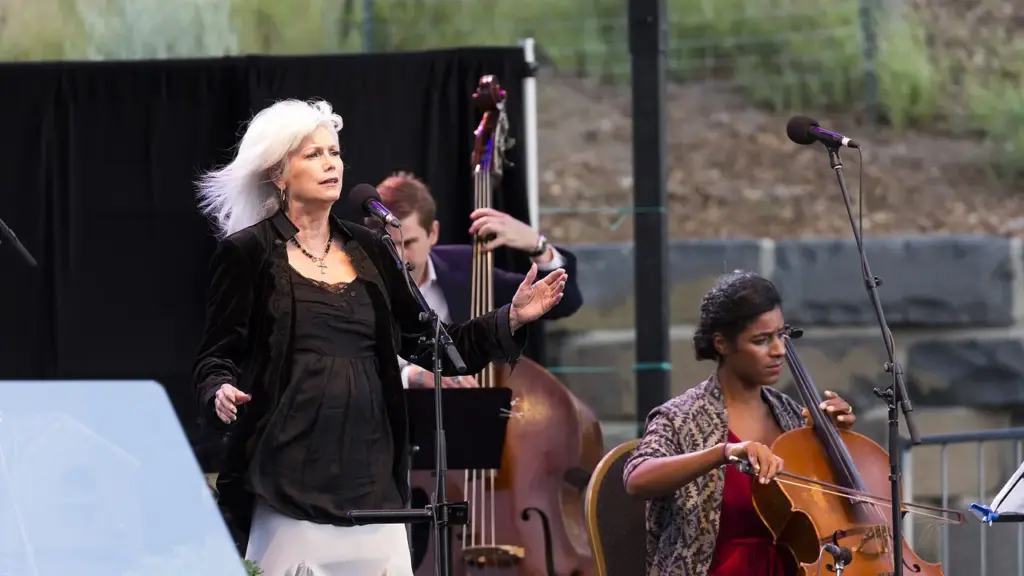
The voice has fallen silent in Europe, but the story continues to resonate. On Sunday, September 6, 2026, Emmylou Harris concluded what she presents as her final European tour in Monheim, Germany. At 79 years old, the American singer with 14 Grammy Awards closed a chapter spanning over half a century in front of a standing audience, after a two-hour concert that traversed all eras of her career.
This is not a retirement. Harris made it clear: she intends to continue singing and performing in the United States for as long as the audience wants her. However, she no longer wishes to cross the Atlantic for long series of dates. This nuance transforms the German evening into a historic moment: one of the artists who has most profoundly connected country, folk, rock, and americana has just bid farewell to an essential part of her audience.
A Last German Night Full of Symbols
The final European rendezvous took place at the Kulturraffinerie K714 in Monheim, near Cologne. According to a report published by Country.de on September 8, the venue reserved several standing ovations for the artist and her band. The program spanned classics, covers, and songs that built her reputation as an interpreter capable of giving new life to the words of others.
The setlist alone tells the story of this legacy: âTwo More Bottles of Wine,â âRed Dirt Girl,â âPancho and Lefty,â âBorn to Run,â and âSave the Last Dance for Me.â Harris has never confined herself to a narrow definition of country. She has engaged in a dialogue between American roots, bluegrass, gospel, folk, and a form of atmospheric rock that will influence several generations.
This final stop came after a series of concerts in Scandinavia, Switzerland, and Belgium. At Bozar in Brussels on September 3, tickets had sold out completely. The Belgian institution recalled the figures of an extraordinary career: over 25 albums, approximately 15 million records sold, and fourteen Grammy Awards.
Why Her Departure Goes Beyond Country
Emmylou Harris is not just a star of a musical genre. She has become a bridge. In the 1970s, her collaboration with Gram Parsons helped legitimize a bold meeting between traditional country and rock. After Parsons’ death in 1973, she continued this work without ever settling for merely reproducing the formula.
Her solo discography subsequently built an immediately recognizable identity: a clear voice, fragile yet strong, and a rare sense of song selection. Harris has worked with Bob Dylan, Neil Young, Willie Nelson, Dolly Parton, Mark Knopfler, Linda Ronstadt, and many others. Each of these collaborations has broadened her audience without erasing her uniqueness.
The album âWrecking Ball,â produced by Daniel Lanois in 1995, remains one of the most powerful examples of her ability to reinvent herself. At a time when the industry could have relegated her to the great voices of the past, she chose darker, more modern textures. The record opened a new phase of her career and became a reference for contemporary americana.
France Absent from a European Farewell
For the French audience, this tour leaves a particular taste: no dates were scheduled in France. The contrast is stark for an artist who gave her first concert in Paris at the Olympia in March 1977. Nearly fifty years later, French fans had to travel to Brussels, Zurich, or Germany to hear her one last time on the continent.
This absence also speaks to something about the current geography of live performance. Tours by historical artists often favor a limited number of venues, loyal partners, and markets where demand is immediately measurable. In Harris’s case, the sold-out dates in Oslo and Brussels demonstrated that the European attachment remains intact.
The final tour was therefore not a nostalgic exercise in half-empty venues. It resembled a series of reunions aware of their rarity. The audience knew they would likely never see this artist cross the Atlantic again. Each song carried the discreet weight of a final passage.
An Artist Who Refuses to Use the Word Retirement
In an interview published earlier this year, Harris explained that international touring had become difficult, while asserting that she would continue to play in the United States. Her schedule confirms this distinction: after Europe, an appearance is notably announced in San Francisco in October during an evening honoring Steve Earle.
This choice resembles the artist. Since her beginnings, she has moved forward without a spectacular staging of her own legend. She prefers to talk about songs, musicians, and transmission. Ending European tours does not erase this mission; it allows her to adapt it to her age and energy without transforming a practical decision into a grand, definitive departure.
What Europe Loses with This Last Tour
The departure of Emmylou Harris reminds us that the era of the great figures who directly connected the folk scenes of the 1960s, the country-rock of the 1970s, and modern americana is gradually coming to an end. Few artists still active can recount this continuity from the inside. Her concerts had become living archives as much as performances.
Her influence, however, remains very current. The contemporary taste for unadorned voices, intimate narratives, and intersections between pop, folk, and country carries part of her imprint. Long before americana became a recognized category in the industry, Harris had shown that a song could travel between genres without losing its soul.
Emmylou Harris’s last European night does not merely conclude a tour. It marks the end of a stage relationship that began nearly half a century ago between an American voice and the audience of the continent. The singer will continue elsewhere. In Europe, there will now remain the records, the memories, and that rare impression of having seen a legend choose the moment to say goodbye.