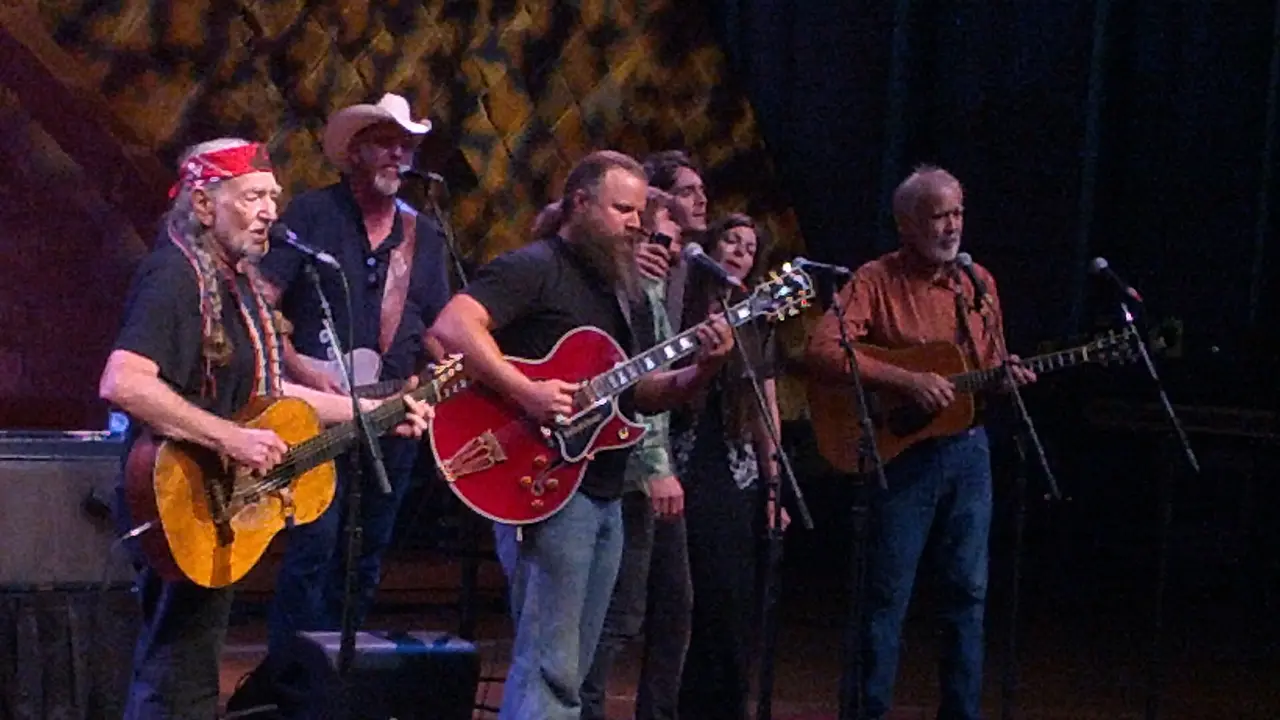
On August 18, 2026, the Outlaw Music Festival returns to the road in Maryland Heights, Missouri, with a lineup that looks less like a simple tour date than a statement of method. Willie Nelson & Family, The Avett Brothers, Lukas Nelson, Stephen Wilson Jr., Sierra Hull and Don Was and the Pan-Detroit Ensemble share the same evening at the Hollywood Casino Amphitheater. In a live industry where costs keep rising and fragile festivals sometimes cancel because demand is not strong enough, this American caravan keeps moving with a clear idea: turn musical heritage into a profitable collective experience.
The event is not new, but its timing matters. The August 18 date opens a dense Midwest and Northeast run, before stops in Shakopee, East Troy, Clarkston, Noblesville, Chicago, Wantagh, Bethel and Saratoga Springs. This is not only a series of concerts. It is a traveling cultural product built around a trusted brand. Outlaw Music Festival sells a promise that is simple and rare in 2026: a day of music that feels familial without being small, rooted without being frozen, popular without flattening itself.
The Power of a Festival Held Together by Story
In contemporary live entertainment, the name on the bill is no longer always enough. Audiences weigh expensive tickets, travel, weather, extra fees and fatigue with the sheer volume of offers. The Outlaw Music Festival answers that tension with a narrative. Willie Nelson, an almost institutional figure of country freedom, acts as the gravitational center. Around him, the programming brings together artists who speak to several generations: the fraternal Americana of The Avett Brothers, the direct lineage of Lukas Nelson, the rock tension of Stephen Wilson Jr., the bluegrass virtuosity of Sierra Hull, and the musical authority of Don Was.
That mixture creates an economy of trust. A spectator does not come only for one song or one hit. They come for an atmosphere, for an idea of American music, for a day when heritage is performed in the present tense. That is the difference between a stacked bill and a festival brand. In a market that has become unforgiving, where the smallest imbalance between artist fees, logistics and sales can crack an event, this coherence is enormously valuable.
Willie Nelson as a Cultural Platform
Willie Nelson is no longer only a headliner. He has become a cultural platform. His name reassures older audiences, intrigues younger ones, and attracts fans of country, folk, roots rock and American songwriting. At 93, his presence turns every date into something both fragile and massive: people are not going to see an interchangeable production, they are joining a continuity.
That continuity is also familial. Lukas Nelson’s presence gives the festival a clear line of transmission. It avoids the trap of the museum, because heritage is not merely celebrated, it circulates. The Avett Brothers add another bridge: a band capable of filling large venues while keeping an artisanal image. Sierra Hull signals that acoustic virtuosity can still exist on large-capacity stages. Together, the lineup gives Outlaw Music Festival an architecture many events envy: broad appeal without dilution.
The Quiet Business of Loyalty
The strength of this model also lies in its economics. Live Nation and Blackbird Presents are not selling an isolated date; they are deploying a flexible live franchise that can adapt to regions, amphitheaters and local audiences. The Hollywood Casino Amphitheater, with its large open-air format, fits this grammar perfectly: big enough to absorb a long program, popular enough to welcome different ticket tiers, and connected enough to the highway network to become a one-night destination.
For this kind of event, the ticket is only part of the equation. Parking, food and beverage, merch, VIP experiences, concessions, customer data and local impact all matter. The Outlaw Music Festival operates like a temporary micro-city. Value is created before the first chord and continues after the final encore. That is exactly what major operators want: live brands that do not depend on a single album cycle, but on the feeling of an appointment.
Why It Matters in 2026
The tour’s return on August 18 says something larger than country music. At a time when streaming has made music available everywhere, the live experience is where scarcity is rebuilt. Outlaw Music Festival does not only promise songs. It promises a territory, a community, a duration. In a world of instant content, spending an entire day with artists on stage becomes almost a luxury.
This luxury is not the luxury of the red carpet. It is the luxury of belonging. People come to stand inside a musical genealogy, to see how a song moves through ages, to measure what a legend can still gather when he refuses to become a simple archive. Willie Nelson, at the front of this caravan, embodies something cultural brands desperately seek: authenticity that can scale without losing its accent.
If the Maryland Heights date truly launches another strong run, the Outlaw Music Festival will confirm its singular place in the live landscape: neither a boutique festival nor an impersonal mega-show, but a road organized around an idea. And that idea may be the most profitable of all: in an industry saturated by novelty, the future sometimes belongs to those who know how to keep memory moving.