


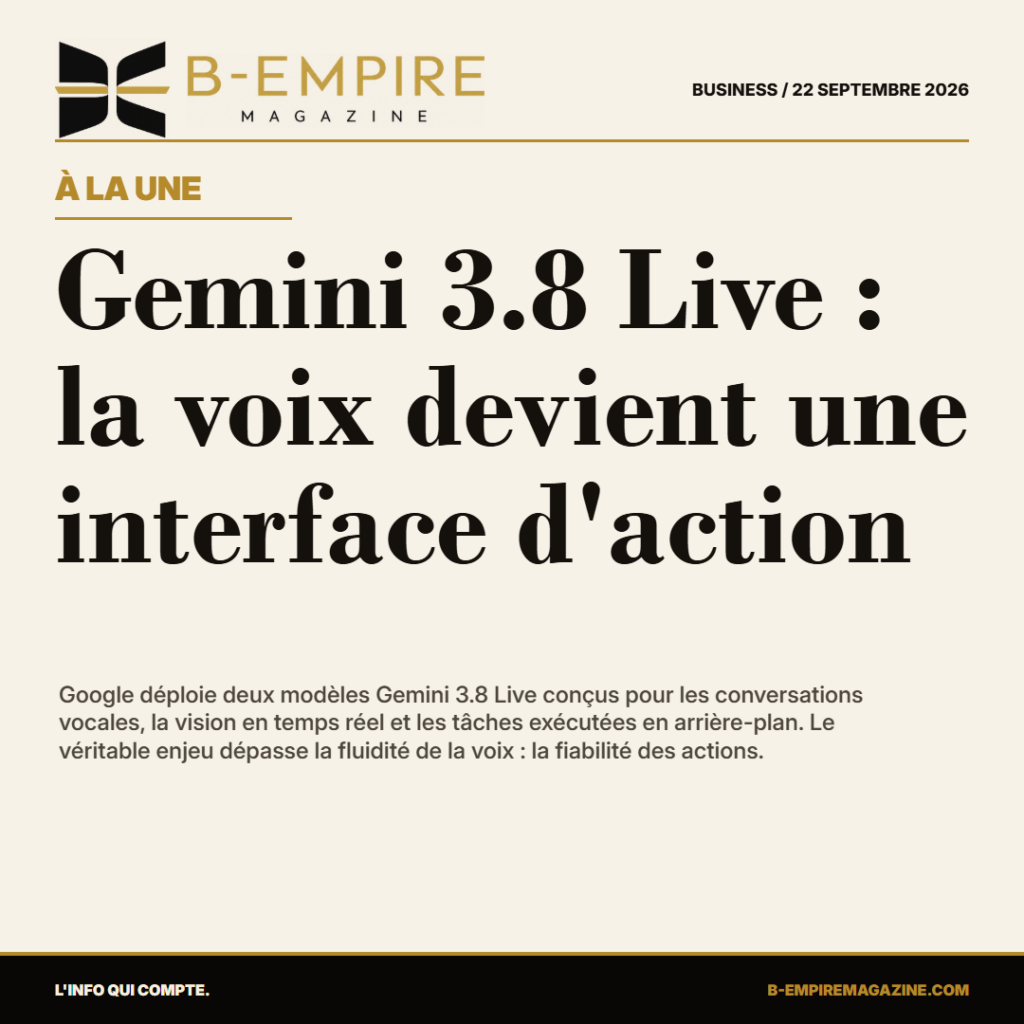
Talking to an AI without interrupting the task you gave it: that is the wager behind Gemini 3.8 Live. On September 15, 2026, Google introduced two models for voice interactions, Gemini 3.8 Live and Gemini 3.8 Live Extended Thinking. The first prioritizes speed and deployment at scale; the second targets more complex requests. Their shared promise is not merely a more human-sounding voice but a conversation that continues while tools and service calls operate in the background.
A conversation that does not end with the words
According to Google, 3.8 Live can incorporate visual information in near real time and automatically switch among 97 supported languages during an exchange. The model can acknowledge a request, continue the conversation and call tools without forcing the user to wait through a long silence. Extended Thinking adds reasoning that Google presents as better suited to multi-step tasks, with spoken progress cues while those tasks run.
The change may sound subtle, but it alters the logic of the interface. A traditional voice assistant answers a question and waits for the next one. An agent that can check information, use a service and return with a result enters the workflow itself. It then becomes essential to know which actions it can actually carry out, what access it has and when a person must approve the next step.
Uses divided across products and subscriptions
Google says the models are rolling out in the Gemini API and AI Studio for developers. For consumers, 3.8 Live is headed to Search Live; Extended Thinking is coming to Gemini Live and selected Workspace uses, subject to conditions that vary by app and subscription. For enterprises, Google still describes private previews for Gemini Enterprise. A feature appearing in a demonstration therefore does not mean it is available everywhere, or on the same terms.
The company also highlights its performance on several benchmarks for speech and task completion. Those figures are useful for comparing systems under defined conditions, but they do not guarantee the quality of a booking, an email or a decision made with real-world data. For a product manager, the decisive test remains error handling: interruptions, ambiguous information, confirmation of sensitive actions and a record of what the system actually did.
Trust begins after the demo
Google says audio generated by its AI products carries a SynthID watermark intended to make detection easier. That is a transparency measure, not a complete answer to the consent and privacy questions raised by an interface listening throughout a conversation. Adding vision creates another requirement: distinguishing what the model observed from what it inferred.
Gemini 3.8 Live therefore illustrates a shift in the assistant market: from the quality of a response to the continuity of an action. Voice can make tools faster and more accessible. It can also make mistakes less visible than a form or a sequence of clicks. The winner will not necessarily be the system that speaks most naturally, but the one that can explain its limits, ask for confirmation and recover clearly from failure.
A fluid conversation can conceal an essential difference between intention and execution. When the assistant says it is preparing a message, has it only drafted it, saved it for review or already sent it? When several services are involved, which holds the latest information? To stay in control, users need explicit confirmations, especially when an action involves a purchase, personal data or a public message. A pleasant voice does not remove the need for a readable interface that lets people verify the outcome.
The Live API documentation describes a continuous stream of sound, images and text, with options to interrupt the model and let it use tools. It also outlines different integration paths for developers. This points to a less theatrical reality than a product demo: building a reliable voice service means handling connectivity, delays, permissions and secure access. The model is only one component in a larger system. Moving from a successful demonstration to an everyday product will depend as much on the engineering around the model as on its conversational qualities.
The multilingual promise deserves a practical test too. Switching languages mid-sentence could help a bilingual household, an international team or a customer-support service. Yet recognizing a language alone says nothing about the accuracy of names, accents or specialist terms. In such settings, a transcript that can be inspected and corrected may matter more than response speed. It lets a user catch a misunderstood instruction before it triggers an action.
For businesses, another question arises: how do you measure the cost of a completed task, rather than just a minute of conversation? An agent that answers quickly but requires repeated corrections does not necessarily save time. Teams will need to assess how many requests are resolved, how often a person must intervene and how much time is lost when an action fails. That real-world economics, as much as speech quality, will determine whether large-scale adoption makes sense.