


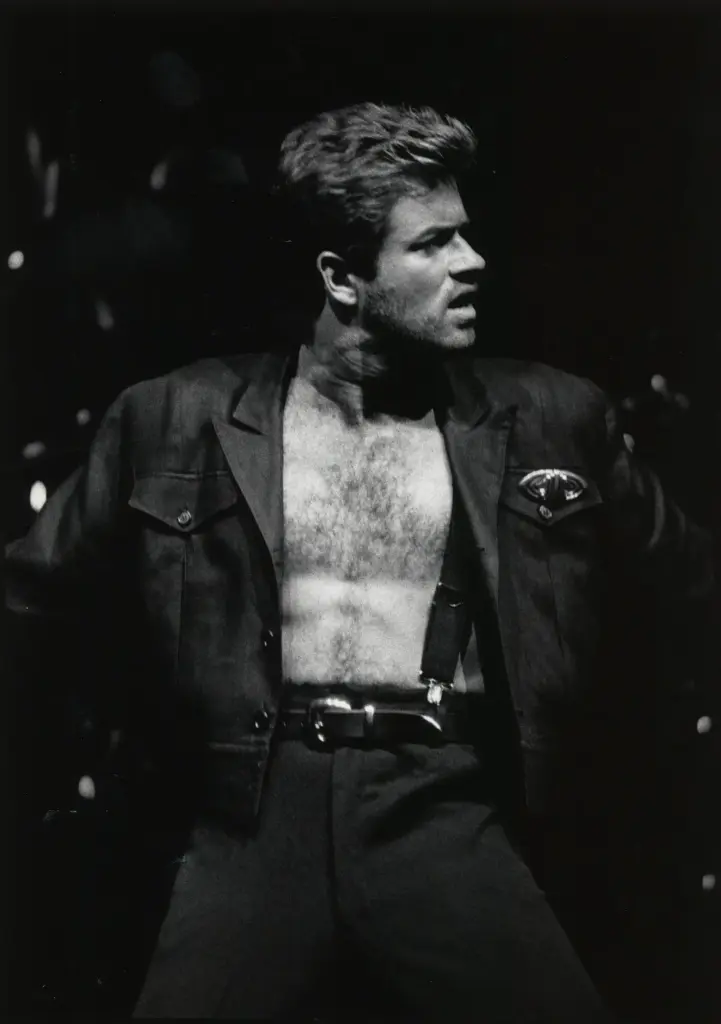
Thirty-eight years after two electric nights at Paris-Bercy, George Michael takes the stage again in a way that even his most loyal fans had long stopped hoping for. Released on November 6, 2026, George Michael: The Faith Tour brings together 18 live performances previously unreleased, recorded during the triumphant 1988 tour. The project is accompanied by a restored concert film made from footage shot on 35mm with 14 cameras: a time capsule that today regains the visual and sonic power it deserves.
This is not just a simple compilation meant to feed nostalgia. It is a testament to a turning point: the moment when the former Wham! singer establishes himself as a global solo superstar, takes control of his image, and transforms the album Faith into a cultural phenomenon. By choosing Paris as the backdrop for this resurrection, the project also places Bercy at the heart of a major story in international pop.
A Forgotten Concert Filmed as a Global Event
According to Sony Music Entertainment, the recordings come from the European leg of the Faith Tour, George Michael’s first solo tour. The concerts filmed at the Palais Omnisports de Paris-Bercy in 1988 utilized 14 cameras and 35mm film, an ambitious setup that allows for a high-quality cinematic restoration today.
The official film website presents the result as an archival reconstruction designed for the big screen and contemporary listening. The material has not been treated as a historical curiosity. It has been assembled to convey the energy of a venue, the precision of a band, and the magnetism of an artist who, at 25, already knew how to hold a vast crowd almost effortlessly.
The film is preceded by Finding Faith, a short film by Mary McCartney that places the tour in its cultural context. This choice gives meaning to the archive: it is not just about watching George Michael sing his hits, but understanding what this abrupt transition from a beloved pop duo to a more adult, riskier, and fully claimed solo career represented.
Eighteen Tracks to Hear George Michael at His Peak
The live album features 18 tracks, blending key songs from Faith with hits from the Wham! catalog. Sony emphasizes that these performances had never been officially released. This is the central argument of the project: fans are not receiving a new remaster of already known recordings, but a complete evening revealing George Michael’s voice, phrasing, and stage authority during a pivotal time.
Faith was already a seismic event. The album established the singer among the very few artists capable of dominating pop radio, dance floors, and American charts simultaneously. âFaith,â âFather Figure,â âOne More Try,â and âMonkeyâ all reached number one on the Billboard Hot 100. Behind the statistics, the tour was meant to prove that this studio success could translate into a physical, spectacular, and credible presence on stage.
Bercy, Witness to a Metamorphosis
Paris holds a special place here. Bercy is not an added backdrop; the venue becomes the theater of an artistic metamorphosis. The European audience already knew George Michael as a pop idol, but the Faith Tour showcased a musician determined to control the sound, rhythm, arrangements, and staging. The restored images capture this moment before collective memory simplifies it into a few clips and a leather jacket.
This French dimension gives the project a particular resonance. At a time when tours are instantly documented by thousands of phones, these two nights in 1988 were preserved by a heavy, costly filming designed to last. The fact that these reels are reaching the public nearly four decades later reminds us of the role of major Parisian venues in the global circulation of music.
Why This Archive Goes Beyond Nostalgia
The release comes at a time when the catalogs of deceased artists have become a major cultural and economic issue. Reissues, documentaries, and restored concerts are multiplying, sometimes at the risk of repeating the same images. The Faith Tour has a decisive advantage: its primary material had remained largely invisible and inaudible in an official edition. It adds something to the narrative instead of simply repackaging it.
Music Week emphasizes that the rights holders also want to introduce George Michael to a new generation. This ambition is credible, as the project combines several entry points: the album for streaming and physical formats, the film for the collective experience, and the short film to provide context for viewers who did not experience the explosion of Faith.
The challenge remains delicate. Protecting a legacy does not mean freezing an artist in a perfect image. The strength of George Michael also came from his contradictions: mastery and vulnerability, fame and rejection of its constraints, the desire to please and the fierce will to remain the author of his own story. A good restoration must reveal the human behind the icon.
The Signal That Pop Cannot Ignore
The rediscovery of the Faith Tour also speaks to our current relationship with spectacle. Modern productions feature gigantic screens, digital effects, and meticulously programmed staging. The images from 1988 redirect attention to another form of power: an instantly recognizable voice, a precise band, solid songs, and a performer capable of building tension without masking the music.
This return can also remind us of the international scope of an artist sometimes reduced to a few year-end standards or the aesthetics of his most famous clips. George Michael was not just a hitmaker. He wrote, produced, arranged, and negotiated with the industry from an increasingly independent position. The young man captured at Bercy is precisely at the moment when this ambition becomes impossible to ignore.
The world is not just watching an old concert: it is witnessing the reappearance of a moment when everything still seemed possible. With 18 unreleased performances, a restoration from 35mm film, and Paris as the central stage, George Michael: The Faith Tour transforms a dormant archive into a global event. The promise is not to recreate 1988, but to finally allow the public to see and hear what Bercy understood that night: George Michael had already entered history.