


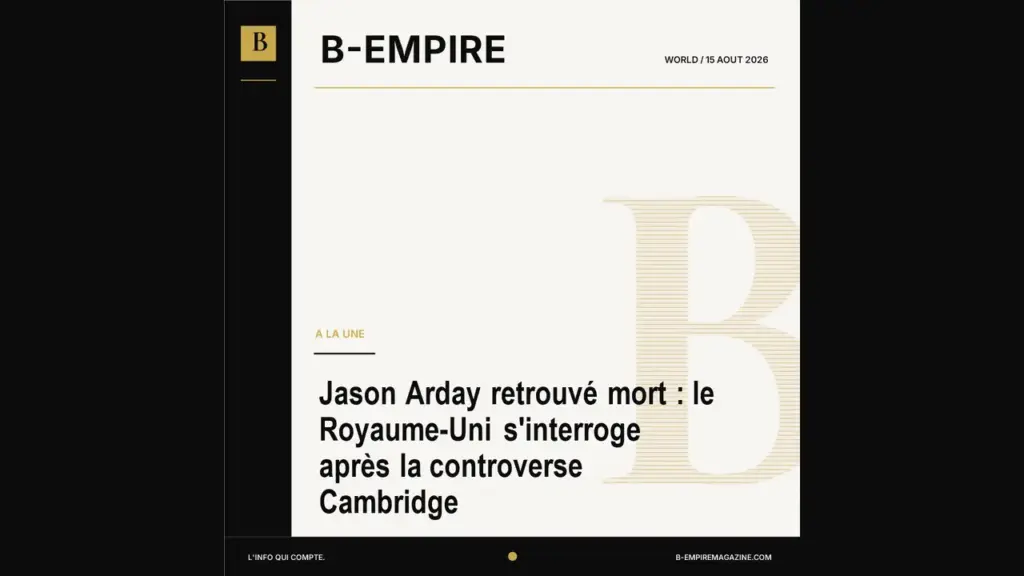
The death of Jason Arday, former professor of sociology of education at the University of Cambridge, has abruptly transformed an academic controversy into a national debate in the UK. Found dead on Friday, August 14, 2026, in London, just days after his resignation, the 41-year-old academic had become the center of a media storm surrounding allegations of plagiarism and questions regarding certain aspects of his background. On Saturday, the British Prime Minister called for reflection. This tragedy now imposes a broader question: how far can a society push the public examination of an individual without losing its sense of proportion?
An Unexpected Disappearance After Weeks of Controversy
According to the Associated Press, Jason Arday was found unresponsive at an address in Battersea, south London. Emergency services were unable to revive him. The Metropolitan Police stated that the death is considered unexpected, but not suspicious at this stage. A file is to be submitted to the coroner, who is responsible for establishing the precise circumstances.
This official wording is crucial. It means that no conclusions should be drawn regarding the cause of death. In a case already marked by intense exposure, any speculation would be both premature and irresponsible. The confirmed facts are serious enough: a man is dead, his family has been informed, and an official procedure is underway.
Why Jason Arday Became a Global Figure
Jason Arday garnered international attention in 2023 when he was appointed professor at Cambridge at the age of 37. Several institutions then presented him as the youngest Black professor in the history of the university. His background, coupled with his work on racial inequalities, mental health, neurodiversity, and higher education, was portrayed as an exceptional trajectory.
His institutional profile at Cambridge included research on the experiences of Black students and staff, precarity in academia, and the effects of the pandemic on higher education. He had also held positions at Glasgow, Durham, and Roehampton. His visibility thus extended beyond the academic world: he participated in public debates on diversity, inclusion, and access to the most prestigious institutions.
The Resignation That Triggered a New Phase
The situation shifted in early August. Cambridge opened an investigation following the emergence of new information regarding his qualifications and work. British media had published allegations of plagiarism as well as questions about certain narratives related to his athletic achievements and charitable activities.
Jason Arday resigned on August 5, stating that the succession of accusations, speculation, and public commentary had taken a profound toll on him and his loved ones. Academic questions should naturally be examined. Scientific integrity is a fundamental obligation, and those who report irregularities should not be intimidated. However, legitimate scrutiny of work and the transformation of an individual into a permanent target are not the same thing.
The British Call to Slow Down the Machine
Prime Minister Keir Starmer called on Saturday for a step back and reflection on how the debate had unfolded. This reaction gives the case a political and social dimension. It does not resolve the allegations against the academic. Rather, it emphasizes that a democracy must be able to investigate, criticize, and hold accountable without succumbing to a logic of personal destruction.
Several voices have also suggested that Jason Arday’s identity, having become a symbol of diversity in an elite institution, amplified the violence of the reactions. Others remind us that the seriousness of potential shortcomings should not be minimized. These two concerns can coexist: upholding academic standards and refusing dehumanization.
What This Case Reveals About Our Time
The story of Jason Arday illustrates the power of a now-familiar cycle. A revelation is published, picked up, commented on, and then transformed into an ideological marker. Social media accelerates the movement. Each new detail becomes definitive proof for one camp or the other. The real person disappears behind a symbol: a hero of diversity for some, an embodiment of a failing system for others.
This mechanism is not solely British. It concerns universities, businesses, politics, sports, and entertainment worldwide. Digital speed rewards immediate judgments, while serious investigations require time, documents, contradictory answers, and a clear distinction between established fact and allegation.
Cambridge Facing Lasting Responsibility
The University of Cambridge expressed deep sadness at the news. However, the institution will need to undertake a delicate task. It must explain how recruitment, verification, and evaluation procedures functioned while protecting the dignity of those involved. The answers cannot rest solely on the individual who held the position.
This institutional responsibility is central. When a personality is elevated to the status of a symbol, the organizations that participate in this staging must also assume how they control information, support their employees, and manage crises. Transparency should not come only after a reputation has collapsed.
The Real Signal That No One Can Ignore
The death of Jason Arday should neither erase academic questions nor justify further attacks. It should interrupt the automatic nature of instant condemnations. The justice of facts demands that accusations be verified. Human justice requires that the person never be reduced to their record.
The UK now enters a time of mourning, investigation, and introspection. The coroner will need to establish the circumstances of the death. Cambridge will have to respond to institutional inquiries. The media and the public must, in turn, measure the weight of an attention that has become continuous. In this tragic story, the most urgent lesson may be the simplest: demanding accountability never absolves one from maintaining a limit.