


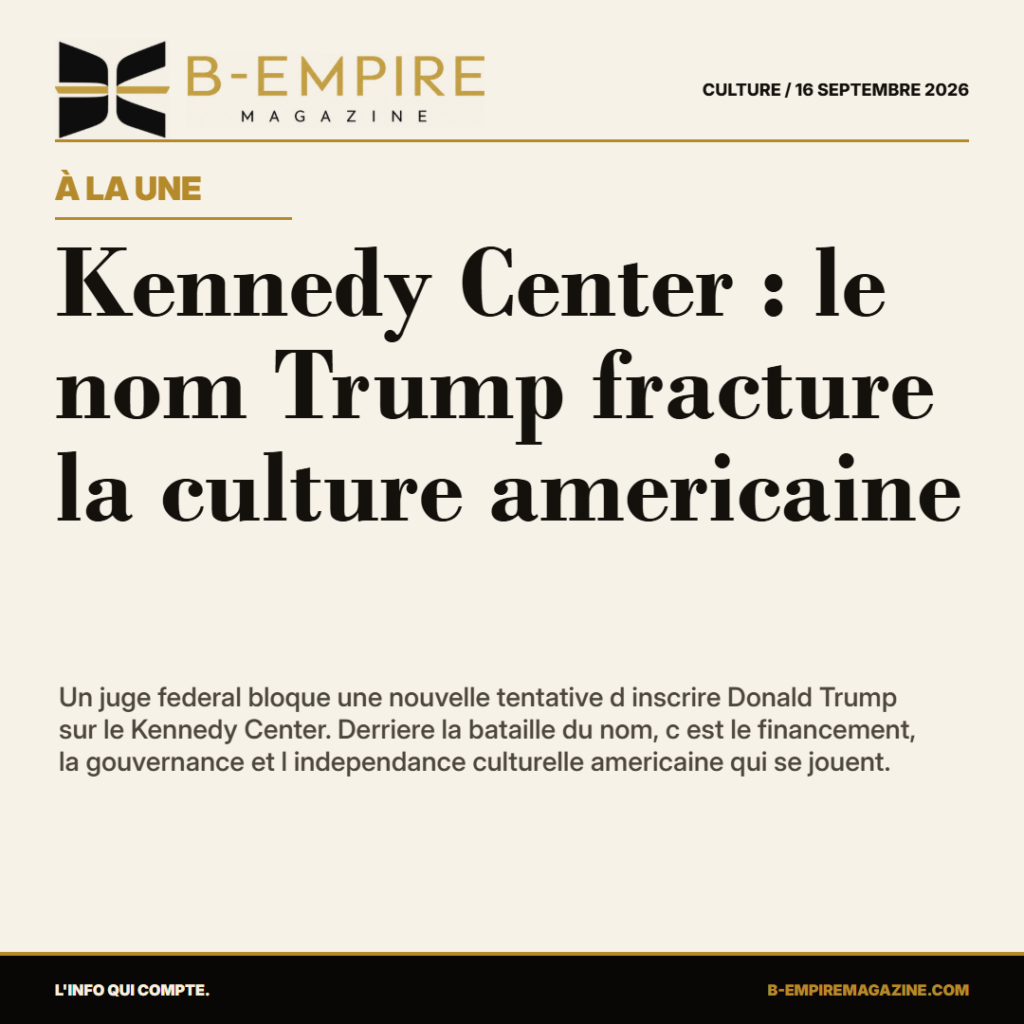
The Kennedy Center is no longer only a performing arts venue. In September 2026, it has become a battlefield where law, public money, national memory and political ego collide. A federal judge has blocked another attempt by the board of trustees to add Donald Trump name to the building or its grounds. The case may look symbolic. In reality, it is deeply material: who controls cultural institutions when their financial survival depends on political power?
According to the Associated Press, Judge Christopher Cooper reiterated that only Congress can authorize such a change at this federally chartered institution dedicated to John F. Kennedy. The Kennedy Center board had voted in August to recognize Trump, partly in connection with renovation funding. The ruling comes as the center faces repair needs, internal tensions and a public fight over its identity.
A Naming Fight, But Not Only That
In the cultural world, names are never neutral. They tell a story of legitimacy, lineage and promise. The Kennedy Center carries the name of a president associated with the arts as a civic mission. Adding the name of a living president involved in permanent political conflict would turn the institution into a partisan object. That shift is what gives the affair its explosive force.
The debate is therefore not only about an inscription. It is about the boundary between recognition, patronage, appropriation and power. In a university, museum or private foundation, donor names are part of the cultural economy. But the Kennedy Center is a national institution. Its facade is not an ordinary advertising surface. It belongs to a collective memory governed by public authority.
Renovation as Political Leverage
The crisis is even more tense because the building needs work. Several American outlets have reported discussions about temporary closure for renovation, safety concerns and structural deterioration. This is where the file becomes business. Major cultural institutions live from a fragile mix: public funding, philanthropy, ticket revenue, partnerships, prestige and trust. When one of those pillars becomes conditional, the balance is distorted.
If a political leader says funds, donors or renovation depend on a naming recognition, the logic of patronage changes. Support no longer serves only the work or the building. It also serves the staging of power. For artists, administrators and audiences, the question becomes immediate: can one still program, criticize and create freely in a venue whose future is tied to personal loyalty?
A Test for Cultural Independence
American cultural institutions are never completely separate from politics. They depend on budgets, boards, appointments, tax exemptions and major donors. But they claim programming autonomy. That autonomy is what allows them to host uncomfortable works, critical artists and different publics.
The Kennedy Center concentrates that tension at national scale. If its governance can be redirected through politically aligned appointments, and if its name can become part of a funding negotiation, the precedent goes beyond Washington. Other museums, theaters, orchestras and art centers could be exposed to the same logic: money in exchange for political branding.
Why the World Is Watching
For B-EMPIRE, this affair also speaks to cultural capitals around the world. Paris, London, Dakar, Lagos, Abu Dhabi and Seoul all face the same question: how can ambitious cultural venues be financed without turning them into showcases for power? Cultural architecture is expensive. Renovations are even more expensive. But the value of an institution rests on something immaterial: trust.
That trust is lost when the public feels that the building no longer serves art but an influence operation. It is gained when rules are clear, funding is transparent and the names attached to places respect the history they embody. Judge Cooper did not only block an inscription. He reminded the country that some institutions cannot be renamed by force of leverage.
The most interesting part of this crisis is that everyone claims to want to save the Kennedy Center. The disagreement is about the symbolic price of rescue. If renovation requires surrendering the independence of the venue, it may restore the walls while damaging the soul. If it respects the law, history and artistic plurality, it can become a national project again. Culture does not live only from marble, donations and names carved in stone. It lives from shared trust.
That is why the dispute matters beyond one inscription. It shows how cultural infrastructure can become vulnerable when capital repairs, donor politics and symbolic recognition are bundled together. For audiences, the basic question is simple: does the venue belong to public culture, or to the person who can pressure the strongest financial rescue?
Sources
- Associated Press – Judge blocks Kennedy Center board from putting Trump name on the building or grounds
- CBS News – Judge rules Kennedy Center board cannot put Trump name on building again
- Roll Call – Judge again blocks efforts to add Trump name to Kennedy Center
- Associated Press via Local10 – Kennedy Center will close for renovations after judge blocks returning Trump name