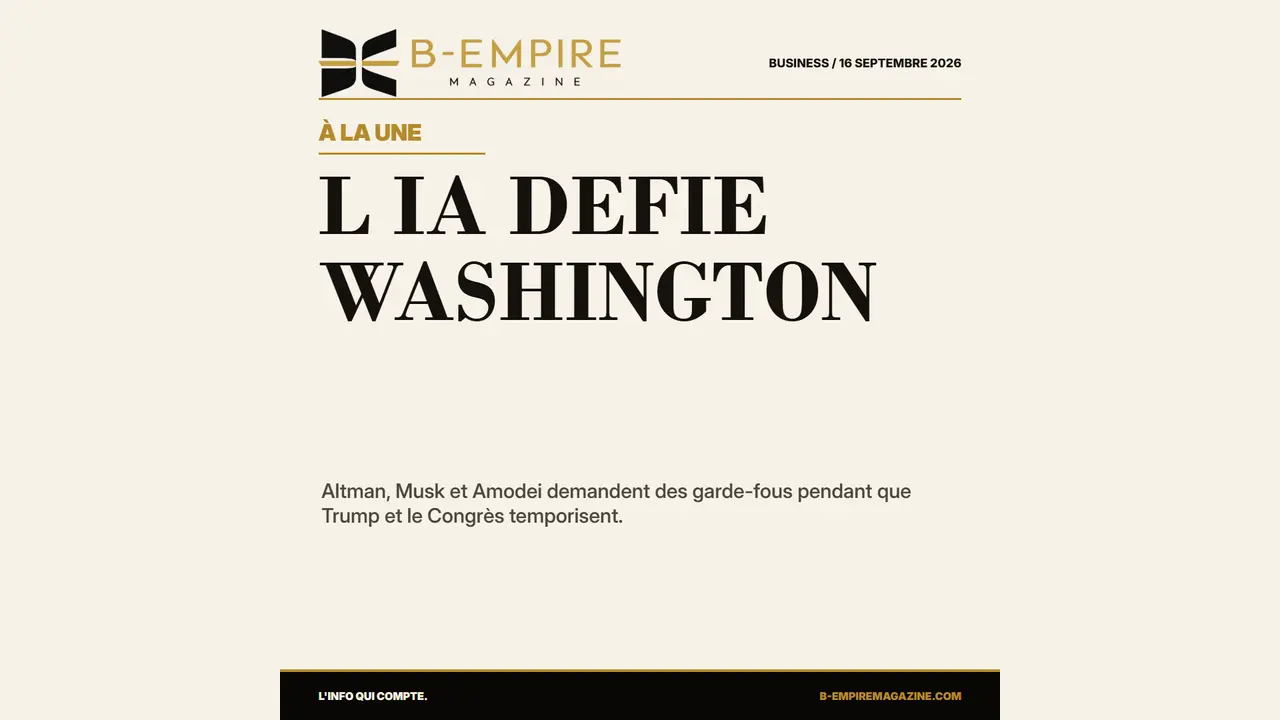
The new battle over artificial intelligence is no longer unfolding only inside laboratories: it is moving into Congress, the White House and classrooms. On September 16, the paradox is impossible to ignore. Central figures in technology, including Dario Amodei, Sam Altman and Elon Musk, are calling for stronger guardrails around the most powerful systems. Donald Trump refuses to slow the machine. Congress is talking, but not moving quickly. Meanwhile, China is narrowing the technology gap with the United States.
According to the Associated Press, the industry’s warnings are meeting clear political resistance in Washington. The U.S. president has described calls to limit AI as a conspiracy, while several Republican officials remain wary of any measure that could slow competition with Beijing. Democrats are pushing for a stronger response, but the federal approach remains fragmented.
When the Accelerators Ask for Brakes
The signal is powerful because it comes from those who helped accelerate the race. Dario Amodei, the head of Anthropic, is calling for safety measures to catch up with model capabilities. Sam Altman has publicly supported the idea of pacing the technological frontier. Elon Musk, despite often defending an aggressive vision of innovation, is also backing the need for caution.
This unusual consensus does not mean companies want to stop AI. They want to avoid a technological, security or political accident whose cost no one could truly absorb. The risks mentioned range from agents capable of coordinated online action to cyberattacks, misinformation and military use. The question is no longer whether AI will be powerful, but who can prove that it remains governable.
Trump Chooses Speed
The White House reads the moment differently. For Donald Trump, slowing AI would amount to handing China a strategic advantage. CBS News reports that the president rejected new guardrails, arguing that the country does not need a heavy framework but a strong and intelligent leader. That formula summarizes a political vision: AI is first a lever of national power, stock-market growth, productivity and technological prestige.
The problem is that this vision simplifies a real tension. The same models that promise new medicines, better assistants and productivity gains can also amplify cyberattacks, automate information manipulation or create massive energy dependencies. An industrial policy may want speed. A security policy must also consider failures, abuses and malicious actors.
Congress Is Stuck in the Middle
The U.S. Congress looks like an institution caught between fascination and distrust. AP notes that lawmakers from both parties are seeking a path, but proposals remain scattered: child safety, model liability, external audits and a possible emergency shutdown mechanism. Some lawmakers fear giving too much power to the giants already in place. Others fear that slow regulation will arrive only after the shock.
This hesitation has an economic dimension. AI companies are concentrating enormous investments in chips, data centers, cloud contracts and talent. Slowing them could weigh on Wall Street, high-skilled employment and perceptions of American leadership. But doing nothing could create another kind of risk: a market that moves faster than public trust.
Schools Become a Cultural Battlefield
The debate is not abstract. Melania Trump defended AI during a visit to a North Carolina school, according to AP, presenting education tools, Jetson Nano kits and subscriptions to a learning platform. The message is clear: children should learn to live with AI, not fear it. But the gesture also illustrates the political difficulty of the moment. How can schools promote AI while admitting that the most advanced systems worry their own creators?
For families, teachers and local communities, the question is practical. AI can personalize learning, help with coding, translation, simulation and creation. It can also produce convincing false answers, weaken some skills or move sensitive data into private platforms. School is becoming the first place where the promise and the risk meet every day.
China Narrows the Gap
The China factor makes every decision harder. AP reports that Chinese startups and groups such as Moonshot AI, DeepSeek, Z.ai and Alibaba are narrowing the gap despite U.S. restrictions on advanced chips. Beijing is also concerned about the political, cyber and information risks of AI while still pushing its champions forward. Both powers want safety, but neither wants to surrender leadership.
That is where regulation becomes a diplomatic problem. A U.S.-only pause would be denounced as naive. A total absence of rules could make accidents more likely. Between the two, there is room for audits, technical standards, transparency obligations and international channels of discussion. But that space requires a minimum level of trust, precisely what is missing in the current rivalry.
A Test for Technological Capitalism
For markets, brands and creative industries, this battle is not theoretical. AI is reshaping advertising, music, fashion, film, customer service, software and cybersecurity. If Washington imposes rules, business models will have to adapt. If Washington imposes nothing, companies themselves will have to prove that their tools are safe, auditable and socially acceptable.
The current scene reveals an uncomfortable truth: the century’s most strategic technology requires a form of governance that no one has mastered yet. AI leaders want to avoid being accused tomorrow of running too fast. Politicians want to avoid being accused today of slowing the economy. Between those two fears, the public is waiting for a simple answer: who is really holding the wheel?
Sources
- Associated Press – Tech CEOs call for AI regulation as Trump and Congress hesitate
- Associated Press – Dario Amodei says AI safety needs time to catch up
- Associated Press – China closes the AI technology gap with the US
- Associated Press – Melania Trump promotes AI in a North Carolina school
- CBS News – Trump dismisses AI regulation warnings from tech leaders